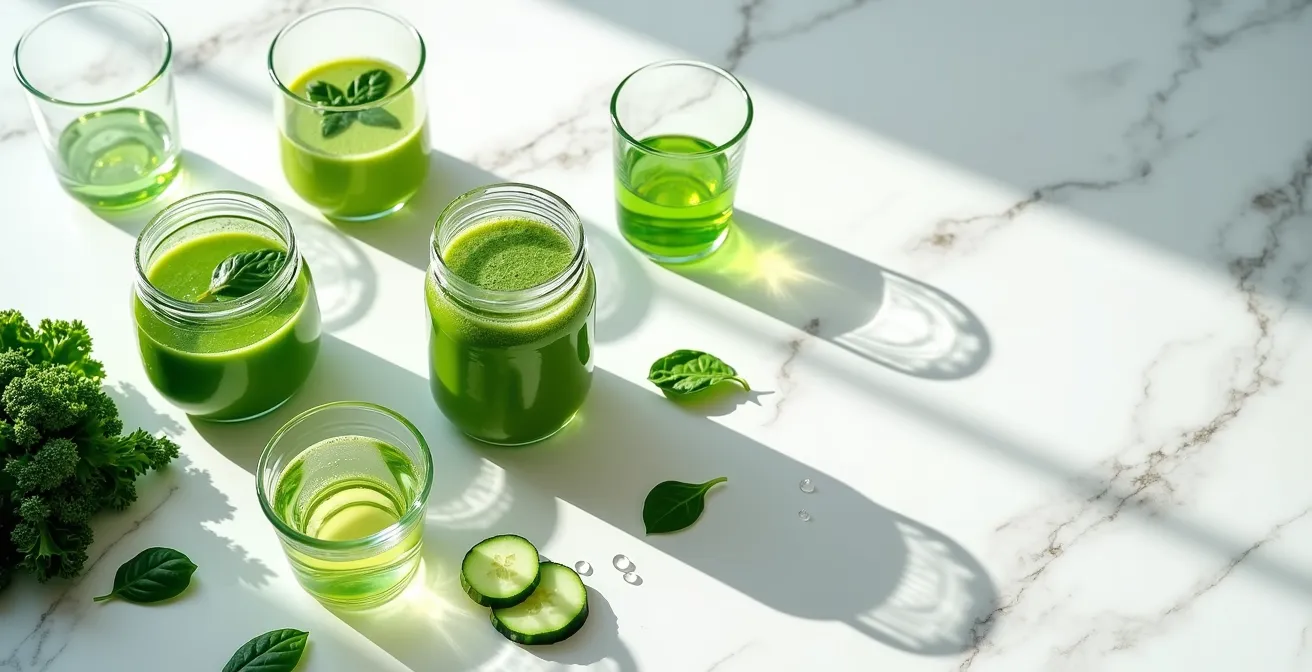
The daily consumption of raw green elixirs is only safe if you strategically manage their ‘anti-nutrient’ content; blindly blending is a significant health risk.
- High-oxalate greens like spinach can increase kidney stone risk, but this can be mitigated by pairing them with calcium, limiting portions, or cooking them.
- The key to long-term safety is rotating different types of greens (e.g., kale, chard, romaine) to prevent the cumulative buildup of any single compound.
Recommendation: Instead of using the same ingredients daily, adopt a ‘strategic rotation’ approach to your greens and balance your smoothies with healthy fats and acids to maximize benefits while minimizing risks.
The vibrant, emerald-green smoothie has become a modern symbol of peak health. Promising a flood of vitamins, a surge of energy, and a full-body “detox,” it’s an alluring quick-fix for anyone looking to purify their system with raw, natural ingredients. Health enthusiasts are drawn to juice cleanses and daily green elixirs, believing them to be a panacea for everything from dull skin to low energy. The common wisdom suggests that more is better, and that a daily dose of blended greens is an unquestionable step towards wellness.
But what if the key to safety isn’t found in the ingredients themselves, but in the strategic management of them? The wellness world often overlooks a critical detail: many raw leafy greens contain compounds known as “anti-nutrients,” like oxalates and goitrogens. Consumed in high doses daily, these can pose real risks, particularly for susceptible individuals. A daily, unmanaged green smoothie habit can contribute to painful kidney stones or interfere with thyroid function. This isn’t a reason to fear greens, but a call to understand them better.
This guide moves beyond the hype to offer a cautious, evidence-based perspective. We will focus on biochemical balancing, not just blending. We will explore the specific risks associated with popular greens, provide clear strategies to mitigate them, and empower you with the knowledge to make your daily green elixir a truly safe and beneficial practice. We will cover how to manage dangerous compounds, optimize nutrient absorption through timing, and even make your smoothies taste great without a spoonful of sugar.
For those who prefer a visual guide, the following video offers a simple and refreshing recipe for a spring detox smoothie. It’s a perfect starting point to see the principles of balancing flavor and texture in action before we delve into the deeper science of daily consumption.
To navigate this topic with clarity, we have structured this guide to address your most pressing concerns, from specific ingredient risks to practical daily integration. The following sections will provide a detailed roadmap for safe and effective green smoothie consumption.
Summary: A Nutritionist’s Guide to Safe Raw Green Elixirs
- Why Spinach Smoothies Can Cause Kidney Stones in susceptible People?
- How to Blend Fibrous Greens so They Don’t Taste Like Grass?
- When to Drink Green Juice: Empty Stomach or With a Meal?
- Kale vs. Chard: Which Green Is Safer for Raw Consumption?
- The “Green Glow” Effect: Which Chlorophyll Source Clears Acne Best?
- How to Incorporate More Dark Leafy Greens into Breakfast Without Ruining the Taste?
- Can a Whole Food Diet Reduce Chronic Inflammatory Markers in 8 Weeks?
- DIY vs. Store-Bought: Which Antioxidant Superfood Blends Actually Work?
Why Spinach Smoothies Can Cause Kidney Stones in susceptible People?
The primary concern with daily, high-volume consumption of certain raw greens, particularly spinach, is their high concentration of oxalates. Oxalates are naturally occurring compounds that can bind with calcium in the urine to form calcium oxalate crystals, the most common type of kidney stone. For individuals with a history of stones, or other risk factors, this is not a theoretical danger. In fact, research involving over 240,000 participants found a 30% higher risk of kidney stones for those eating spinach eight or more times per month. The issue isn’t spinach itself, but the cumulative load of oxalates when consumed frequently in large, raw quantities.
The danger is amplified in the context of “green smoothie cleanses.” One well-documented case report highlights a woman whose kidneys failed after a 10-day cleanse where she drank two cups of spinach daily. Her risk was heightened by a history of gastric bypass surgery and antibiotic use, both of which can increase oxalate absorption. In her smoothie habit alone, she was consuming over 1,200mg of oxalate daily—a stark contrast to the recommended limit of under 250mg for at-risk individuals. This demonstrates how a seemingly healthy habit can become harmful without proper knowledge of anti-nutrient management.
However, this does not mean you must eliminate spinach. The key is strategic consumption. You can significantly mitigate the risk by applying a few simple biochemical principles:
- Limit Raw Portions: If you have a history of kidney stones, limiting raw spinach to less than two cups per week is a prudent step.
- Pair with Calcium: Consuming high-oxalate foods with calcium-rich ingredients (like yogurt, fortified plant milk, or sesame seeds) in the same meal is crucial. The oxalate binds to the calcium in the gut, not the kidneys, and is then safely excreted.
- Cook Your Greens: Boiling spinach can reduce its soluble oxalate content by up to 60%, making it a much safer option for frequent consumption.
- Rotate Your Greens: The most effective strategy is to avoid relying on a single green. Rotating with low-oxalate options like kale is a powerful way to get nutrients without the high cumulative load.
How to Blend Fibrous Greens so They Don’t Taste Like Grass?
One of the biggest hurdles to maintaining a green smoothie habit is the flavor. Fibrous, pungent greens like kale or chard can easily overwhelm a smoothie, resulting in a “grassy” or bitter taste that is difficult to enjoy. The solution lies not in masking the flavor with sugar, but in understanding the chemistry of taste and texture. A high-speed blender is essential, as it pulverizes tough cell walls, creating a smoother, less gritty texture that is inherently more palatable. The transformation from tough leaves to a creamy liquid is the first step in taming the taste.
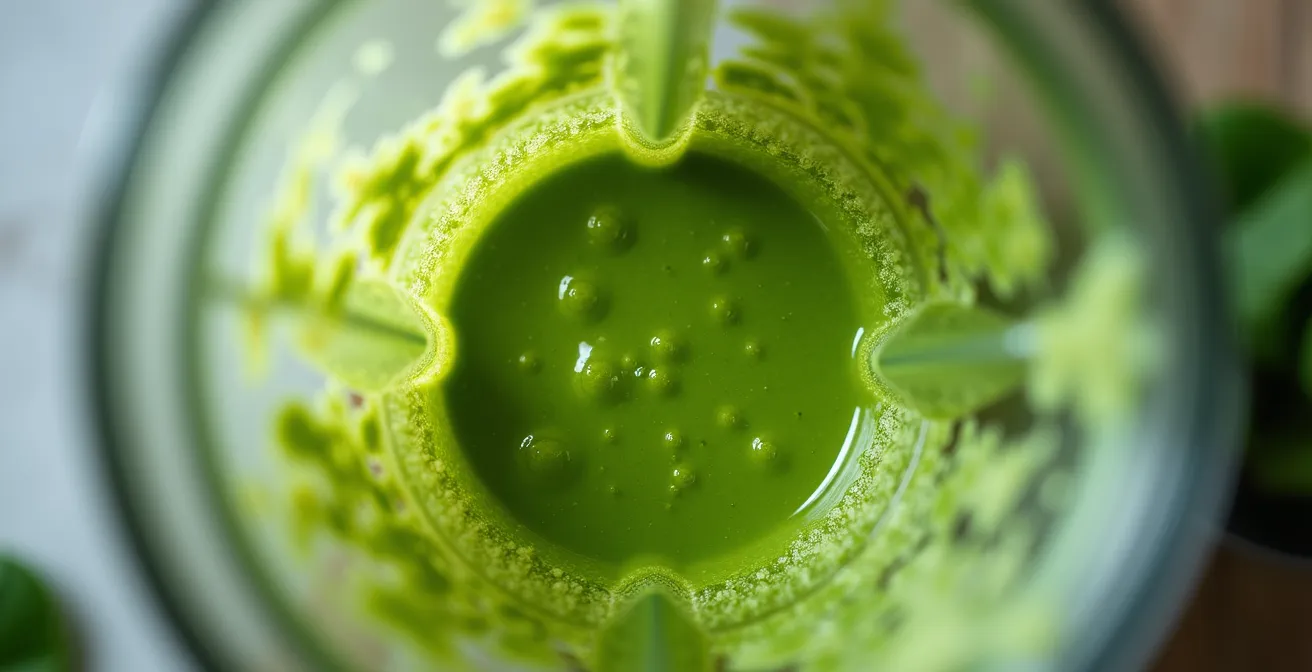
Beyond the blend itself, achieving flavor harmony is a matter of biochemical balancing. The “grassy” flavor often comes from aldehydes released when greens are blended. This taste can be neutralized by adding an acid, such as lemon or lime juice. The sweetness from fruit helps, but it’s the combination of different elements that creates a truly delicious smoothie. Following a proven formula can take the guesswork out of the process.
To create a perfectly balanced and palatable green smoothie every time, consider this formula:
- Base (2 parts): Start with mild-tasting greens like romaine or butter lettuce.
- Nutrient Density (1 part): Add a smaller amount of a more pungent green like kale.
- Sweetness & Creaminess (2 parts): Use fruits like mango, pineapple, or banana. Using frozen fruit creates a thicker, creamier texture that effectively masks any lingering green taste.
- Acid (1 part): Squeeze in fresh lemon or lime juice to neutralize bitterness.
- Flavor Bridge (1 part): Add a “zing” with fresh ginger, mint, or basil to tie all the flavors together.
A pro-tip is to blend your greens and liquid (like water or unsweetened almond milk) together for a full minute before adding any other ingredients. This pre-blending step ensures the fibers are completely broken down, leading to a silkier final product.
When to Drink Green Juice: Empty Stomach or With a Meal?
Once you’ve perfected your recipe, the next strategic question is timing. The common advice to drink green juice on an empty stomach is based on the idea of maximizing nutrient absorption without any digestive interference. When consumed alone, the vitamins, minerals, and phytonutrients are rapidly delivered to your system, and it provides an immediate hydration boost. However, this approach isn’t right for everyone. For those with sensitive digestion or blood sugar issues, a morning glass of fruit-sweetened green juice can trigger a sharp glucose spike and subsequent crash, or even IBS symptoms.
Conversely, consuming your green smoothie with or as part of a meal containing healthy fats (like avocado, nuts, or seeds) changes the equation entirely. The fat slows down the absorption of sugar from the fruit, leading to a more stable blood sugar response. This makes it a much safer option for pre-diabetics or anyone focused on weight management. Furthermore, this timing is critical for absorbing fat-soluble vitamins—specifically Vitamins A and K, which are abundant in leafy greens. Without fat present, your body cannot properly absorb these essential nutrients. This creates a scenario of nutrient competition and trade-offs: what’s the best timing for you depends entirely on your personal health goals.
The following table, based on insights from nutrition experts, breaks down the benefits and drawbacks of each approach. It’s important to remember that smoothies can stay in the stomach for 2-3 hours when calorie-dense, impacting feelings of fullness and subsequent meals.
| Consumption Timing | Benefits | Drawbacks | Best For |
|---|---|---|---|
| Empty Stomach (Morning) | Maximum nutrient absorption, immediate phytonutrient delivery, hydration boost | Potential blood sugar spike, may trigger IBS symptoms | Those with stable blood sugar, robust digestion |
| Pre-Workout | Nitrate boost for performance, quick energy, enhanced nitric oxide production | May cause cramping if consumed too close to exercise | Athletes, active individuals |
| With Fatty Meal | Maximizes fat-soluble vitamin absorption (A, K), slower sugar release | Nutrient competition, reduced mineral absorption from meal | Pre-diabetics, those seeking weight management |
Kale vs. Chard: Which Green Is Safer for Raw Consumption?
The principle of “anti-nutrient management” becomes clearer when comparing two popular greens: kale and Swiss chard. While both are nutritional powerhouses, they have vastly different safety profiles when it comes to raw consumption, especially on a daily basis. The primary distinction lies in their oxalate content. As we’ve discussed, oxalates are the main culprit behind kidney stones for susceptible individuals. In this regard, kale is the clear winner for raw safety.
Swiss chard contains an extremely high level of oxalates, while kale contains very little. However, the story doesn’t end there. Kale contains moderate-to-high levels of goitrogens, compounds that can interfere with thyroid function in susceptible people by inhibiting iodine uptake, especially when consumed raw in large quantities. Swiss chard, on the other hand, is low in goitrogens. This highlights a crucial concept: no single green is perfect. Each has a unique profile of benefits and potential risks that must be managed. This is where the concept of strategic rotation becomes paramount.
This comparative analysis from a comprehensive study on nutrients and anti-nutrients in leafy greens illustrates the trade-offs between these two popular choices.
| Safety Parameter | Kale | Swiss Chard | Winner |
|---|---|---|---|
| Oxalate Content | Low (20mg/100g) | Very High (960mg/100g) | Kale |
| Goitrogen Level | Moderate-High | Low | Swiss Chard |
| Nitrate Concentration | Low-Moderate | High (varies by soil) | Kale |
| Heavy Metal Risk | Lower accumulation | Higher accumulation potential | Kale |
| Overall Raw Safety | Safe for most people | Caution for kidney stone risk | Kale |
Relying on kale every single day could pose a theoretical risk to thyroid function for some, while a daily chard habit dramatically increases oxalate load. The safest approach is therefore not to pick a “winner,” but to alternate between them and other greens like romaine, arugula, and parsley. This practice of strategic rotation prevents the cumulative load of any single anti-nutrient. As Dr. Michael Greger of NutritionFacts.org wisely puts it:
The safest green is not one or the other, but a variety. Rotating between kale, chard, spinach, romaine, and other leafy greens prevents cumulative buildup of any single anti-nutrient
– Dr. Michael Greger, NutritionFacts.org
The “Green Glow” Effect: Which Chlorophyll Source Clears Acne Best?
Beyond risk management, many are drawn to green elixirs for their purported aesthetic benefits, often dubbed the “green glow” effect on skin. This isn’t just marketing hype; it’s rooted in the science of the gut-skin axis. The health of your digestive system is directly reflected in the clarity and radiance of your skin. Conditions like acne are often linked to systemic inflammation and poor gut health. Green smoothies, when made correctly, can be a powerful tool to support this connection.
The magic isn’t necessarily from one specific “chlorophyll source,” but from the synergistic effect of the components in a whole-food, blended green drink. First, the fiber from the blended leaves is essential for maintaining healthy digestion and promoting regular bowel movements, which is a primary pathway for eliminating waste and toxins from the body. When this system is sluggish, it can manifest as skin issues. Second, leafy greens are packed with antioxidants, vitamins, and minerals that combat oxidative stress and reduce inflammation throughout the body. By reducing the overall inflammatory load, you create an internal environment less prone to acne breakouts.
The benefits are therefore a combination of improved detoxification pathways (via fiber) and reduced inflammation (via antioxidants and phytonutrients). While any dark leafy green—spinach, kale, parsley, cilantro—will contribute chlorophyll and nutrients, the “best” source is, once again, a variety. Rotating your greens ensures a broad spectrum of different phytonutrients, each offering unique anti-inflammatory properties. The key is the whole, blended plant, not an isolated chlorophyll supplement, which lacks the crucial fiber needed to support the gut-skin axis.
How to Incorporate More Dark Leafy Greens into Breakfast Without Ruining the Taste?
The idea of “strategic rotation” and daily consumption can seem daunting, especially at breakfast. The thought of a pungent kale smoothie first thing in the morning can be off-putting. The key to consistency is to make the process as seamless and palatable as possible. One of the most effective methods is the “green ice cube” hack, which allows you to add a measured dose of greens to any smoothie without altering the flavor profile significantly.
This method works best with milder greens like spinach or butter lettuce, which can be blended with water and frozen into convenient cubes. You can then add one or two of these cubes to a fruit-forward smoothie (like strawberry-banana or mango-pineapple). The small, frozen portion of greens blends in undetected, providing a nutrient boost without the “grassy” taste. As your palate adapts, you can gradually move to using stronger greens like kale for your cubes. This incremental approach makes it easy to incorporate a variety of greens into your diet without breakfast becoming a chore.
Of course, smoothies aren’t the only way. You can also finely chop or “chiffonade” greens and incorporate them into savory breakfast dishes. A handful of finely chopped spinach or kale disappears completely into scrambled eggs, a tofu scramble, or even savory oatmeal with mushrooms and garlic. The heat from cooking wilts the greens, reducing their volume and mellowing their flavor, while also helping to break down some of the anti-nutrients like goitrogens in kale. The goal is to make the addition of greens a simple, almost automatic part of your morning routine.
Here are some practical ways to get started:
- Green Ice Cube Hack: Blend 2 cups of mild spinach with 1 cup of water, pour into ice cube trays, and freeze. Add 1-2 cubes to any smoothie.
- Savory Scrambles: Fold finely chopped kale or spinach into eggs or tofu during the last few minutes of cooking.
- Savory Oatmeal: Stir chard or other greens into oatmeal along with savory toppings like mushrooms, soy sauce, or a fried egg.
- Start Mild: If you are new to green smoothies, start with very mild greens like butter lettuce or romaine before moving on to kale.
Can a Whole Food Diet Reduce Chronic Inflammatory Markers in 8 Weeks?
The benefits of incorporating green elixirs extend far beyond simple vitamin intake; they are a component of a larger strategy to combat chronic inflammation. Chronic low-grade inflammation is a root cause of many modern diseases, and dietary choices are a primary driver. A diet high in processed foods can promote inflammation, while a whole-food diet rich in plants can actively reduce it. The evidence for this is robust. For instance, a major meta-analysis on the Mediterranean diet showed it induced a significant reduction of key inflammatory biomarkers like C-reactive protein (CRP) and Interleukin-6 (IL-6).
Green smoothies can be a powerful tool within this anti-inflammatory framework. By replacing a pro-inflammatory meal (like a processed breakfast cereal or pastry) with a nutrient-dense green smoothie, you are doing two things: removing an inflammatory trigger and adding a host of anti-inflammatory compounds. The dark leafy greens themselves, along with additions like omega-3-rich flax or chia seeds and spices like turmeric, create a potent anti-inflammatory cocktail. This isn’t a quick fix, but a sustained practice. Consistency is key, and measurable changes in inflammatory markers like CRP can often be seen within a period of about 8 weeks of dedicated dietary change.
To systematically use green smoothies for this purpose, it’s helpful to follow a clear protocol. This ensures you are including all the necessary components to achieve a measurable anti-inflammatory effect. The focus should be on nutrient synergy—combining greens with healthy fats and spices to maximize their biological impact.
Your 8-Week Anti-Inflammatory Green Smoothie Protocol
- Daily Greens Intake: Include 2-3 cups of a variety of dark green leafy vegetables in your daily smoothie.
- Omega-3 Boost: Add 1-2 tablespoons of an omega-3 source like flax or chia seeds to combat inflammation.
- Spice Synergy: Incorporate anti-inflammatory spices, such as turmeric, always paired with a pinch of black pepper to increase its bioavailability.
- Meal Replacement: Consistently replace one pro-inflammatory meal per day (e.g., a processed breakfast) with your green smoothie.
- Monitor and Adjust: For a data-driven approach, consider measuring your C-reactive protein (CRP) levels at the beginning and end of the 8-week period to track progress.
Key Takeaways
- Oxalate risk from greens like spinach is real but manageable. Mitigate it by limiting raw portions, pairing with calcium-rich foods, or cooking them to reduce oxalate content.
- The cornerstone of safe, long-term consumption is “strategic rotation.” Alternating between different greens (kale, chard, romaine, etc.) prevents the harmful buildup of any single anti-nutrient.
- Timing is a strategic choice. Drink on an empty stomach for rapid nutrient delivery if your blood sugar is stable, or with a fatty meal to slow sugar release and maximize absorption of vitamins A and K.
DIY vs. Store-Bought: Which Antioxidant Superfood Blends Actually Work?
The final practical decision for any green elixir enthusiast is whether to make your own or rely on the convenience of store-bought powders and bottled juices. While commercially prepared options offer speed, there are significant trade-offs in terms of nutritional quality, cost, and safety. The primary advantage of a DIY fresh smoothie is bioavailability. Water-soluble nutrients like Vitamin C and active enzymes begin to degrade almost immediately after blending. A freshly made smoothie offers these delicate compounds at their peak potency.
Store-bought options, on the other hand, present a different picture. Powders offer excellent shelf life and convenience, and they can be a good source of minerals and stable polyphenols. However, they have often lost a significant portion of their heat-sensitive vitamins during processing. Bottled green juices are even more problematic. As nutritionists at Jill Health point out, these are often a far cry from their healthy image.
Store bought green smoothies are often high in sugar and calories, and low in protein and fibre, similar to any other fruit juice. Sugar is often used in store-bought green juices/smoothies to increase palatability and shelf life.
– Jill Health Nutritionists, Jill Health
This high sugar content, combined with a lack of fiber (which is often stripped out during juicing), can lead to the very blood sugar spikes you might be trying to avoid. Furthermore, both powders and bottled products carry their own safety concerns, from potential heavy metal contamination in powders to bacterial risks in improperly stored fresh juices. Making your smoothie at home gives you complete control over ingredients, sugar content, and freshness.
| Factor | DIY Fresh | Store-Bought Powder |
|---|---|---|
| Bioavailability | Maximum for vitamins C, enzymes | Good for polyphenols, minerals |
| Shelf Life | 24 hours maximum | 12-24 months |
| Cost per Serving | $2-4 (including waste) | $1-3 (no waste) |
| Safety Concerns | Bacterial contamination risk | Heavy metal contamination risk |
| Nutrient Preservation | Degrades quickly | Stable but some vitamin loss |
| Convenience | 15-20 min prep + cleanup | 2 minutes to mix |
Armed with this knowledge, you can now transform your green smoothie habit from a potential risk into a powerful, sustainable part of your wellness routine. Start today by choosing a low-oxalate green, a balancing fruit, and a healthy fat. Take your first step towards safe, effective, and delicious sipping that truly supports your long-term health.