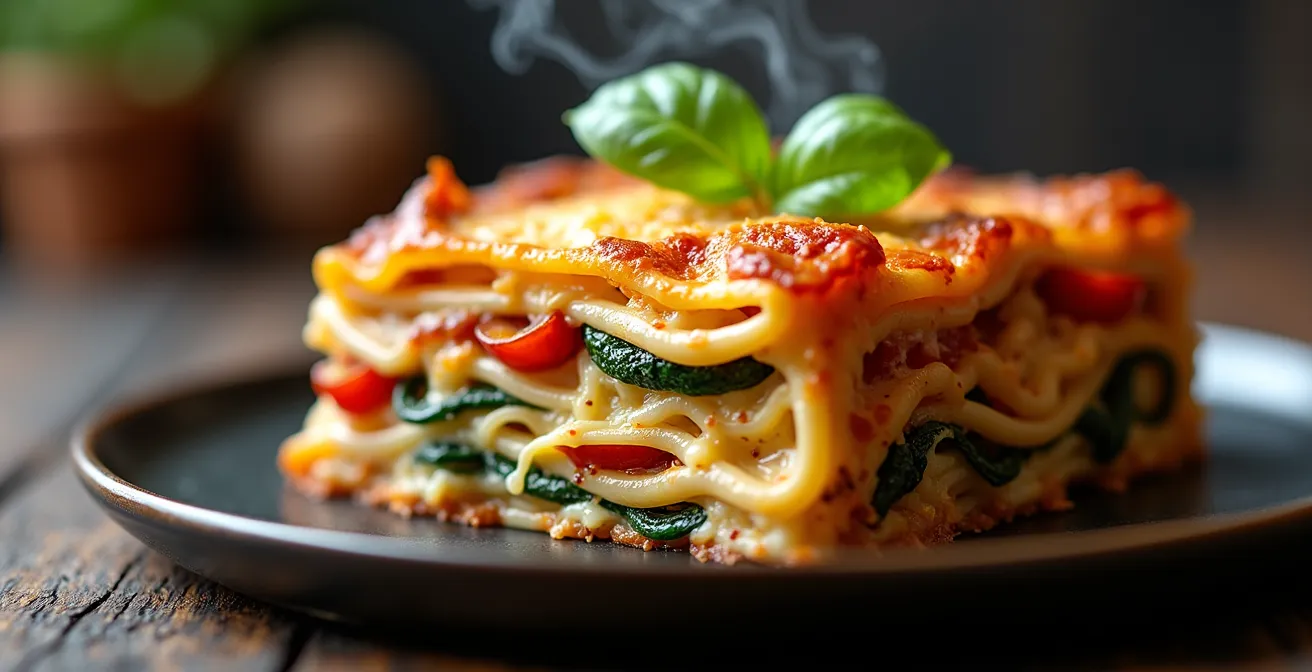
A watery lasagna is not a recipe failure; it is a structural engineering failure caused by unmanaged moisture load.
- Vegetables must be pre-treated to reduce their high water content before assembly.
- The choice of cheese and noodles directly impacts the final structural integrity and moisture absorption.
Recommendation: Approach lasagna construction as an architectural project, analyzing and preparing each component to manage its properties and ensure the final build is stable.
The moment of truth arrives. You pull your beautiful vegetable lasagna from the oven, its top a bubbling, golden-brown masterpiece. You let it rest, slice into it, and serve. But instead of a firm, proud stack of layers, a soupy deluge floods the plate. The structure collapses. This common frustration isn’t a sign that you’re a bad cook; it’s a sign that you’ve been following a recipe instead of an architectural blueprint. Most recipes focus on flavor but ignore the fundamental physics of moisture management.
The standard advice—”pre-cook your veggies,” “use a thick sauce”—is correct but incomplete. It tells you *what* to do, but not *why* it’s a critical step in a larger system. A watery lasagna is a system failure where the moisture load exceeds the structure’s capacity to contain it. The ingredients have bled into one another, turning distinct layers into an incoherent stew. This isn’t a flavor problem; it’s an engineering one.
But what if we stopped thinking like cooks and started thinking like structural food engineers? This guide reframes the challenge. The key to a perfect vegetable lasagna isn’t a secret ingredient; it’s a systematic approach to component engineering. We will deconstruct the lasagna system, analyzing each element—vegetables, cheese, noodles, and sauce—as a building material with specific properties. By understanding and managing these properties, you can build a lasagna with absolute structural integrity every single time.
This article provides a blueprint for constructing a flawless vegetable lasagna. We will explore how to manage the moisture load from vegetables, select the most stable components, and understand the critical physics of the resting period to ensure your next lasagna stands tall and proud.
Summary: Building a Lasagna That Defies Gravity and Water
- The Watery Mess Risk: Why You Must Cook Vegetables Before Layering?
- Tofu vs. Cashew Ricotta: Which Crumble Holds Up Better in Heat?
- Boil or No-Boil: Which Noodle Type Absorbs Excess Moisture?
- Why Lasagna Must Rest for 30 Minutes Before Cutting?
- How to Build Flavor Depth in Lasagna Without Meat Sauce?
- Reimagining Traditional Recipes: How to Keep the Soul Without the Meat?
- Using Raw Cashews to Create Dairy-Free Cheeses and Creams
- Why Home Cooking Is the Ultimate Skill for Long-Term Health?
The Watery Mess Risk: Why You Must Cook Vegetables Before Layering?
The primary antagonist in our structural narrative is water. Vegetables are essentially bags of water; for instance, health resources show that cucumbers and zucchini contain between 92-96% water by weight. When heated in the oven, these vegetables release this massive moisture load directly into your lasagna, turning your carefully constructed layers into a swimming pool. Pre-cooking isn’t just about softening the vegetables; it’s a critical dehydration step to manage the structural load. Without this step, you are designing the system to fail.
There are several engineering methods to reduce this moisture content, each with different levels of effectiveness. Salting vegetables like eggplant or zucchini and letting them sit for 30 minutes uses osmosis to draw out a significant amount of liquid. Roasting or sautéing uses heat to evaporate moisture while simultaneously adding a layer of caramelized flavor—a process that enhances both structure and taste. For maximum effectiveness, especially with very wet vegetables like mushrooms, a combination of salting and then roasting provides the best defense against a watery outcome.
Even with these methods, some residual moisture is inevitable. To combat this, culinary authorities like Gordon Ramsay employ an additional absorption strategy. He recommends browning a small amount of flour in the oven and then lightly sprinkling it over the vegetable layers. This toasted flour acts like a desiccant, absorbing excess liquid from the sauce and vegetables during baking, which helps keep the final structure thick and tight. This isn’t just cooking; it’s proactive moisture management.
The following table, based on an analysis of common culinary techniques, breaks down the primary methods for vegetable dehydration.
| Method | Effectiveness | Best For | Time Required |
|---|---|---|---|
| Salting | High for osmosis | Zucchini, Eggplant | 30 minutes |
| Roasting | Moderate, adds flavor | Mushrooms, Bell Peppers | 25 minutes |
| Sautéing | Quick moisture removal | Spinach, Onions | 5-10 minutes |
| Salt-Then-Roast | Maximum effectiveness | All high-moisture vegetables | 45 minutes |
Tofu vs. Cashew Ricotta: Which Crumble Holds Up Better in Heat?
The creamy ricotta layer acts as the mortar between your pasta “bricks.” In a vegetarian or vegan lasagna, this component’s stability under heat is paramount. The two primary dairy-free contenders, tofu and cashew ricotta, have vastly different structural properties. Tofu, a soy-based protein curd, is inherently stable. When pressed firmly to remove its water content, it crumbles into a texture remarkably similar to dairy ricotta and holds its form exceptionally well during baking. It doesn’t “melt” or become runny, providing a reliable, structurally sound layer.
Cashew ricotta, made from blended soaked cashews, offers a richer, creamier mouthfeel. However, its stability is a function of its preparation. A cashew cream with too much water will break down and contribute to the very watery mess we are trying to avoid. The key is to engineer its consistency. By using a low liquid-to-cashew ratio and incorporating binders, you can dramatically improve its heat stability. These binders act as structural reinforcements at a microscopic level.
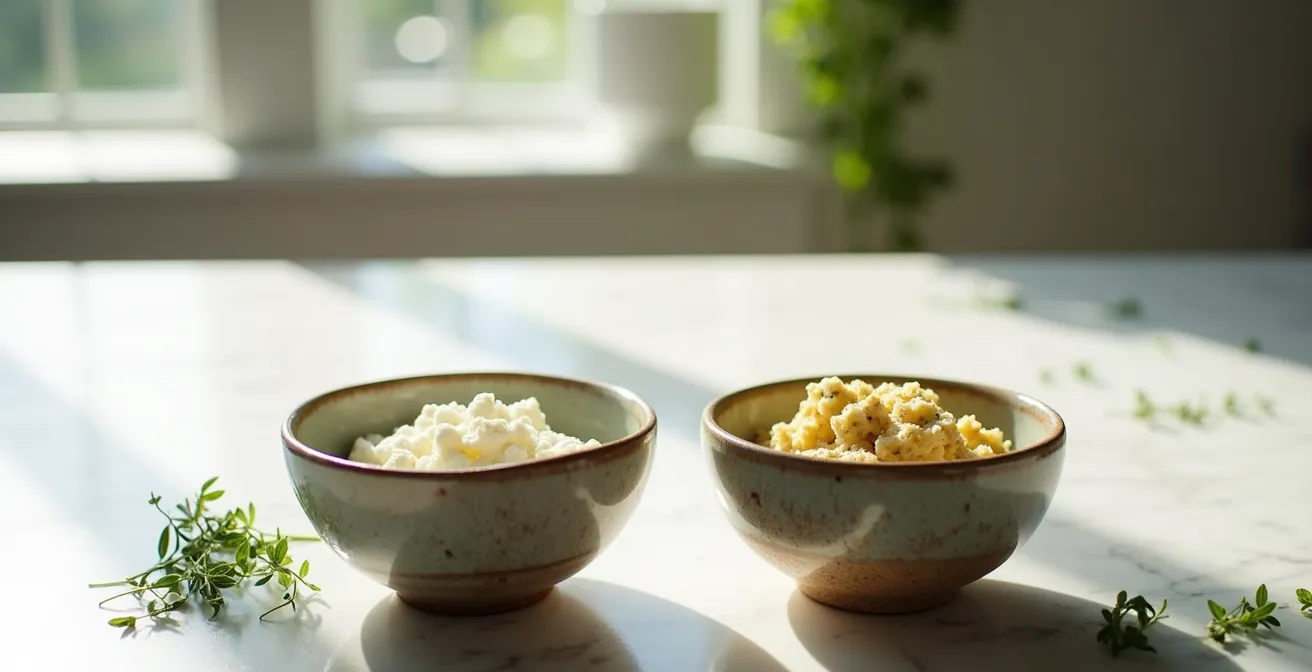
The visual difference in texture before baking, as seen above, hints at their performance under heat. Tofu’s defined crumble contrasts with cashew’s smoother paste. For home cooks looking for foolproof results, pressed extra-firm tofu is the more reliable choice. For those committed to the creaminess of cashews, component engineering with binders is not just recommended; it’s mandatory for structural success.
Action Plan: Engineering Ricotta Stability
- Press Tofu: Press a block of extra-firm tofu for at least 30 minutes to remove up to 40% of its moisture before crumbling.
- Control Cashew Ratio: Blend soaked cashews with minimal liquid, aiming for a 1:3 ratio of liquid to cashews for a dense, stable paste.
- Incorporate Binders: Add 2 tablespoons of tapioca starch per cup of cashew ricotta to improve its binding capacity under heat.
- Add Absorbers: Mix in 3 tablespoons of nutritional yeast to absorb moisture and add a savory, cheese-like umami flavor.
- Enhance Water-Holding: For an extra guarantee, incorporate 1 teaspoon of psyllium husk powder into your cashew mix for superior water retention.
Boil or No-Boil: Which Noodle Type Absorbs Excess Moisture?
The pasta sheets are the primary structural support of the lasagna—the floor joists of your edible building. Their ability to absorb moisture is a key variable in the final equation. This brings us to a central debate in lasagna engineering: boil vs. no-boil noodles. No-boil noodles are designed specifically to be moisture sponges. They are thinner and par-cooked, allowing them to fully hydrate by absorbing liquid from the surrounding sauce during the bake. This function makes them a powerful tool for managing excess water, effectively wicking it away and turning it into a structural component.
However, many professional chefs, including Gordon Ramsay, argue against them, favoring traditional dried pasta sheets used *without* pre-boiling. His reasoning is that uncooked dry sheets maintain a better, more “al dente” texture after baking. Because they start completely dry, their capacity to absorb moisture is maximized, helping to keep the final dish “thick and tight.” This method turns the noodle into an active participant in moisture control, rather than a passive layer. Using fresh pasta, on the other hand, is the worst choice from a structural standpoint, as it has a high moisture content to begin with and contributes to the problem rather than solving it.
For those who do use no-boil noodles, proper pre-treatment can optimize their performance. Forgetting to do so can result in dry, tough spots in the final dish. Some cooks, like Ina Garten, have refined a technique to ensure even hydration. Her method involves soaking the no-boil sheets in hot water before layering. This pre-hydration step ensures the noodles cook evenly without having to steal too much liquid from the sauce, striking a balance between absorption and texture. The optimal balance is achieved by soaking in 140°F water for 15 minutes, providing just enough hydration to soften them for an even bake.
Why Lasagna Must Rest for 30 Minutes Before Cutting?
The final, and perhaps most violated, rule of lasagna engineering is the resting period. Cutting into a lasagna straight from the oven is the equivalent of demolishing a building before the concrete has set. The 30-minute rest is not about patience; it’s a critical phase where the physics of the dish transform it from a hot liquid system into a stable, solid structure. During this time, two crucial processes occur: thermal equilibrium and starch retrogradation.
As the lasagna cools, the temperature begins to even out. The super-hot, free-flowing liquid in the sauces and cheese starts to thicken as it drops below boiling point. More importantly, the starches in the pasta, which gelatinized (swelled with water) during baking, begin to cool and re-form a more rigid molecular structure. This process, known as retrogradation, is what causes the liquids to “set.” The starches effectively trap the free moisture within a gel-like matrix, creating the firm, sliceable texture you desire. Cutting too soon breaks this delicate matrix before it can form, releasing all the trapped liquid in a catastrophic “dam break” effect.
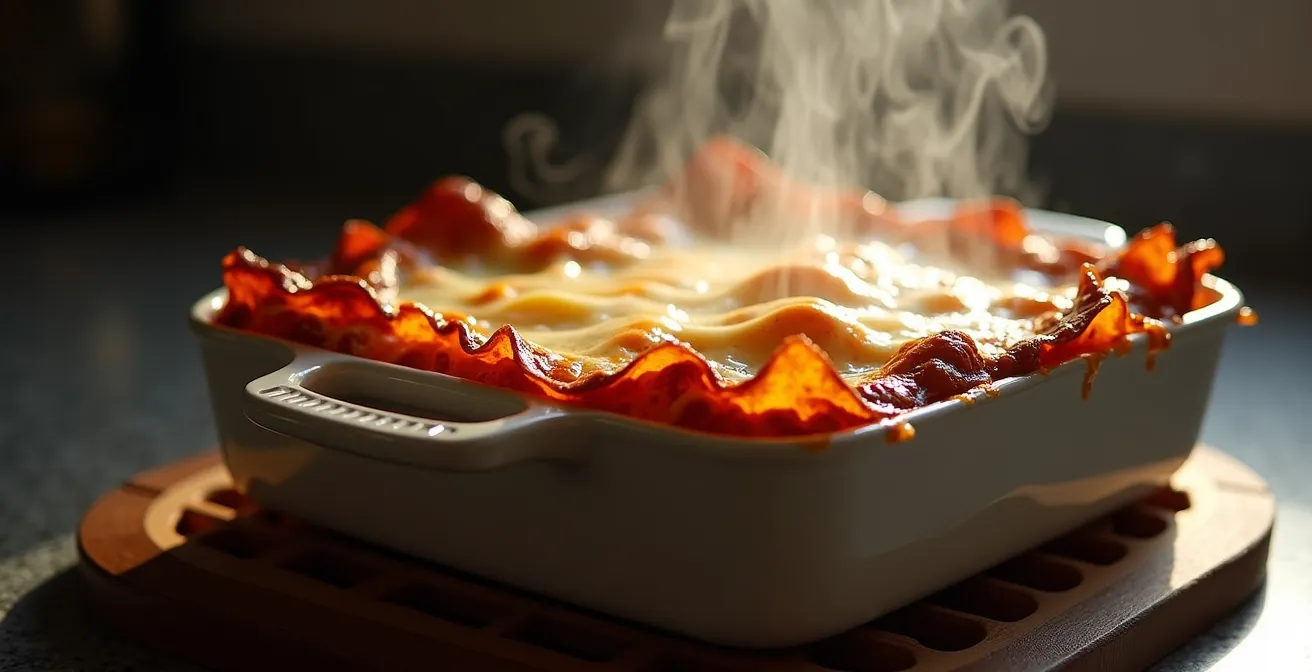
The visual cues are clear. A resting lasagna, as pictured, will stop bubbling aggressively. The cheese will set, and the edges will pull slightly away from the pan as the structure contracts. This period is non-negotiable. It’s when your delicious ingredients synergize and become a cohesive, unified whole. Attempting to rush this process will invariably compromise the structural integrity you’ve worked so hard to build. Allowing it to rest not only guarantees a clean slice but also prevents mouth burns from super-heated cheese and sauce.
How to Build Flavor Depth in Lasagna Without Meat Sauce?
A common pitfall of vegetable lasagna is a lack of flavor depth. Meat-based bolognese sauces develop a deep, savory complexity (umami) from the browning of the meat and long simmering times. Replicating this depth in a vegetarian context requires a deliberate flavor engineering strategy. You cannot simply substitute vegetables for meat; you must build layers of umami from different sources to create a rich, satisfying foundation.
The first step is to maximize the flavor of your tomato base. Using high-quality San Marzano tomatoes provides a sweeter, less acidic starting point. A critical technique is the “pincage,” where you brown the tomato paste in the pan for a few minutes before adding any liquids. This caramelizes the sugars in the paste, creating a profound depth that cannot be achieved otherwise. From there, you can introduce other umami-rich components. Ingredients like miso paste, mushroom powder, or even a splash of soy sauce can be mixed into the sauce to provide that savory backbone typically associated with meat.
Texture is another key component of flavor perception. A sauce with a single, uniform texture can feel flat. To mimic the complexity of a meat sauce, create textural variance. Finely chopped walnuts or lentils can be added to the sauce to simulate the texture of ground mince. Meanwhile, incorporating larger, “meaty” chunks of roasted mushrooms provides a satisfying bite and another layer of roasted, earthy flavor. Finally, balancing the acidity is crucial. A splash of balsamic vinegar added at the end of cooking can brighten all the other flavors and cut through the richness of the cheese.
- Replace meat umami with 2 tablespoons of miso paste mixed into the tomato sauce.
- Add 1 tablespoon of mushroom powder to boost savory depth.
- Brown tomato paste in the pan for 2-3 minutes before adding liquids (pincage technique).
- Layer different acidities by adding balsamic vinegar at the end and using San Marzano tomatoes for depth.
- Create textural interest with finely chopped walnuts for “mince” and roasted mushrooms for “chunks.”
Reimagining Traditional Recipes: How to Keep the Soul Without the Meat?
Transitioning a classic recipe like lasagna from meat-based to vegetarian requires more than simple substitution. It requires deconstruction. To keep the “soul” of the dish, you must first identify what that soul truly is. A professional chef analysis puts it perfectly:
The ‘soul’ of lasagna is not an ingredient but a set of functions: deep umami, richness from fat, and satisfying texture.
– Professional Chef Analysis, Engineering Vegetarian Lasagna
This functional approach is the core of successful recipe reimagination. Your goal is not to find a “fake meat” but to engineer a system of ingredients that collectively performs these essential functions. Deep umami can be built with roasted mushrooms, miso, and caramelized tomato paste. Richness from fat can be delivered through a well-emulsified cashew cream or the strategic use of olive oil. Satisfying texture can be created by combining the soft crumble of tofu ricotta with the firm bite of roasted eggplant and the structural support of the pasta.
This process often requires a greater investment in time. While a meat sauce develops flavor through the slow breakdown of proteins, a vegetable ragu builds it through concentration and caramelization. A key finding is that allowing a vegetable ragu to simmer for an hour or more creates a depth of flavor that rivals a traditional bolognese. This long simmer allows the natural sugars in vegetables like carrots and onions to sweeten and the flavors to meld into a complex, unified whole. It is this investment of time, combined with a functional understanding of each ingredient, that allows you to preserve the soul of the dish while completely changing its components.
By shifting your perspective from ingredients to functions, you gain the freedom to innovate without losing the essence of what makes a traditional dish so beloved. You are no longer just following a recipe; you are designing an experience. This mindset empowers you to adapt any classic recipe to fit modern dietary preferences or available ingredients, confident that the final result will be both authentic and delicious.
Using Raw Cashews to Create Dairy-Free Cheeses and Creams
For those building a dairy-free lasagna, raw cashews are a cornerstone material. Their high fat content and neutral flavor make them an incredibly versatile base for creating creams and cheeses that can rival their dairy counterparts in richness. However, their success is entirely dependent on proper engineering. The goal for a lasagna “ricotta” is a thick, stable, and slightly grainy texture, not a smooth, pourable cream.
The first critical step is soaking. Soaking raw cashews in hot water for at least four hours (or boiling them for 10 minutes if short on time) is non-negotiable. This process softens the nuts, making them easier to blend into a creamy consistency and neutralizing phytic acid, which can impart a bitter taste. The next variable is the ratio of cashews to liquid. For a ricotta-like texture, a ratio of 3 parts cashews to 1 part liquid is ideal. Any more liquid risks creating a runny cream that will compromise the lasagna’s structural integrity.
To truly mimic ricotta, you must then introduce elements that create its characteristic flavor and texture. A tablespoon or two of lemon juice or apple cider vinegar provides the necessary tang and also helps to “curdle” the cashew proteins, giving it a more authentic, slightly separated texture. Nutritional yeast is another key additive; it thickens the mixture, absorbs a small amount of moisture, and imparts a cheesy, umami flavor. Finally, a small amount of tapioca starch acts as a binder, ensuring the cashew ricotta holds its shape and doesn’t break down when exposed to the high heat of the oven. One reader shared their success with a different substitution, highlighting the flexibility of this component:
I tried silken tofu instead of cottage cheese. Perfect texture and we didn’t miss the ricotta.
– Reader comment, Cookie and Kate
Key Takeaways
- Structural failure (a watery mess) is preventable by treating lasagna construction as an engineering project.
- Moisture management is the single most critical factor; pre-cooking and dehydrating vegetables is non-negotiable.
- The choice of components—especially noodles and cheese alternatives—must be based on their structural properties, such as absorption and heat stability.
Why Home Cooking Is the Ultimate Skill for Long-Term Health?
Mastering a complex dish like vegetable lasagna does more than just solve a culinary problem; it teaches a fundamental skill with profound implications for long-term health: systems thinking. When you cook from scratch, you gain complete control over the system of ingredients. You decide the quantity and quality of salt, fat, and sugar—variables that are fixed and often excessive in processed foods. For example, a serving of homemade vegetable lasagna can contain 356mg of sodium, whereas many store-bought frozen versions exceed 1000mg. This control is the foundation of a healthy diet.
Beyond nutritional control, the act of complex cooking trains your brain to see connections and consequences. You learn firsthand how one variable (like the water content in zucchini) impacts every other part of the system, from the texture of the noodles to the final structural integrity of the slice. This is precisely what a culinary education expert describes as the hidden value of cooking:
Mastering a complex, multi-component dish like lasagna teaches a crucial life skill: systems thinking. You learn how one variable impacts every other part of the system.
– Culinary Education Expert, The Value of Complex Cooking
This skill extends far beyond the kitchen. It enhances problem-solving abilities, encourages resourcefulness, and fosters a deeper connection to the food you eat. By understanding the “why” behind the “what,” you are no longer just a consumer following instructions. You become a creator, an engineer capable of adapting, innovating, and troubleshooting. Home cooking, viewed through this lens, is not a chore but the ultimate expression of agency over your own well-being. It is the practice of building a healthier life, one well-structured, delicious meal at a time.
Now that you possess the blueprint of a food engineer, apply this systems-thinking approach to your next culinary project to achieve predictable, delicious, and structurally sound results.
Frequently Asked Questions on Constructing the Perfect Vegetable Lasagna: Preventing the Watery Mess
How do I know when my lasagna has rested enough?
When it’s fresh out of the oven, everything is still extra wet and bubbling. You’ll know it has rested enough when the aggressive bubbling subsides and the layers of pasta, sauce, and cheese have had time to set up. This makes the lasagna less soupy and soggy, as well as easier to cut through cleanly.
What happens if I cut into lasagna too soon?
The internal liquids haven’t reached thermal equilibrium. Cutting too soon causes a ‘dam break’ effect where the trapped, super-heated liquid flows out, destroying the structural integrity of your layers and leading to a soupy plate.
Can I speed up the resting process?
No, the process cannot be rushed. The setting of the lasagna relies on starch retrogradation, a chemical process that transforms the liquid sauce into a set matrix. This requires both time and a gradual reduction in temperature to occur properly.