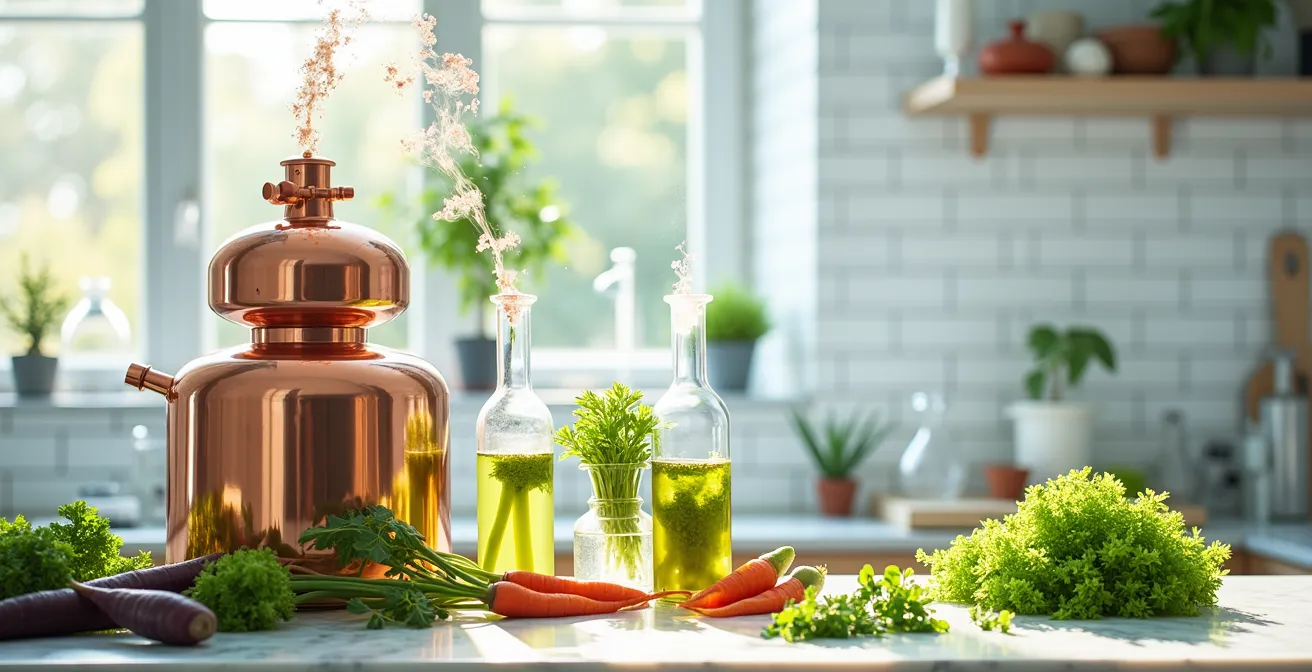
Molecular gastronomy isn’t about making plants unnatural; it’s a scientific method to unlock their deepest, most authentic essence.
- Techniques like spherification and essence extraction are tools to deconstruct and reveal hidden flavors and textures, not to merely create novelty.
- The value of advanced plant-based cuisine is measured by the sensory architecture and the unique emotional experience it provides, justifying both the process and the price.
Recommendation: Approach these techniques not as rigid recipes, but as an artist’s tools to express the soul of an ingredient on a new culinary canvas.
What is a beet? A root, a color, a sweet, earthy flavor? For centuries, culinary tradition has answered this by roasting, boiling, or pickling. But in the landscape of modern cuisine, this question receives a far more complex and thrilling response. The vegetable is no longer just an ingredient; it is a canvas. It can become a delicate foam, a surprising “caviar,” or a pure, distilled essence that captures its soul in a single drop. This is the world of haute plant-based innovation, a discipline that stands at the intersection of nature, science, and art.
Many have encountered the buzzwords of molecular gastronomy—spherification, foams, gels—and dismissed them as gimmicks or overly complicated fads. The common critique suggests these methods create “over-processed” foods that stray too far from their natural state. But what if this perspective misses the point entirely? What if these techniques, in the hands of a visionary chef, are not about altering nature but about revealing it? This is not about processing for the sake of it, but about a profound dialogue with the ingredient, a methodical deconstruction of its very essence to present it in its purest, most startling form.
This exploration moves beyond simple recipes to uncover the philosophy and intent behind these advanced techniques. We will dissect the science of creating fruit juice “caviar,” debate the utility of a rotary evaporator, and confront the critique of over-processing. By comparing the depth offered by ancient fermentation with the immediacy of modern foams and examining the longevity of culinary trends, we will build a complete picture of where plant-based gastronomy is today. This is a journey into the artistic heart of vegetable cookery, where technology serves not to mask, but to magnify.
For those who prefer a more academic format, the following lecture provides a foundational look into the principles of reinventing food texture and flavor, perfectly complementing the practical explorations in this guide.
To navigate this advanced culinary landscape, this guide is structured to address the most pressing questions for any aspiring chef or advanced cook. From specific techniques to broader industry trends, each section builds upon the last to provide a comprehensive understanding of plant-based innovation.
Summary: The New Vocabulary of Plant-Based Cuisine
- How to Make “Caviar” from Fruit Juice Using Spherification?
- Rotary Evaporator at Home: Is It Worth It for Essence Extraction?
- The “Over-Processed” Critique: When Does Innovation Go Too Far?
- Fermentation vs. Foam: Which Technique Adds More Depth to Plants?
- How Long Do “Viral” Food Innovations Last on Fine Dining Menus?
- Is Vegan Fine Dining Worth the Price Tag for Non-Vegans?
- What Professional Chefs Are Cooking Now: 5 Trends Shaping Modern Menus
- Marine Algae in the Kitchen: Beyond Sushi and Salads
How to Make “Caviar” from Fruit Juice Using Spherification?
Spherification is arguably one of the most iconic techniques in the molecular gastronomy toolkit. It’s the art of transforming a liquid into delicate spheres that burst in the mouth, releasing their flavorful core. This is not about mimicry; it is about creating a new sensory experience—containing a moment of pure flavor within an ephemeral, gelled membrane. The process relies on a simple chemical reaction. As a culinary overview from ScienceDirect explains, spherification is achieved when liquidized foods are mixed with sodium alginate and then dropped into a bath of calcium chloride, forming spheres with liquid centers.
Imagine a bright, tart passion fruit juice, not as a simple liquid, but as a cluster of shimmering pearls that pop on the tongue, delivering an intense, surprising burst of flavor. This technique allows a chef to control not just taste, but also texture and timing. The “caviar” can be used to garnish a dish, providing pockets of acidity or sweetness that contrast with other components. It’s a tool for building sensory architecture, where each element is placed with intention.
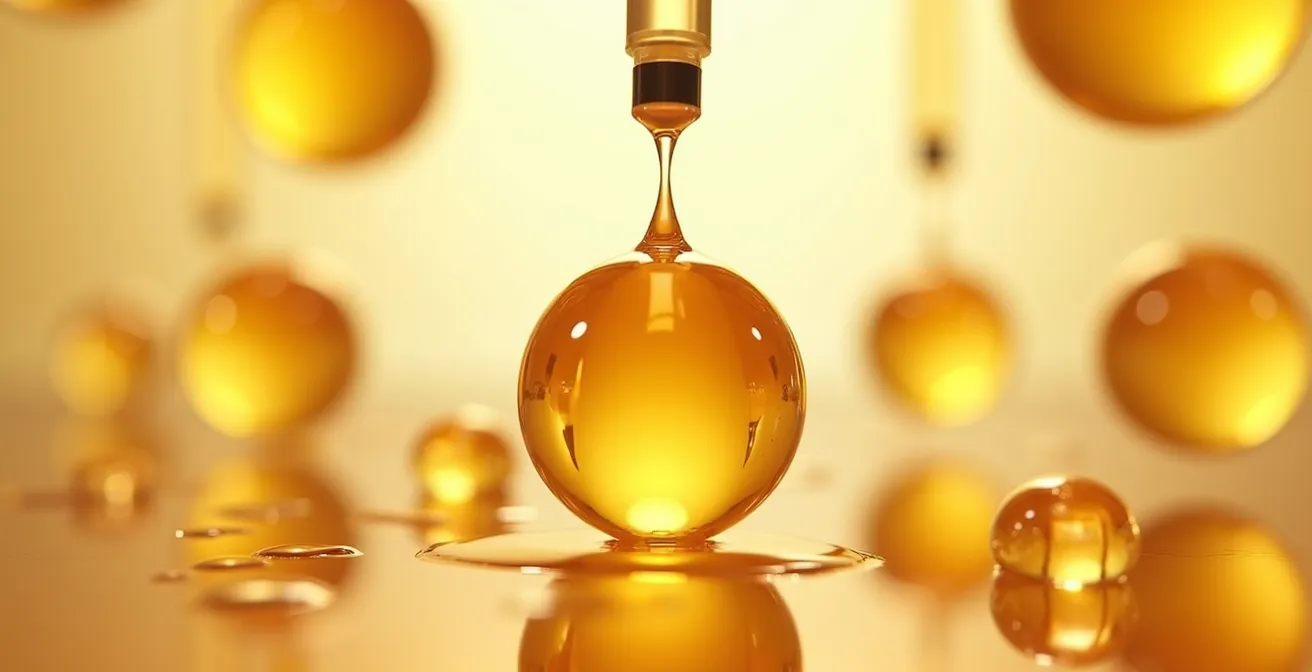
As you can see, the technique allows for the creation of perfectly uniform orbs, each holding its liquid essence captive. The magic lies in the thinness of the gel wall—just strong enough to hold its shape, yet delicate enough to dissolve with the slightest pressure. Mastering this balance is the key to successful spherification, turning a simple juice into an element of high-concept cuisine.
Action Plan: Spherification Success Checklist
- Ingredient Analysis: Check the pH and calcium content of your base liquid (e.g., fruit juice). Highly acidic or calcium-rich liquids require reverse spherification.
- Ratio Precision: Measure sodium alginate and calcium chloride with a high-precision scale (to 0.01g). Typical ratios are 0.5-1% alginate for the base and 0.5% calcium chloride for the bath.
- Hydration & Resting: Fully dissolve the sodium alginate in your liquid using an immersion blender. Let the mixture rest for at least an hour, or preferably overnight, to eliminate air bubbles for perfectly clear spheres.
- Bath Control: Ensure the calcium chloride bath is still and at room temperature. Dropping the spheres into a moving liquid will deform them.
- Rinsing and Storing: Gently remove the spheres from the bath with a perforated spoon after they have formed a stable skin (30-60 seconds) and rinse them in a clean water bath to stop the gelling process and remove any bitter taste.
Rotary Evaporator at Home: Is It Worth It for Essence Extraction?
The rotary evaporator, or “rotovap,” is a fixture in scientific laboratories that has found a second life in avant-garde kitchens. It distills liquids under vacuum, allowing it to happen at very low temperatures. This prevents the delicate aromatic compounds in foods from being destroyed by heat. The result is an almost impossibly pure “essence” of an ingredient—the smell of fresh mint, the aroma of a forest floor, or the flavor of a chili without its heat. But this power comes at a steep price. As Ecodyst, a manufacturer of this technology, notes, “The cost and footprint of traditional rotary evaporators has been prohibitive for all but the largest—and most commercially successful—industrial kitchens.”
Indeed, a look at the market confirms this barrier to entry for home cooks or small restaurants. According to industry data, full-size rotary evaporators can cost up to $40,000, with even smaller units exceeding $5,000. So, is it worth it? The answer depends entirely on the goal. If the aim is simply to concentrate a liquid, other methods are far more economical. But if the goal is flavor deconstruction—isolating an ingredient’s soul—the rotovap is unparalleled.
Consider the work at Alinea in Chicago, a pioneer in culinary innovation. One of their famous applications involves distilling the pure essence of chilies. In this process, the capsaicin, the chemical responsible for heat, is left behind. This allows the chefs to use the pure, fruity, and aromatic flavor of a habanero in a dish without its overwhelming spiciness. For a home cook, this level of investment is likely unjustifiable. However, for a professional chef dedicated to pushing sensory boundaries, the ability to create entirely new flavor profiles makes the rotovap an indispensable tool for true essence extraction.
The “Over-Processed” Critique: When Does Innovation Go Too Far?
One of the most persistent critiques leveled against molecular gastronomy is that it creates “unnatural” or “over-processed” food. The argument suggests that a carrot should look and taste like a carrot, and that transforming it into a foam, gel, or powder is a perversion of its nature. This view, however, fundamentally misunderstands the artistic and philosophical intent behind the techniques. As Chef Grant Achatz, a leading figure in the movement, puts it:
Eating isn’t just about satisfying your stomach, it needs to stimulate your brain too.
– Grant Achatz, Interview on molecular cuisine philosophy
This is the core of the counter-argument. High-end plant-based innovation is not about processing; it’s about expression and revelation. Cooking, by its very nature, is a process of transformation. Slicing, heating, and seasoning are all forms of “processing.” Molecular techniques are simply a more advanced set of tools in this continuum. They allow a chef to deconstruct an ingredient to its fundamental components—flavor, aroma, texture, color—and reassemble them in a way that creates a new, heightened experience. Innovation goes “too far” only when the technique overshadows the ingredient, when it becomes a gimmick rather than a tool for deeper expression.
The ultimate validation of this approach can be seen in its acceptance at the highest echelons of the culinary world. A powerful example is Eleven Madison Park in New York City. After its celebrated transition to an entirely vegan menu, a move heavily reliant on innovative techniques to elevate vegetables, the restaurant successfully retained its three Michelin stars in 2023. This achievement proves that a purely plant-based menu, crafted with scientific precision and artistic vision, can deliver an experience deemed worthy of the world’s most prestigious culinary award. It silences the notion that this is mere novelty, confirming its place as a legitimate and celebrated form of haute cuisine.
Fermentation vs. Foam: Which Technique Adds More Depth to Plants?
In the quest to build complexity in plant-based dishes, chefs often turn to two very different, yet equally powerful, families of techniques: fermentation and foams. The choice between them is a matter of artistic intent, as they add “depth” in fundamentally different ways. Fermentation is an ancient, biochemical process, while foams are a modern, physical one.
Fermentation is a slow, transformative art. It leverages microbes to break down sugars and proteins, creating a vast array of new flavor compounds. This process builds a deep, layered, and often funky umami that is difficult to achieve otherwise. Think of the savory complexity of miso, the tangy depth of kimchi, or the wine-like notes of a well-made kombucha. This is depth born of time and biology. In contrast, foams (or espumas) create depth through texture and aroma. By trapping air within a liquid, a chef creates a light, ethereal texture that dissipates on the tongue, delivering an immediate and intense aromatic release directly to the palate. This is depth born of physics and immediacy.
Neither technique is inherently superior; they serve different purposes in the construction of a dish. Fermentation adds a foundational, savory backbone, while a foam can provide a fleeting, aromatic high note. The most sophisticated dishes often create a textural dialogue by using both. The following table breaks down their distinct impacts.
| Technique | Transformation Type | Flavor Impact | Texture Result |
|---|---|---|---|
| Fermentation | Biochemical | Creates umami depth | Dense, complex structure |
| Foam | Physical | Immediate aroma release | Light, airy texture |
| Combined | Both | Multi-layered experience | Varied textures |
Ultimately, the decision rests on the desired narrative of the dish. Is the goal to tell a story of time and transformation, or to capture a perfect, fleeting moment? The modern chef understands that true depth comes from mastering both vocabularies.
How Long Do “Viral” Food Innovations Last on Fine Dining Menus?
In an age of social media, culinary innovations can become “viral” overnight. A striking visual, like a transparent ravioli or a cloud of smoke, can dominate feeds for weeks. This leads to a valid question: are these techniques fleeting trends or lasting additions to the culinary repertoire? The answer lies in the distinction between a gimmick and a genuine advancement. A gimmick is a technique used for its novelty alone, offering a momentary surprise but little else. A genuine advancement is a new tool that allows chefs to express flavor, texture, or aroma in a way that was previously impossible.
Viral trends based on pure novelty tend to have a short lifespan on fine dining menus. Once the surprise wears off, there is little substance to sustain interest. However, techniques that offer real functional or sensory benefits become integrated into the standard vocabulary of modern chefs. Spherification, once a jaw-dropping novelty, is now a standard tool for adding a textural pop. Sous-vide cooking, once seen as a laboratory technique, is now ubiquitous in professional kitchens for its unparalleled precision.
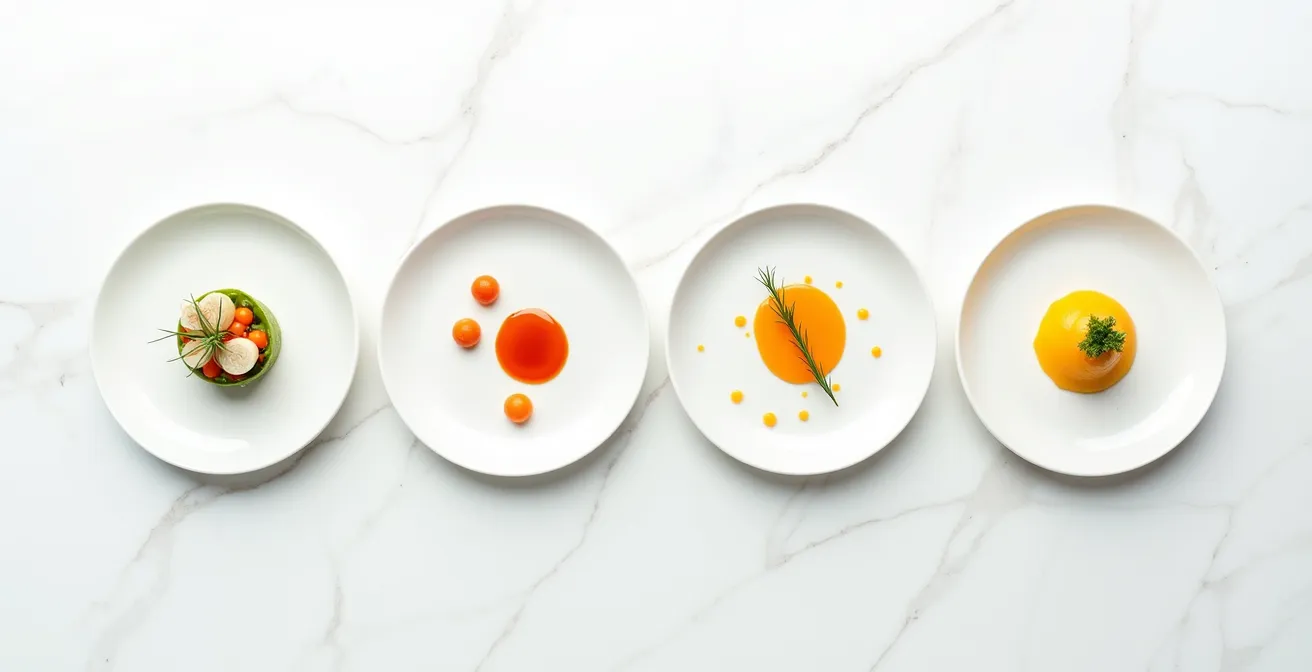
The longevity of an innovation is proven by its ability to deliver consistent excellence, not just initial shock value. The case of Alinea restaurant is illustrative. The restaurant was awarded three Michelin stars in 2011 and has maintained that elite status for over a decade. This sustained success was not built on a series of viral, one-off tricks. It was built on a philosophy of constant, meaningful innovation, where new techniques are developed and refined to consistently create new and profound dining experiences. Innovations last when they are in service of the food, not the other way around.
Is Vegan Fine Dining Worth the Price Tag for Non-Vegans?
A common hesitation among non-vegans considering a high-end plant-based restaurant is the price. The thinking goes: “Why should I pay hundreds of dollars for a meal of just vegetables?” This question, while understandable, is based on a flawed premise. It assumes the value of a dish is tied directly to the cost of its raw ingredients. In fine dining, this has never been the case. A diner does not pay for a piece of fish; they pay for the chef’s skill, creativity, vision, and the entire ecosystem of service and ambiance that creates a memorable experience.
The same principle applies with even greater force to haute plant-based cuisine. The price tag reflects the immense artistry, labor, and technical innovation required to transform a humble vegetable into a complex, multi-layered course. It accounts for the weeks of fermentation, the precision of a rotovap, and the hours of research and development. In fact, research from the National Restaurant Association reveals that 64% of full-service diners value the overall dining experience more than price. The goal is a transcendent sensory journey, regardless of the primary ingredient.
This is not a niche concern. The market is responding with enthusiasm, as demand for high-quality vegan options continues to surge. Market analysis projects that the Vegan restaurant Market is growing at a CAGR of 12.5% through 2033. Non-vegans are not paying for the absence of meat; they are paying for the presence of extraordinary creativity. They are paying to see how a chef can take a familiar ingredient, like a carrot or a mushroom, and present it in a way that challenges their perception and delights their senses. The question is not “is it worth it for a non-vegan?” but rather, “are you open to experiencing the pinnacle of culinary art, where the canvas happens to be a plant?”
What Professional Chefs Are Cooking Now: 5 Trends Shaping Modern Menus
The world of professional cooking is in a constant state of evolution, driven by new technologies, a deeper understanding of ingredients, and shifting consumer values. While molecular gastronomy provides the tools, several broader trends are directing how those tools are applied, particularly in the plant-based space. These trends shape the menus of today and tomorrow.
- Hyper-Localism and Foraging: Chefs are moving beyond simply sourcing from local farms to foraging for wild ingredients in their immediate bioregion. Techniques like essence extraction are then used to capture the fleeting aromas of wild herbs, flowers, and mushrooms, creating a “snapshot” of a specific place and time.
- The “Waste-to-Treasure” Movement: With a growing focus on sustainability, chefs are finding innovative ways to use every part of the plant. Vegetable peels are fermented into savory sauces, stems are distilled into clear waters, and leaves are turned into delicate crisps. This is where both ancient preservation and modern technology converge.
- The Rise of Fungi and Myco-protein: Mushrooms have always been a staple, but chefs are now exploring the entire fungal kingdom. This includes cultivating rare mushroom varieties and using mycelium (the root structure of mushrooms) as a base for creating new, savory, protein-rich textures that serve as the centerpiece of a dish.
- Advanced Fermentation: This goes far beyond standard pickling. Chefs are building dedicated fermentation labs to create their own custom misos, garums (traditionally a fish sauce, now made with plants), and vinegars. This allows for the development of a unique “flavor library” that is proprietary to the restaurant.
- Plant-Based Charcuterie: Applying the principles of traditional meat curing to vegetables is a major trend. Beets are salt-cured and aged to resemble bresaola, watermelon is smoked and seared to mimic tuna, and mushrooms are pressed and dried into savory “salami.” This is about texture and umami, not simple imitation.
These trends are not isolated; they are a response to a clear shift in consumer behavior. With data showing that 59% of U.S. households purchased plant-based foods in 2024, professional chefs are not just experimenting for a niche audience; they are catering to a mainstream movement toward more thoughtful and creative plant-based eating.
Key Takeaways
- Molecular technique is a tool for artistic expression and flavor revelation, not a gimmick to create unnatural food.
- Depth in plant-based dishes is achieved through a dialogue between biochemical transformations (like fermentation) and physical ones (like foams).
- The value and price of vegan fine dining are justified by the immense skill, labor, and sensory experience provided, not by the cost of the raw ingredients.
Marine Algae in the Kitchen: Beyond Sushi and Salads
When most people think of algae in the kitchen, their minds go to nori-wrapped sushi or a wakame salad. While delicious, these applications only scratch the surface of the vast and vital role algae play in modern, and particularly plant-based, cuisine. In the world of molecular gastronomy, marine algae are the invisible architects of texture. They are the source of hydrocolloids—natural polymers that can thicken, emulsify, and gel liquids in ways no other ingredient can.
Hydrocolloids like alginate (from brown algae), carrageenan (from red algae), and agar-agar are fundamental to many of the techniques discussed in this guide. They are the engine behind spherification, the stabilizing force in foams, and the foundation for creating firm or soft gels with a clean flavor release. As highlighted in a scientific overview, natural polymers extracted from marine algae are used to create a new vision for culinary preparations, enabling chefs to build textures that are both novel and precise. Without algae, much of the modern culinary toolkit would simply not exist.
Beyond their texturizing properties, algae are also a powerhouse of flavor, specifically umami. Kombu, a type of kelp, is rich in glutamates and forms the base of dashi, the foundational savory broth of Japanese cuisine. In modern plant-based cooking, kombu dashi provides a deep, oceanic, and meaty backbone to sauces, soups, and marinades, proving that profound savory flavor does not need to come from animals. By understanding algae as both a texturizer and a flavor enhancer, a chef unlocks a new dimension of possibilities, turning these humble sea plants into a cornerstone of haute cuisine.
The journey into haute plant-based innovation is not a rejection of nature, but a deeper engagement with it. It requires curiosity, precision, and an artist’s eye. The next step is to stop seeing a vegetable for what it is, and start imagining everything it could become. Begin your own experiments, start with a single technique, and let the ingredient guide you.