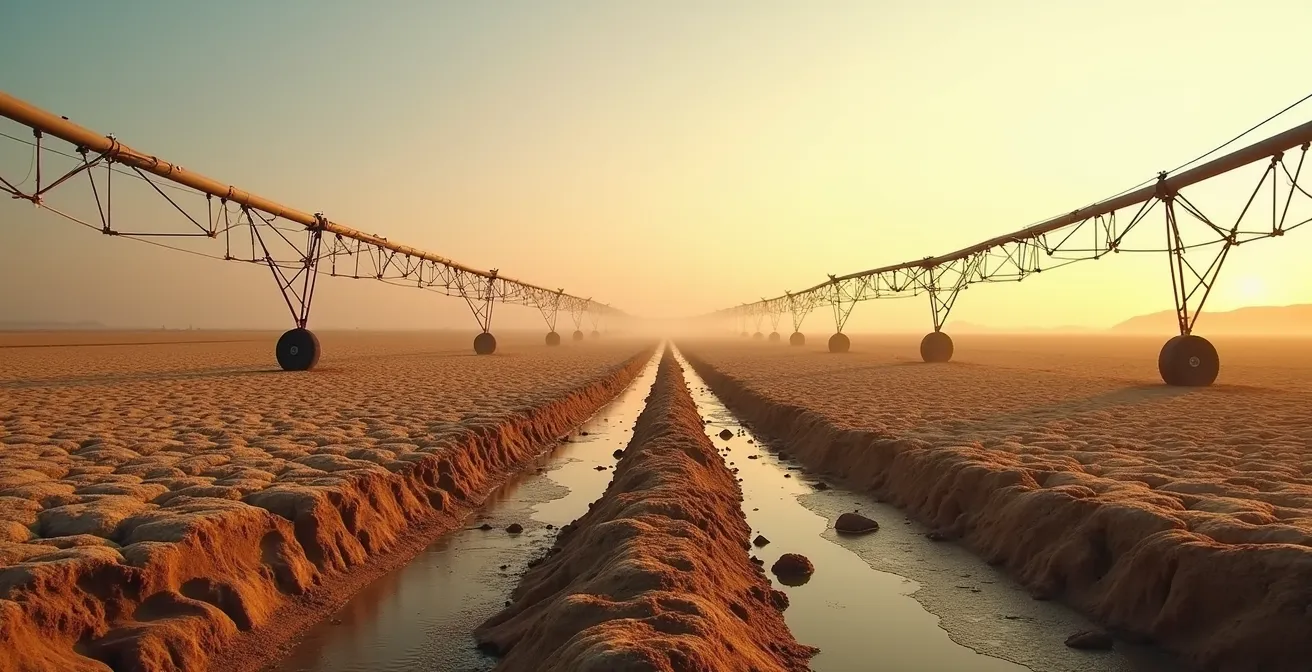
The cheap burger on your plate is a mirage, masking a multi-billion dollar bill paid for with irreplaceable public water.
- Industrial farming relies on depleting ancient “fossil” aquifers, primarily for water-intensive animal feed crops.
- Public subsidies artificially lower the shelf price of meat, hiding its immense environmental and water-related costs.
Recommendation: Understanding the “blue water” footprint of foods—the water drawn from finite ground and surface sources—is the most critical first step to true water conservation.
The debate around industrial meat production often revolves around greenhouse gas emissions or animal welfare. These are critical issues, but they obscure a more immediate and irreversible crisis happening beneath our feet: a systemic drain on the world’s finite freshwater supplies. Every discussion about factory farming that ignores the water equation is missing the single most fundamental input required to sustain it. We see a simple burger, but we fail to see the thousands of liters of water, often drawn from dwindling sources, that it embodies.
The common perception is that this is simply a matter of volume. While the numbers are staggering, the real story is far more alarming. It’s about the *type* of water being used. The industry’s reliance on “blue water”—water from rivers, lakes, and, most critically, underground aquifers—to irrigate feed crops is creating a debt that future generations will be unable to repay. This isn’t just about using water; it’s about consuming a finite resource far faster than nature can replenish it.
This article will not re-tread the familiar arguments. As a water resource engineer, my focus is on the data and the systems. We will dissect the true water cost of industrial meat, moving beyond the farm gate to analyze the economic policies that mask the price, the specific threat of aquifer depletion, and the global implications of our dietary choices on water security. It’s time to understand that the fight for water security is increasingly being fought on our dinner plates.
This analysis will break down the interconnected facets of industrial agriculture’s water footprint, providing a clear-eyed view of the challenges and the leverage points for change. Explore the full picture below.
Summary: Industrial Farming vs. Water Scarcity: The Hidden Cost of Your Burger
- The Antibiotic Resistance Risk Coming from Industrial Animal Farms
- Why Is Factory Farmed Meat Cheaper Than Vegetables?
- Regenerative Grazing vs. Plant-Based: Which Heals the Land Faster?
- How Much Land Could We Reforest if Everyone Went Plant-Based?
- When Will Aquifers Run Dry Due to Feed Crop Irrigation?
- Water Conservation on Your Plate: Which Foods Are Thirsty?
- Reducing Greenhouse Gas Emissions: How Much Does Diet Really Matter?
- Water Conservation on Your Plate: Which Foods Are Thirsty?
The Antibiotic Resistance Risk Coming from Industrial Animal Farms
The high-density conditions of Concentrated Animal Feeding Operations (CAFOs) are a breeding ground for disease, leading to the prophylactic use of massive quantities of antibiotics. This practice has a direct and dangerous consequence that flows from the farm into our water systems: antibiotic resistance. When animal waste, laden with antibiotic-resistant bacteria and residual drugs, contaminates local water sources, it fosters the evolution of “superbugs” that are immune to conventional medical treatment.
The scale of this public health threat is no longer theoretical. The consequences are measured in human lives. A stark report from World Animal Protection found that in 2019 alone, there were an estimated 975,000 human deaths and 35 million illnesses linked to drug-resistant microbes originating from factory farming. This is a direct pipeline from industrial agriculture to the hospital bed, facilitated by contaminated water.
Field studies confirm this pathway. A 2024 analysis of water near CAFOs in Michigan detected microbial source tracking markers like pig2bac and cowM3 exclusively in samples taken after spring manure applications. These findings demonstrate a clear link between farming operations and the introduction of fecal matter—and the resistant bacteria it carries—into surface water. The water crisis is not just about quantity; it’s about the quality and safety of the water that remains.
Why Is Factory Farmed Meat Cheaper Than Vegetables?
The paradox of a highly processed meat product costing less than fresh produce baffles many consumers. The answer lies not in production efficiency, but in a vast system of economic distortions. The low price is an illusion, created by massive government subsidies and a failure to account for what economists call externalized costs—the environmental and social damages that aren’t included in the shelf price.
A primary driver of this price distortion is direct financial support. For instance, the EU’s Common Agricultural Policy provides €53 billion per year in subsidies, a significant portion of which supports the meat and dairy industries and the intensive cultivation of animal feed. This public money effectively lowers the operational costs for industrial producers, allowing them to sell products at a price that doesn’t reflect their true production expense, particularly their immense water consumption.
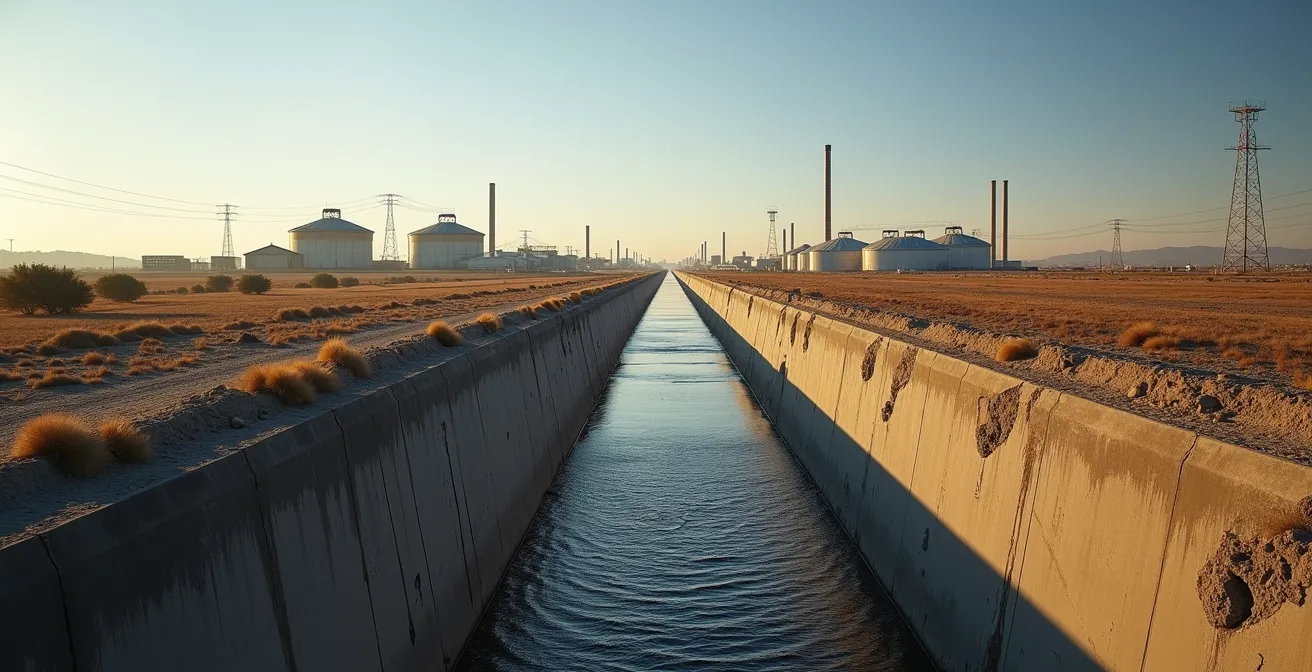
This public funding of private industry is only part of the story. The true cost becomes clearer when we calculate the environmental damage left for society to manage.
The True Cost of a Big Mac
An analysis by David Robinson Simon highlights the scale of these externalized costs. He estimates that the U.S. meat and dairy industry externalizes approximately $414 billion in costs annually. This includes factors like water depletion, pollution, and healthcare expenses related to diet. Applying this model, a Big Mac hamburger with a market price of $4 actually carries a hidden societal cost closer to $12. The consumer pays the low price at the counter, but society pays the remaining two-thirds through taxes, environmental degradation, and public health impacts.
Regenerative Grazing vs. Plant-Based: Which Heals the Land Faster?
In response to the harms of industrial agriculture, two primary alternatives have emerged: regenerative grazing and plant-based agriculture. When it comes to water, the debate is nuanced and requires understanding the difference between “green water” and “blue water.” Green water is rainwater stored in the soil, part of the natural local water cycle. Blue water is drawn from finite surface or groundwater sources like rivers and aquifers for irrigation.
Regenerative grazing, where cattle are managed to mimic natural herd movements, primarily relies on green water. The impact on finite blue water sources is minimal. However, its water footprint in terms of total green water can be high, and its scalability to feed a global population is a subject of intense debate. Plant-based agriculture’s water footprint is highly variable; some crops are water-intensive and rely heavily on blue water irrigation, while others are not.
The distinction between these water sources is the most critical factor in assessing sustainability. A food system’s impact on water scarcity is almost entirely a function of its reliance on blue water. The following table breaks down the typical water usage profiles.
| Production Type | Green Water Use | Blue Water Use | Grey Water Impact |
|---|---|---|---|
| Grass-Fed Beef | High (rainfall) | Low | Low |
| Industrial Beef | Medium | High (irrigation) | High (pollution) |
| Plant Agriculture | Variable | Variable | Medium (pesticides) |
While regenerative grazing offers significant benefits in soil health and reduced blue water use compared to industrial systems, a large-scale shift to water-intensive plant crops could merely trade one problem for another. The key is reducing overall consumption and prioritizing foods—whether animal or plant—with a low blue water footprint.
How Much Land Could We Reforest if Everyone Went Plant-Based?
The water footprint of industrial agriculture is inextricably linked to its land footprint. The vast majority of agricultural land is used not to grow food for direct human consumption, but to grow feed for livestock. This intensive cultivation of crops like corn and soy is a primary driver of global blue water consumption. Reallocating this land and the water used on it represents one of the greatest environmental opportunities of our time.
The potential impact is staggering. As Jasmine Clark, a prominent voice on the issue, highlighted in Open Access Government, a significant global shift away from animal products would unlock immense resources.
Reducing animal-based foods offers the potential to save enough water to feed 1.8 billion additional people globally.
– Jasmine Clark, Open Access Government – The devastating water footprint of animal agriculture
This isn’t just about saving water; it’s about what that water enables. Freeing up land currently dedicated to feed crops opens the door for massive reforestation and rewilding projects. These projects would not only sequester enormous amounts of carbon but would also help restore natural water cycles, improve biodiversity, and enhance the resilience of ecosystems. The water currently pumped from aquifers to grow animal feed could be the same water that supports a revitalized planet.
When Will Aquifers Run Dry Due to Feed Crop Irrigation?
The most urgent aspect of the agricultural water crisis is the depletion of non-renewable groundwater sources. Many of the world’s most productive agricultural regions rely on aquifers containing “fossil water”—water that seeped underground during the ice ages and is not being replenished by modern rainfall at any meaningful rate. Once this water is pumped out, it is gone for thousands of years. We are, in effect, mining water.
The Ogallala Aquifer in the United States, which supports a vast portion of the nation’s agriculture, is the quintessential example. In areas with the most intensive agriculture, the depletion is stark. For example, the Kansas Reflector reports that in parts of the state, water levels have dropped an average of 28.2 feet since the mid-20th century, far exceeding the average across the aquifer’s eight-state span. This drawdown directly threatens the viability of rural communities.
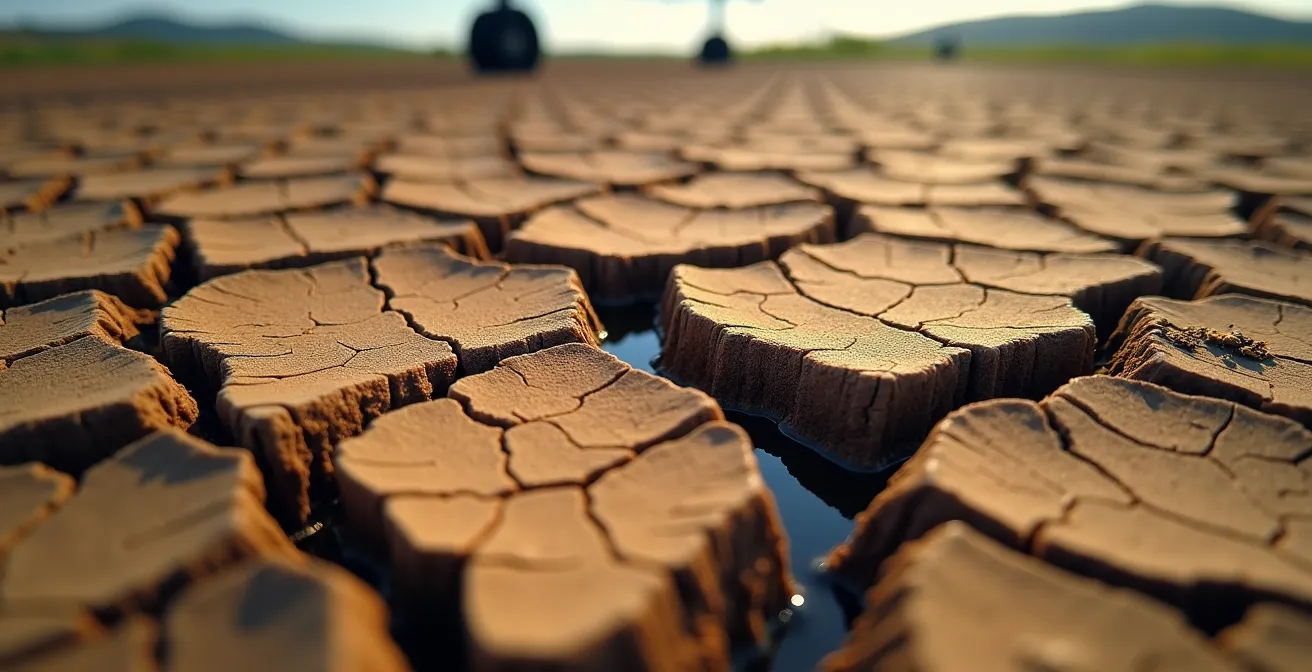
The timeline for replenishment makes the current rate of extraction profoundly unsustainable. This isn’t a resource that will bounce back next season.
The Ogallala’s Finite Lifespan
The water within the Ogallala Aquifer is ancient, having taken as long as six million years to accumulate. It is a finite resource, much like oil or coal. Current extraction rates for agriculture, primarily for feed crops like corn, far outpace the natural recharge rate from rainfall. Scientific models project that once depleted, the aquifer would take over 6,000 years to refill naturally. We are emptying a 6-million-year-old savings account in a few generations.
Water Conservation on Your Plate: Which Foods Are Thirsty?
While the problem is systemic, individual choices, when aggregated, create powerful market signals that can drive change. Understanding the water footprint of different foods is the first step. The numbers are often shocking, particularly for animal products, due to the enormous volume of water required to grow their feed over their lifetime. Beef is consistently ranked as one of the most water-intensive foods.
A foundational study by Mekonnen and Hoekstra provides a stark figure: producing one kilogram of industrial beef requires, on average, a staggering 15,415 liters of water. To put that in perspective, that’s equivalent to more than 100 full bathtubs of water for just over two pounds of meat. The vast majority of this water is blue water used for irrigating the feed crops consumed by the animal.
By contrast, most vegetables, fruits, and legumes have a dramatically smaller water footprint. A kilogram of vegetables requires around 322 liters of water, while fruits need 962 liters. Shifting dietary patterns from water-intensive animal products to plant-based alternatives is one of the most effective personal strategies for water conservation.
Your Action Plan: Reducing Your Water Footprint
- Assess Your Plate: Identify the most water-intensive foods you consume regularly (typically beef, pork, and dairy).
- Set a Reduction Goal: Start by replacing one or two of these meals per week with plant-based alternatives like lentils, beans, or tofu.
- Prioritize Low-Footprint Foods: Actively incorporate foods with a naturally low water footprint, such as potatoes, cabbage, and root vegetables.
- Combat Food Waste: Understand that wasted food equals wasted water. Plan meals and purchase only what you will realistically consume.
- Educate Your Circle: Share what you’ve learned. Explaining the “blue water” cost of food is a powerful way to help others understand the issue beyond a simple “eat less meat” message.
Reducing Greenhouse Gas Emissions: How Much Does Diet Really Matter?
While water is the focus of this analysis, it is impossible to ignore the connection to climate change. The same industrial systems that deplete our aquifers are also significant contributors to greenhouse gas (GHG) emissions. The link between them is, once again, the intensive production of animal feed. This process involves nitrogen fertilizers, which release nitrous oxide (a potent GHG), and the use of fossil-fuel-powered machinery.
The water and climate footprints are two sides of the same coin. According to analysis from the Heinrich Böll Foundation, animal production is responsible for 29% of the entire global water footprint of agriculture. This massive allocation of land and water resources to livestock is a key driver of both water scarcity and GHG emissions. The choice is not between solving for water or solving for climate; the solutions are largely the same.
Ultimately, the artificially low price of meat obscures its total environmental impact, a point forcefully made by Earth.org.
This artificially low pricing fails to account for the extensive environmental damage caused by animal agriculture, including GHG emissions, deforestation, water usage, and pollution.
– Earth.org, How Meat and Dairy Subsidies Are Driving Climate Change
Therefore, a dietary shift aimed at conserving blue water will inherently reduce GHG emissions. By choosing foods that are less resource-intensive, we address multiple environmental crises simultaneously. The power of a plant-rich diet lies in its efficiency—it requires less land, less water, and generates fewer emissions per calorie produced.
Key Takeaways
- The price of meat is artificially low due to massive public subsidies that hide its true water cost.
- Industrial agriculture is draining “blue water” from finite fossil aquifers, a non-renewable resource.
- Shifting to a plant-rich diet is one of the most powerful individual actions for global water conservation.
Water Conservation on Your Plate: Which Foods Are Thirsty?
We have journeyed from the microscopic threat of antibiotic resistance to the continental scale of aquifer depletion. We have seen how economic policies mask the true cost of our food and how the water crisis is deeply connected to climate change. All these complex, global systems converge in a single, tangible place: your plate. The abstract concepts of “blue water footprint” and “externalized costs” become concrete in the choice between a beef burger and a lentil curry.
To be a conscious participant in the global water system is to recognize the virtual water embedded in your food. It is to understand that a steak produced in a water-scarce region using irrigated feed crops represents a transfer of that region’s finite water resources to your table. Acknowledging this hidden flow of water is the fundamental shift in perspective required for meaningful change.
This knowledge is not meant to induce guilt, but to empower. It transforms the act of eating from a passive habit into a powerful form of environmental stewardship. Every meal becomes an opportunity to vote for a more sustainable and water-secure world. The most impactful action is not about achieving perfection overnight, but about starting the journey of conscious consumption, armed with the understanding of what truly makes a food “thirsty.”
The first step is practical application. Begin today by auditing your own plate and identifying one small change you can make. Use this knowledge not as a burden, but as a tool to align your daily actions with the future of a water-secure planet.