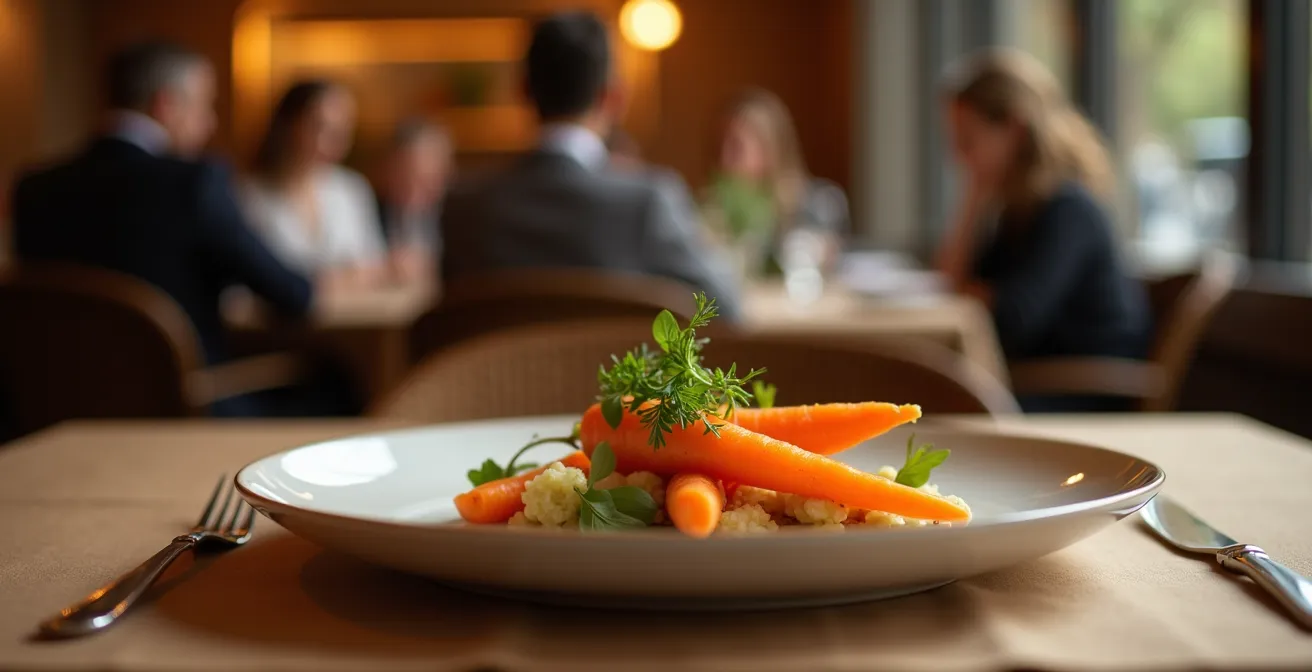
The high price of a vegan tasting menu isn’t for the raw ingredients, but for the extreme labor and technical artistry required to transform them into something extraordinary.
- Top-tier plant-based chefs focus on innovating with vegetables through complex techniques, not simply imitating meat.
- The experience is an investment in culinary art, measured by complexity and unique flavors that are impossible to replicate elsewhere.
Recommendation: Judge the meal on its creativity and execution, not on a preconceived notion of what a carrot “should” cost. This is about culinary ROI, not grocery bills.
Let’s be blunt. You’re considering dropping several hundred dollars on a meal for a special occasion. You’re no stranger to fine dining, but this time, the target is a high-end vegan restaurant. A voice in your head, the one that enjoys a perfectly seared steak or buttery piece of fish, is screaming a simple question: “Is this a rip-off?” It’s a valid concern. When Michelin-starred establishments build menus around vegetables, are you paying a premium for virtue signaling, or is there genuine, tangible value for a discerning, non-vegan palate?
The common arguments—it’s for the experience, it’s healthy, it’s good for the planet—often miss the point for a skeptic. You aren’t there for a lecture; you’re there for a world-class meal. The fear is paying filet mignon prices for what is, fundamentally, a plate of vegetables. But what if the entire premise of that fear is wrong? What if the value isn’t in the raw ingredient, but in the radical, labor-intensive transformation it undergoes?
This isn’t about replicating meat. The best vegan fine dining is a different beast entirely. It’s about culinary alchemy, where chefs use immense skill and cutting-edge techniques to unlock flavors and textures in plants you never knew existed. The true value proposition for the non-vegan is not found in what’s missing from the plate, but in the shocking and delightful presence of masterful cooking. This is an exploration of that value—the culinary return on investment (ROI) that justifies the cost.
To help you decide if this investment is right for you, we will deconstruct the experience from a pragmatic perspective. We’ll analyze everything from the economics of a single dish and the logistics of a tasting menu to the innovative techniques that define this culinary frontier.
Summary: Deconstructing the Value of a High-End Vegan Meal
- Why a Carrot Dish Can Cost $35 in a High-End Vegan Restaurant?
- How to Survive a 12-Course Plant-Based Tasting Menu Without Bloating?
- Modernist or Traditional: Which Vegan Fine Dining Style Suits Your Palate?
- The “Fake Meat” Trap: Why High-End Vegan Spots Avoid Mock Meats?
- When to Book Reservations for the World’s Top Vegan Restaurants?
- The Logistics of Farm-to-Table Menus: What Does It Really Take?
- Haute Plant-Based Innovation: Molecular Techniques for Vegetables
- What Professional Chefs Are Cooking Now: 5 Trends Shaping Modern Menus
Why a Carrot Dish Can Cost $35 in a High-End Vegan Restaurant?
The $35 carrot is the ultimate symbol of the skeptic’s dilemma. How can something that costs pennies at the market command such a price? The answer lies in a concept we’ll call “labor-as-ingredient.” You are not paying for the carrot itself; you are paying for its transformation. In fine dining, especially plant-based, the vast majority of the cost is tied to the immense human effort and skill required to elevate a humble ingredient into something extraordinary. That carrot might have been slow-roasted for eight hours, dehydrated, rehydrated in a house-made vegetable demi-glace, thinly sliced into a “rose,” and served with a sauce made from its own roasted trimmings that took two days to reduce.
This economic reality is reflected across the industry. While consumers often expect plant-based to be cheaper, foodservice data shows this is a misconception at the premium level. For instance, industry analysis reveals an 82% price premium on plant-based alternatives in some foodservice settings, driven by processing, R&D, and the skilled labor needed to create a high-quality product. A fine dining restaurant is the apex of this model. The kitchen brigade might spend more cumulative hours on that single carrot dish than on preparing and butchering a primal cut of beef.
Furthermore, the overheads of a fine dining establishment—rent in a prime location, a large team of highly trained chefs and servers, expensive plateware, and extensive wine cellars—are fixed costs. A tasting menu at a New York Michelin-star restaurant can easily be around $145, regardless of whether the star is a scallop or a sunchoke. The price reflects the cost of the entire operational machine, where culinary artistry and time are the most expensive ingredients on the menu.
How to Survive a 12-Course Plant-Based Tasting Menu Without Bloating?
A multi-course tasting menu is a marathon, not a sprint. For a diner unaccustomed to processing large volumes of fiber, the prospect of a 12-course vegetable-forward journey can be intimidating. The fear of bloating or digestive discomfort—”sensory overload”—is real and can ruin the experience. However, great chefs are not just artists; they are structural engineers of the dining experience. A well-designed plant-based menu is carefully orchestrated to guide your digestion, not overwhelm it.
The key is the strategic sequencing of courses. Menus often progress from light, raw, and acidic preparations to richer, cooked, and fermented dishes. This isn’t random; it’s designed to awaken your palate and digestive system gently. Palate cleansers, like a bright sorbet or a sharp consommé, are not just fancy interludes. They serve a biological purpose, helping to reset your taste buds and digestive enzymes for the next wave of flavors. Acknowledging this structure can transform your experience from a test of endurance into a guided journey. This focus on the holistic experience is paramount; as the National Restaurant Association notes, it’s a key driver for diners.
In fine dining, 64% of full-service diners value the overall dining experience more than price
– National Restaurant Association, Fine Dining Restaurant Statistics 2024
Your role in this partnership is to pace yourself. Don’t attack the breadbasket. Drink plenty of water. Pay attention to the rhythm of the service, which is intentionally spaced to allow for digestion. If you’re a novice in this domain, here is a practical checklist to help you navigate the experience comfortably and get the most value out of every course.
Your Action Plan: Pacing a Multi-Course Vegan Meal
- Follow the Flow: Begin with lighter, raw preparations before progressing to fermented items for optimal digestive flow. Trust the chef’s intended sequence.
- Use the Tools Provided: Take full advantage of palate cleansers between courses—they’re strategically designed to reset your digestive enzymes and prepare you for what’s next.
- Sync with the Kitchen’s Rhythm: Match your eating pace to the service. A typical 15-20 minute gap between courses is designed to allow for proper digestion. Don’t rush.
- Be Strategic with Portions: Focus on smaller portions of grain-heavy or dense dishes, while allowing yourself to fully enjoy the intricate, vegetable-focused courses.
- Rethink Your Drink: Consider choosing non-alcoholic fermented pairings, which can aid digestion, rather than wine, which can sometimes slow it down.
Modernist or Traditional: Which Vegan Fine Dining Style Suits Your Palate?
Not all vegan fine dining is created equal. Just as with traditional cuisine, there are different philosophies and styles. Understanding them is key to choosing an experience that aligns with your personal taste and sense of adventure, ensuring you don’t end up at a hyper-experimental lab when you were hoping for comforting elegance. Broadly, high-end vegan restaurants fall into a few key categories, each with its own risk-reward profile for the skeptical diner.
The Modernist or “avant-garde” style is where you’ll find the culinary alchemy in full force. Think foams, gels, spherification, and powders—techniques from molecular gastronomy used to create surprising textures and flavor combinations. This style is for the adventurous foodie who values innovation and surprise above all else. It’s high-risk, high-reward; a dish might be a revelation or a conceptual step too far. In contrast, the Traditional style focuses on veganizing classic techniques, particularly from French cuisine. Here, you’ll find rich, comforting flavors, masterful sauces (made with nut creams and vegetable reductions instead of dairy), and a focus on familiar luxury. It’s a lower-risk entry point for a classic palate.
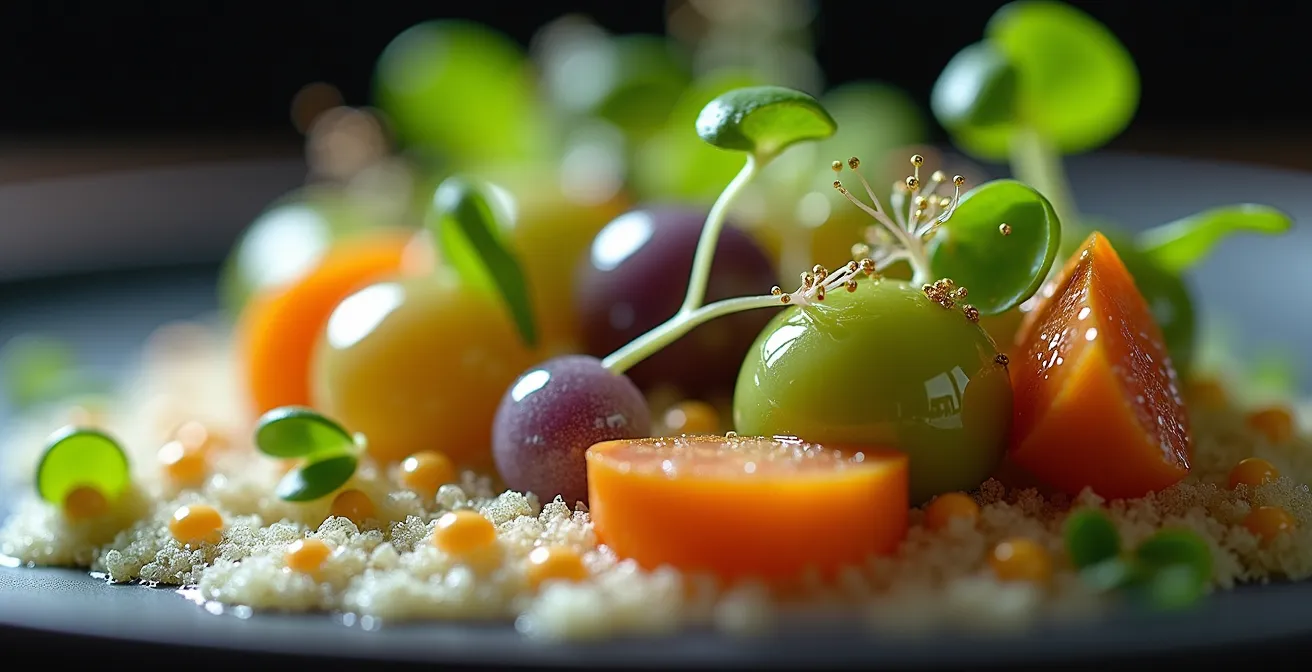
A third, emerging category is the Ethno-Botanical approach. These restaurants dive deep into a specific region’s indigenous ingredients and ancient techniques, like complex fermentation or slow-cooking methods. The focus is on historical depth and discovery, offering a unique cultural journey. The following table breaks down these styles to help you find your best fit.
This table, based on an analysis of the global vegan restaurant market, can help you decide which style offers the best culinary ROI for your palate.
| Style Aspect | Modernist Vegan | Traditional Vegan | Ethno-Botanical |
|---|---|---|---|
| Risk Level | High Risk/High Reward | Low Risk/Medium Reward | Medium Risk/High Cultural Value |
| Techniques | Molecular gastronomy, spherification, foams | Classic French sauces veganized | Ancient fermentation, indigenous methods |
| Price Point | $150-300 per person | $100-200 per person | $120-250 per person |
| Experience Focus | Innovation & surprise | Comfort & familiarity | Historical depth & discovery |
| Ideal For | Adventurous foodies | Classic palates | Cultural explorers |
The “Fake Meat” Trap: Why High-End Vegan Spots Avoid Mock Meats?
For many non-vegans, the concept of plant-based eating is synonymous with “fake meat”—burgers that bleed, sausages made of soy, and chicken made from pea protein. It’s natural to assume that a high-end vegan restaurant would simply offer hyper-realistic, gourmet versions of these products. This is a fundamental misunderstanding. The best plant-based chefs actively avoid the “fake meat trap” because their goal is not imitation, but innovation. They aren’t trying to trick you into thinking you’re eating meat; they’re trying to show you the astonishing potential of a vegetable in its own right.
Relying on mock meats sets up a comparison that a vegetable can never win. A seitan “steak” will always be judged against a real ribeye, and it will almost always fall short for a meat-eater. This creates a sense of lack and disappointment—the very feeling you’re trying to avoid when paying a premium. Great chefs understand this psychology. Instead of chasing a pale imitation, they dedicate their skills to celebrating the unique, inherent qualities of plants. They create vegetable-centric dishes where the texture of a king oyster mushroom or the umami of a fermented tomato is the star, not a stand-in for something else.
This approach is also more sustainable from a culinary perspective. Interestingly, studies on dietary choices show that adherence can be a challenge, with one report finding that as many as 84% of vegetarians and vegans eventually return to eating meat. While the reasons are complex, it suggests that a diet based solely on replication might be less satisfying long-term than one based on genuine new experiences. By creating entirely new flavor profiles, haute cuisine chefs offer a compelling reason to eat plants that has nothing to do with missing meat. They are building a new culinary language, and that is a far more valuable proposition.
When to Book Reservations for the World’s Top Vegan Restaurants?
Securing a table at a world-class restaurant requires strategy, and top-tier vegan establishments are no exception. As this culinary niche gains prestige, the demand for reservations at temples of plant-based gastronomy like Eleven Madison Park in New York or Geranium in Copenhagen can be just as fierce as for their traditional counterparts. Booking isn’t just about getting a seat; it’s about timing your visit to maximize the experience, both in terms of menu quality and value.
The most important factor is seasonality. Unlike traditional fine dining, which can lean on staples like beef or lobster year-round, true farm-to-table vegan menus are hyper-seasonal. The menu in April will be wildly different from the one in October. Booking a table in late spring might reward you with the delicate, vibrant flavors of asparagus, peas, and morels. An autumn reservation, on the other hand, will likely feature a richer, deeper palate of wild mushrooms, root vegetables, and squashes. Researching a restaurant’s seasonal specialties can help you align your visit with the flavor profiles you enjoy most.
Beyond seasonality, there are tactical considerations that can improve your chances or even save you money. Off-peak times can be a goldmine. Many top restaurants offer more accessible (and sometimes more affordable) tasting menus for weekday lunches. The atmosphere may be less formal, but the quality of the cooking remains the same, offering a significant value increase. For the most sought-after spots, it’s also wise to follow them on social media. High-end restaurants often use platforms like Instagram to announce last-minute cancellations, providing a spontaneous opportunity for those quick enough to grab it.
- For Peak Spring Vegetables: Book in late April-May to experience asparagus, fresh peas, and spring alliums at their absolute finest.
- For Rich Autumnal Flavors: Target October-November for menus built around earthy mushrooms, truffles, and complex root vegetables.
- For Better Availability & Experimental Dishes: The post-holiday slump of January-February is often a great time to find a table and experience chefs testing new ideas.
- For a Better Price Point: Always check for weekday lunch menus, which can be 30-40% less expensive than dinner for a comparable experience.
- For Last-Minute Opportunities: Follow your target restaurants on Instagram. Many will post story updates for same-day cancellations.
The Logistics of Farm-to-Table Menus: What Does It Really Take?
The term “farm-to-table” is so overused it has almost lost its meaning. In the context of high-end vegan dining, however, it represents a logistical nightmare that profoundly impacts the final price tag. For these chefs, it’s not about ordering from a large-scale distributor. It’s about building and maintaining a complex network of small, specialized, and often exclusive farms. This direct sourcing is not cheaper; it is significantly more expensive and labor-intensive.
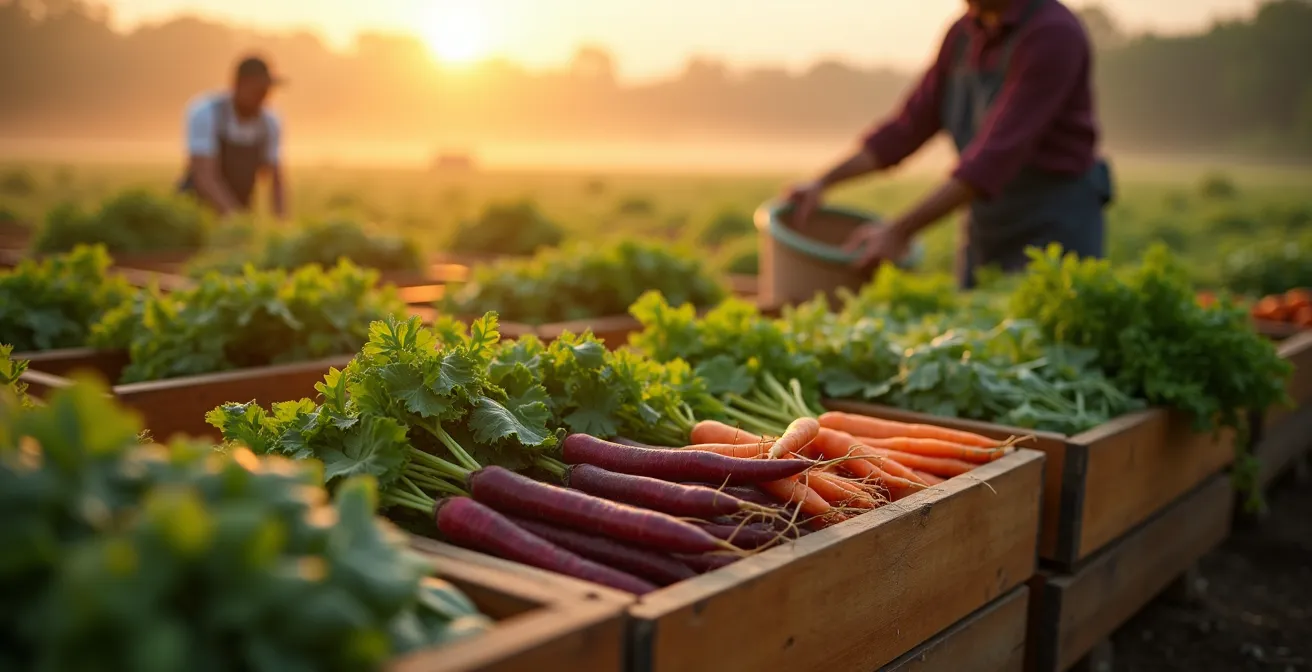
Picture the daily routine: chefs aren’t just placing an order, they’re in constant communication with farmers about what’s peaking that specific day. They may even have their own dedicated farm staff or greenhouses. This hyper-local sourcing means the menu can change daily based on what a farmer harvested that morning. This creates incredible freshness but also immense operational challenges. It requires a highly skilled and adaptable kitchen team capable of creating or modifying dishes on the fly. This level of flexibility and improvisation is a hidden cost baked into your tasting menu.
Furthermore, these restaurants are often dealing with heirloom or rare varietals that are less resilient and have lower yields than commercial crops. The farmer is taking a greater risk to grow them, and the chef pays a premium for that exclusivity. The scalability of such a model is a massive undertaking. For example, the plant-forward chain True Food Kitchen, while not strictly fine dining, demonstrates the investment required; it now operates 46 locations and has secured over $100 million in investment to manage its complex supply chain. For a single, independent fine dining restaurant, this entire logistical burden is managed in-house, representing a huge investment of time and money before a single vegetable even enters the kitchen.
Haute Plant-Based Innovation: Molecular Techniques for Vegetables
If labor and logistics explain the operational costs, it is the application of advanced culinary science that creates the “wow” factor you are paying for. High-end vegan chefs are pioneers, using a symphony of modern techniques to manipulate the texture, flavor, and appearance of vegetables in ways that are simply not possible in a home kitchen or standard restaurant. This is the heart of the culinary ROI: you are paying for access to an experience created by specialized knowledge and equipment.
Techniques like spherification, where a liquid (like intensely flavored tomato water) is turned into a delicate sphere that bursts in your mouth, deliver a flavor intensity that traditional cooking cannot match. Sous-vide cooking, where a vegetable is vacuum-sealed and cooked in a water bath at a precise temperature for hours or even days, achieves a perfect, uniform texture that is impossible with conventional methods. A carrot cooked sous-vide retains a snap and sweetness that roasting or boiling obliterates. These methods are not gimmicks; they are precise tools for flavor and texture control.
This table illustrates how modernist techniques are used to create sensations often associated with animal products, but in a purely plant-based context.
| Technique | Sensory Result | Traditional Equivalent | Application Example |
|---|---|---|---|
| Spherification | Burst of concentrated flavor | Egg yolk richness | Tomato water pearls |
| Gelification | Sauce-like viscosity | Dairy-based sauces | Cashew cream gels |
| Foam/Air | Ethereal lightness | Whipped cream | Beetroot foam |
| Sous-vide | Perfect texture retention | Slow-braised meats | 48-hour mushroom confit |
| Fermentation | Deep umami complexity | Aged cheeses | Koji-aged vegetables |
This is where the value becomes undeniable for a food lover. You may be able to buy the same heirloom carrot as the chef, but you cannot replicate the 48-hour mushroom confit or the koji-aged turnip that delivers a profound, cheese-like umami. You are paying for the chef’s years of training, experimentation, and investment in technology to deliver a sensory experience that expands your definition of what a vegetable can be.
Key Takeaways
- The price of a high-end vegan dish is primarily driven by skilled labor and complex techniques, not the raw cost of the vegetable.
- Top-tier vegan chefs focus on innovating new flavors and textures from plants, rather than imitating meat products.
- Judging the value requires a shift in mindset: you are investing in unique culinary artistry and a sensory experience that cannot be replicated at home.
What Professional Chefs Are Cooking Now: 5 Trends Shaping Modern Menus
So, is it worth it? The final piece of the value puzzle lies in understanding that this is not a static, niche trend. Plant-based haute cuisine is a dynamic and rapidly evolving field of culinary arts. By dining at these establishments, you are getting a front-row seat to the future of food. Chefs are constantly pushing boundaries, and being aware of the latest trends can help you appreciate the creativity and forward-thinking nature of the meal you’re investing in. This isn’t just dinner; it’s a glimpse into the R&D labs of modern cuisine.
The movement is growing far beyond a small subculture, with projections showing a 12.5% compound annual growth rate for the global vegan restaurant market. This growth fuels innovation. Today’s most pioneering chefs are exploring concepts that sound like they’re from a science fiction novel but are appearing on menus right now. From dry-aging vegetables like cuts of meat to creating complex “waters” as a base for sauces, these trends showcase a relentless pursuit of flavor. Here are five of the most significant trends shaping the future of high-end plant-based dining:
- Trend 1: Vegetable Charcuterie. Chefs are using curing and dry-aging techniques, traditionally used for meat, on vegetables. Think beetroots or carrots aged for weeks to concentrate their flavor and create a dense, “meaty” texture, then sliced thin like bresaola.
- Trend 2: Culinary Waters. Forget stock. The new foundation of flavor is bespoke water, infused with the essence of pine, birch, or even minerals to create a subtle but complex base for sauces and consommé’s.
- Trend 3: In-House Fermentation Labs. Top kitchens are going beyond kimchi and kombucha, creating their own unique shoyus (soy sauces) and misos from local legumes, grains, and even vegetable scraps to generate profound umami.
- Trend 4: Palate Reset Courses. Moving beyond simple sorbets, chefs are using bitter elements and complex vinegar shrubs as strategic “interventions” in the tasting menu to cleanse the palate and heighten sensitivity for subsequent courses.
- Trend 5: Texture Innovation. Using advanced tools like ultrasonic homogenizers, chefs are manipulating the cellular structure of vegetables to create satisfying, complex textures that provide a sense of richness and “bite” without imitating meat.
Ultimately, the decision to spend hundreds of dollars on a vegan tasting menu is a personal calculation of value. But for the open-minded, skeptical food lover, the reward is not a lesser version of a meal you already know. It’s a ticket to a completely different show—one built on breathtaking skill, surprising science, and a fundamental respect for the untapped potential of the plant kingdom. The question then becomes not “is it worth it,” but “are you curious enough to find out?”