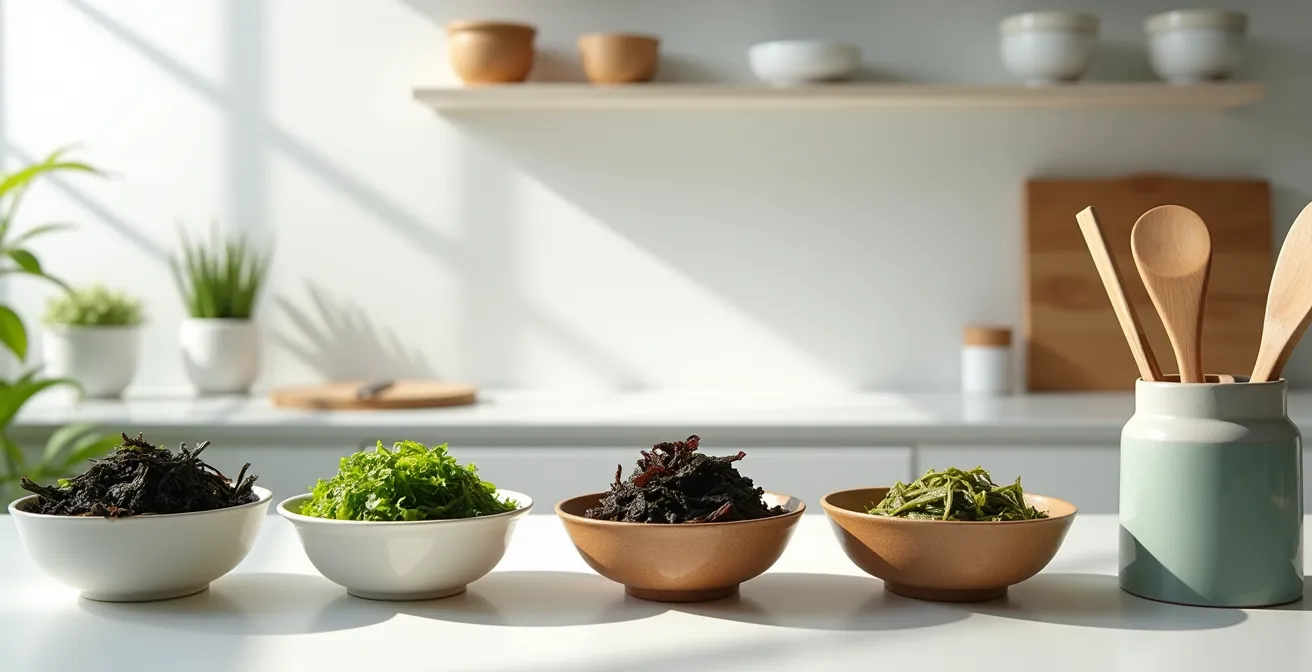
Mastering seaweed isn’t about recipes; it’s about controlling its core properties to unlock incredible flavor and nutrition safely.
- Heavy metal risks are real but manageable by choosing the right species and using proper soaking techniques.
- Texture and flavor are not accidental; they are controlled through precise soaking times and non-boiling extraction methods like infusion.
Recommendation: Treat sea vegetables as a technical ingredient. Focus on understanding their scientific properties to move from intimidation to culinary confidence.
The tide of culinary curiosity is pulling sea vegetables from the ocean depths onto our plates. For many home cooks, however, this ingredient remains a mystery, shrouded in intimidating tales of slimy textures, overpowering “fishy” flavors, and whispers of contaminants. The common advice—to simply toss some into a miso soup or roll it into sushi—barely scratches the surface and does little to build real confidence. We see it used in salads or as a garnish, but its true potential as a foundational flavor agent remains largely untapped in the home kitchen.
The journey to culinary mastery often starts by questioning the basics. What if the fear of a slippery texture in wakame wasn’t a flaw of the ingredient, but a failure of technique? What if the secret to a deeply savory, soul-soothing vegan broth wasn’t just adding kombu, but understanding the precise science of glutamate extraction? The key to unlocking the treasure of the ocean’s pantry lies not in simply following recipes, but in understanding the very nature of marine algae.
This guide pulls back the curtain. We will navigate the currents of safety, demystify the science of texture, and dive deep into techniques for flavor extraction that transform these humble sea plants into culinary powerhouses. We’ll explore how to choose the right algae for the right dish, why kombu is a vegan chef’s secret weapon, and how to combine these oceanic flavors with other plant-based enhancers to create true synergy. It’s time to stop being intimidated and start cooking with the knowledge and precision of a seasoned sea forager.
This article charts a course through the essential knowledge you need to become proficient with sea vegetables. Below is the map of our journey, from ensuring safety to creating showstopping dishes.
Summary: The Modern Cook’s Guide to Marine Algae
- Heavy Metals in Seaweed: Which Origins Are Safer to Eat?
- Nori vs. Dulse vs. Kelp: Which Algae Suits Soups Best?
- Why Kombu Is the Secret Weapon for Rich Vegan Broths?
- How Long to Soak Wakame Before It Becomes slimy?
- How to Extract Flavor from Kelp Without Boiling It?
- Nutritional Yeast 101: How to Use “Nooch” for Cheesy Flavor?
- Elevating Home Cooking with Plant-Based Culinary Arts Techniques for Dinner Parties
- The New Umami Frontier: Synthesizing Seaweed and Plant-Based Flavors
Heavy Metals in Seaweed: Which Origins Are Safer to Eat?
Let’s address the elephant in the sea: safety. Seaweeds are powerful bioaccumulators, meaning they absorb minerals—and unfortunately, heavy metals—from their environment. This is not a reason to panic, but a call for informed sourcing. Certain species, like hijiki, are best avoided entirely. In fact, recent spectroscopy studies reveal that over 70% of total arsenic in hijiki is the more toxic, inorganic form. This makes choosing your seaweed one of the most important steps.
However, knowledge gives you control. Traditional preparation methods, developed over centuries, are incredibly effective at mitigating these risks. The simple act of soaking and rinsing doesn’t just rehydrate; it cleanses. This isn’t just folklore; it’s backed by data.
Case Study: Traditional Japanese Methods Reduce Arsenic
Laboratory testing conducted by Eden Foods provides a compelling example. Their analysis showed that following traditional Japanese preparation—soaking dried hijiki in warm water for just 15 minutes— reduced inorganic arsenic from 59.6 ug/g to 35.9 ug/g, a reduction of over 40%. This demonstrates that while the raw ingredient may pose a risk, proper culinary technique is a powerful tool for safety. The key is not total avoidance, but mindful preparation and moderation.
To navigate these waters safely, you need a clear protocol. Rather than relying on guesswork, follow a consistent set of steps to minimize your exposure while maximizing the nutritional benefits of these incredible plants. The following checklist is your guide to safer seaweed consumption.
Action Plan: Reducing Heavy Metal Risk in Seaweed
- Choose Wisely: Actively avoid Hijiki. Prefer species with known lower metal levels like nori and sea lettuce.
- Soak and Discard: Always soak dried seaweed in warm water (around 50°C) and completely discard the soaking water. This simple step can remove a significant percentage of water-soluble contaminants like arsenic.
- Mind Your Iodine: Limit consumption of high-iodine varieties like kelp and kombu to about 1 gram per week. While essential, their iodine content can be extremely high (up to 4000% of daily intake).
- Check for Certification: Look for brands that provide third-party lab testing certificates on their packaging. This shows a commitment to transparency and quality control regarding heavy metal analysis.
- Practice Moderation: Enjoy seaweed as part of a varied diet, not as a daily bulk food. Consuming small amounts (2-3 tablespoons) every few days keeps intake well within safe limits.
Nori vs. Dulse vs. Kelp: Which Algae Suits Soups Best?
Once safety is addressed, the fun begins. Choosing the right seaweed for your soup is like picking the right wood for a fire; each one brings a different character, texture, and aroma. They are not interchangeable. A sheet of nori, famous for sushi, will dissolve into a clear broth, adding a subtle, nutty ocean flavor and a bit of body. In contrast, flakes of reddish-purple dulse become delightfully chewy, imparting a smoky, almost bacon-like saltiness that stands up beautifully in creamy chowders.
Then there is the king of broth, kelp (often sold as kombu). This thick, leathery seaweed doesn’t dissolve. Instead, it works its magic by slowly infusing the water with deep, mineral-rich umami, creating the foundational dashi broth that is the soul of Japanese cuisine. Each seaweed has a distinct role, transforming the same pot of water in vastly different ways.
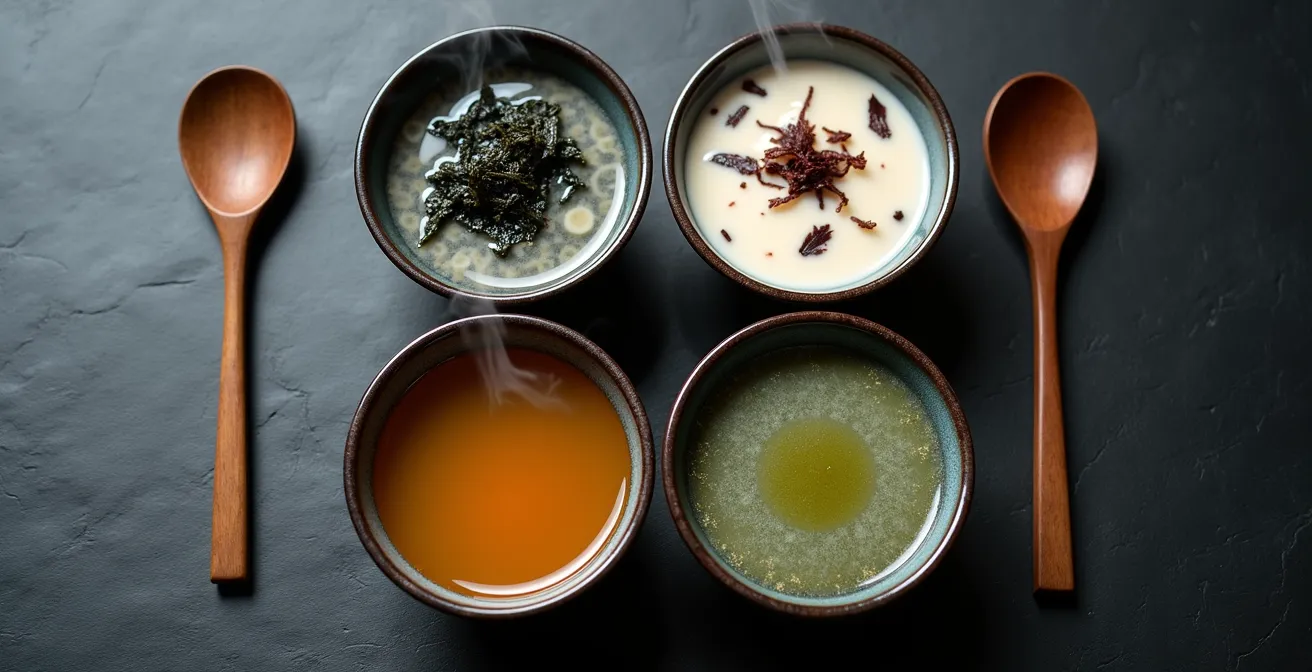
Understanding these differences is the key to moving beyond generic “seaweed soup” and into the realm of intentional, flavor-layered cooking. A quick glance at their properties reveals just how diverse their applications are. The following table breaks down the essential characteristics to guide your choice.
| Seaweed Type | Texture in Soup | Flavor Profile | Best Soup Pairing | Cooking Time |
|---|---|---|---|---|
| Nori | Dissolves quickly, adds body | Mild, nutty, oceanic | Clear broths, miso | 30 seconds |
| Dulse | Chewy, bacon-like when cooked | Smoky, salty, umami | Creamy chowders | 5-10 minutes |
| Kelp/Kombu | Firm, releases thickening agents | Deep umami, mineral-rich | Dashi base, bean soups | 20-30 minutes (infusion) |
| Wakame | Tender, silky when rehydrated | Sweet, delicate ocean taste | Miso soup, Asian broths | 5 minutes |
Why Kombu Is the Secret Weapon for Rich Vegan Broths?
Kombu’s reputation as a “secret weapon” is entirely earned. Its power lies in its high concentration of natural glutamic acid, the compound responsible for the savory fifth taste, umami. When gently heated in water, kombu releases these glutamates, creating a broth with a richness and depth that can rival meat-based stocks. This makes it an indispensable tool for vegan and vegetarian cooking, providing a savory backbone that other vegetables simply cannot replicate. Furthermore, nutritional analysis shows seaweed contains up to 10 times the minerals of most land vegetables, adding a profound mineral complexity to the flavor.
The magic of kombu extends beyond flavor. As the experts at Heritage Seaweed note in their cooking guide, its benefits are multifaceted:
Kombu is rich in umami flavor, which can add a savory taste to dishes. Add a kombu strip to the cooking water for flavorful, extra creamy, easier-to-digest legumes.
– Heritage Seaweed, Seaweed Cooking 101 Guide
The enzymes in kombu help break down the complex sugars in beans, making them more tender and easier on the digestive system. But to truly harness its power, one must understand the art of extraction. Boiling kombu is a common mistake that releases bitter compounds. The real secret lies in gentle, low-temperature infusion.
Case Study: The Cold Brew ‘Mizudashi’ Technique
The team at Forks Over Knives highlights the *mizudashi* (cold brew) method for maximum umami with minimal bitterness. The process involves simmering a strip of kombu in water for just 10 minutes at a low temperature, or even steeping it in cold water overnight in the refrigerator. This low-and-slow extraction coaxes out the desirable glutamates without releasing the bitter-tasting compounds that emerge at boiling temperatures. This technique yields a clean, pure, and deeply savory dashi that serves as a perfect foundation for countless plant-based dishes, from soups to sauces.
How Long to Soak Wakame Before It Becomes slimy?
Ah, the dreaded slime. The fear of a slippery, mucilaginous texture is what keeps many aspiring seaweed enthusiasts at bay. With wakame, this textural transformation is a matter of time and temperature. The “slime” is actually a release of beneficial polysaccharides, but controlling this release is the essence of textural control. You are the one who decides if your wakame will be refreshingly crunchy for a salad or silky and tender for a soup.
The key is to soak with intention. A short dip in cold water preserves the fronds’ structure, keeping them firm and providing a pleasant bite. A longer soak in warm water, however, encourages the release of those polysaccharides, creating the soft, tender texture prized in miso soup. It’s not an accident; it’s culinary science in a bowl. For cooks, this means you can dial in the exact texture you want for any given dish.
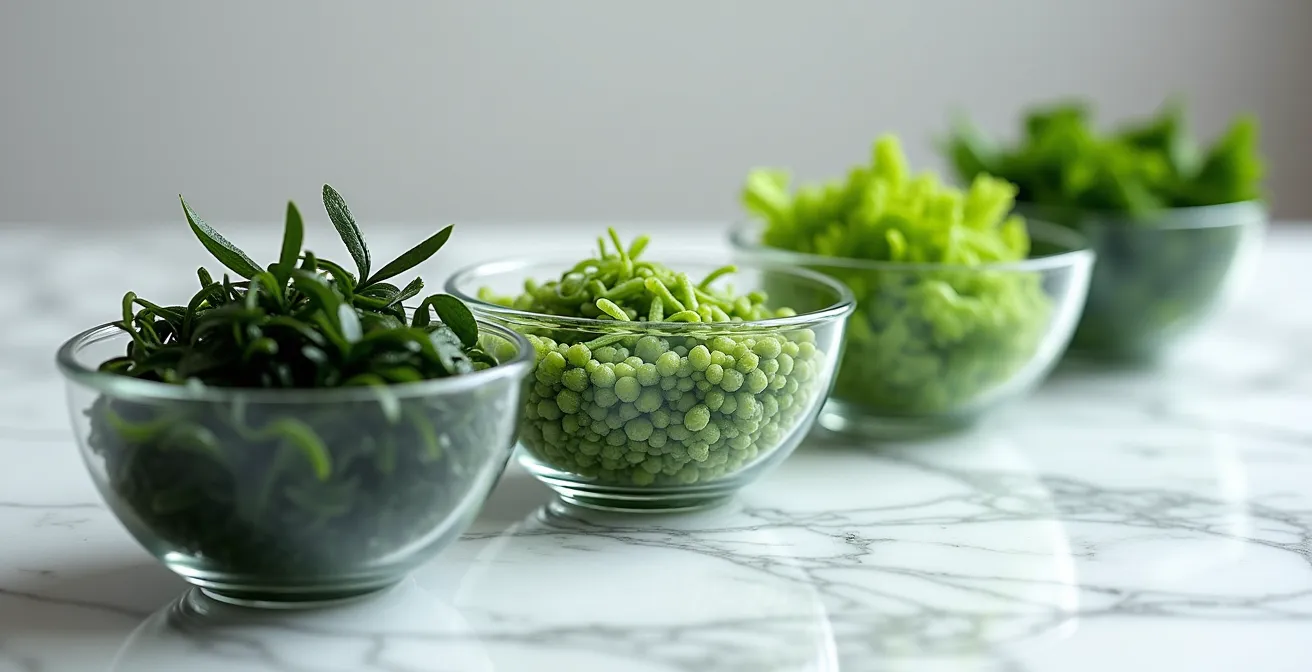
The duration of the soak is directly tied to the final application. There is no single “correct” soaking time, only the right time for your desired result. A splash of rice vinegar in the soaking water can also help temper the polysaccharide release if you’re aiming for a firmer texture.
- For Salads: To achieve a crisp, crunchy texture, soak dried wakame in cold water for exactly 5 minutes. Drain, rinse, and it’s ready to add a refreshing bite.
- For Miso Soup: For that classic silky, tender texture, rehydrate in warm water for 10 minutes. The fronds will expand beautifully and become soft.
- For Stir-Fries: To maintain some firmness so it doesn’t fall apart in the wok, a quick 3-minute soak in warm water is ideal.
- For Blended Sauces: If you *want* to leverage its thickening properties, soak it for 15 minutes or more to maximize the release of polysaccharides before blending.
How to Extract Flavor from Kelp Without Boiling It?
While kombu (a type of kelp) is fantastic for broths, boiling kelp can often lead to a slimy texture and a bitter, overly oceanic flavor. The most sophisticated flavors are often coaxed out with more delicate methods. The goal of advanced flavor extraction is to capture the deep, nutty, and savory notes of umami while leaving the undesirable compounds behind. This requires moving away from the pot of boiling water and embracing techniques like toasting and infusion.
Gentle heat is the key. Toasting a sheet of kelp over a low flame or in a dry pan until it becomes fragrant and brittle completely changes its flavor profile. The harsh notes recede, and a deep, nutty aroma emerges. This toasted kelp can then be crumbled as a seasoning (gomasio) or used for infusion. The science behind this is clear: culinary science research indicates a 60°C (140°F) maximum is the sweet spot for optimal flavor extraction without releasing bitter elements. Boiling water, at 100°C, is simply too aggressive.
Technique Spotlight: Kelp-Infused Oil
As demonstrated by professional chefs at Great British Chefs, one of the most elegant ways to capture kelp’s essence is by creating an infused oil. The technique involves gently toasting a sheet of kelp to awaken its aromas, then steeping it in a quality olive or neutral oil for at least 24 hours at room temperature. The oil becomes a vessel for the kelp’s savory, umami-rich flavor, creating a powerful condiment. Chef Nathan Outlaw uses this very technique to finish seafood dishes, adding a profound depth of flavor without any of the boiled texture. This umami oil can be drizzled over vegetables, pasta, or grains as a finishing touch.
This method completely separates the flavor from the physical seaweed, giving you a versatile tool to add a savory, oceanic backbone to nearly any dish. It’s a perfect example of how chef-level techniques can be adapted for the home kitchen to achieve superior results.
Nutritional Yeast 101: How to Use “Nooch” for Cheesy Flavor?
In the world of plant-based cooking, there’s another umami powerhouse that acts as a perfect counterpart to seaweed: nutritional yeast, affectionately known as “nooch.” These golden, savory flakes are a deactivated form of yeast, and they are prized for their cheesy, nutty flavor profile. As food writer Althea Tan Hutchinson explains, it’s a go-to ingredient for those seeking savory depth.
Nutritional yeast has a nutty, savoury taste similar to Parmesan cheese, and is packed with B vitamins and antioxidants, making it a favourite among vegans and vegetarians, who often call it an ‘umami bomb’.
– Althea Tan Hutchinson, South China Morning Post
Beyond its flavor, nooch is a nutritional heavyweight. It is a complete protein, and nutritional analysis confirms that just two teaspoons contain all nine essential amino acids, making it a valuable addition to any diet. Its primary culinary function, however, is to provide that cheesy, savory kick without dairy.
The real magic happens when you create glutamate synergy by combining nutritional yeast with seaweed. Both contain high levels of glutamates, and when used together, their umami effect is amplified. This pairing is the secret to creating plant-based dishes with astonishing depth and a satisfying “moreish” quality.
- Vegan “Parmesan”: Mix 2 tablespoons of nutritional yeast with 1 tablespoon of finely ground dulse flakes and some cashews for a smoky, cheesy, and savory topping for pasta or salads.
- Broth Enhancement: Whisk a spoonful of nooch into a finished kombu-based dashi to round out the flavor and add a creamy, savory dimension.
- Homemade Furikake: Combine toasted sesame seeds, crumbled nori sheets, a pinch of salt, and a generous amount of nutritional yeast for a spectacular all-purpose seasoning for rice, eggs, or avocado toast.
- Salt-Free Seasoning: Blend nutritional yeast with kelp powder to create a potent seasoning base that provides immense flavor without adding sodium.
Elevating Home Cooking with Plant-Based Culinary Arts Techniques for Dinner Parties
Once you’ve mastered the fundamentals of safety, texture, and flavor, you can begin to use marine algae not just as an ingredient, but as a tool for culinary artistry. The same properties that can be intimidating—like the gelling nature of agar-agar (derived from red algae)—can be harnessed to create dishes that are truly showstoppers. This is where you move from home cook to home chef.
Techniques that seem complex are often based on simple scientific principles. Spherification, for example, sounds like something from a molecular gastronomy lab, but it can be done at home to create stunning garnishes that burst with flavor.
Technique Spotlight: Seaweed “Caviar”
As shown in MasterClass culinary guides, you can use agar-agar to craft elegant ‘caviar’ pearls. The technique involves dissolving agar-agar powder into a flavorful liquid, like a kelp-infused broth. This mixture is then dripped into a tall glass of chilled oil. As the hot droplets sink through the cold oil, they form perfect little spheres that hold the oceanic, umami-rich flavor of the broth. These pearls make for a visually stunning and delicious garnish on canapés, soups, or plant-based seafood dishes, instantly elevating a simple meal to dinner party status.
Even simple powders can be used for dramatic effect in plating. Different seaweeds offer a palette of natural colors and intense flavors that can be used to add a final artistic flourish to a dish. This is about using flavor as both a taste and a visual element.
| Powder Type | Color | Flavor Impact | Plating Technique |
|---|---|---|---|
| Spirulina | Deep blue-green | Mild, slightly sweet | Dusting, color accent |
| Chlorella | Bright green | Grassy, fresh | Sauce coloring |
| Nori powder | Dark purple-black | Intense umami | Rim garnish, contrast |
| Dulse powder | Burgundy red | Smoky, bacon-like | Flavor dust finish |
Key Takeaways
- Seaweed safety is paramount; always choose low-risk species, soak them properly, and practice moderation, especially with high-iodine kelp.
- Texture is not an accident but a result of technique. Control soaking time and temperature to achieve your desired result, from crunchy to silky.
- The best flavors are extracted with gentle heat. Avoid boiling kelp; instead, use toasting and infusion to capture deep umami without bitterness.
The New Umami Frontier: Synthesizing Seaweed and Plant-Based Flavors
We’ve journeyed from the rocky shores of sourcing and safety to the refined techniques of the modern kitchen. The thread that ties it all together is a shift in mindset: viewing marine algae not as a mysterious, wild ingredient, but as a sophisticated culinary component that you can understand and control. Mastering seaweed is about harnessing its elemental properties—its ability to build broth, its response to heat, its very texture.
The path to confidence is paved with knowledge of the ‘why’. You now know why you discard the soaking water, why you simmer kombu instead of boiling it, and why your wakame doesn’t have to be slimy. This understanding is what separates a cook who follows recipes from a chef who creates them. This is the new frontier for the ambitious home cook—a place where culinary science meets a respect for natural ingredients.
The journey culminates in synergy. By combining the oceanic umami of dulse, kombu, and nori with the cheesy, nutty savoriness of ingredients like nutritional yeast, you create layers of flavor that are complex, satisfying, and deeply memorable. This synthesis is the heart of innovative plant-based cooking. You are no longer just adding an ingredient; you are composing a dish.
Embrace these techniques, stock your pantry with a few key sea vegetables, and begin to explore. Start by making a truly savory broth, then move on to crafting your own umami-rich seasonings. The ocean’s pantry is vast, and you now hold the map to its treasures.