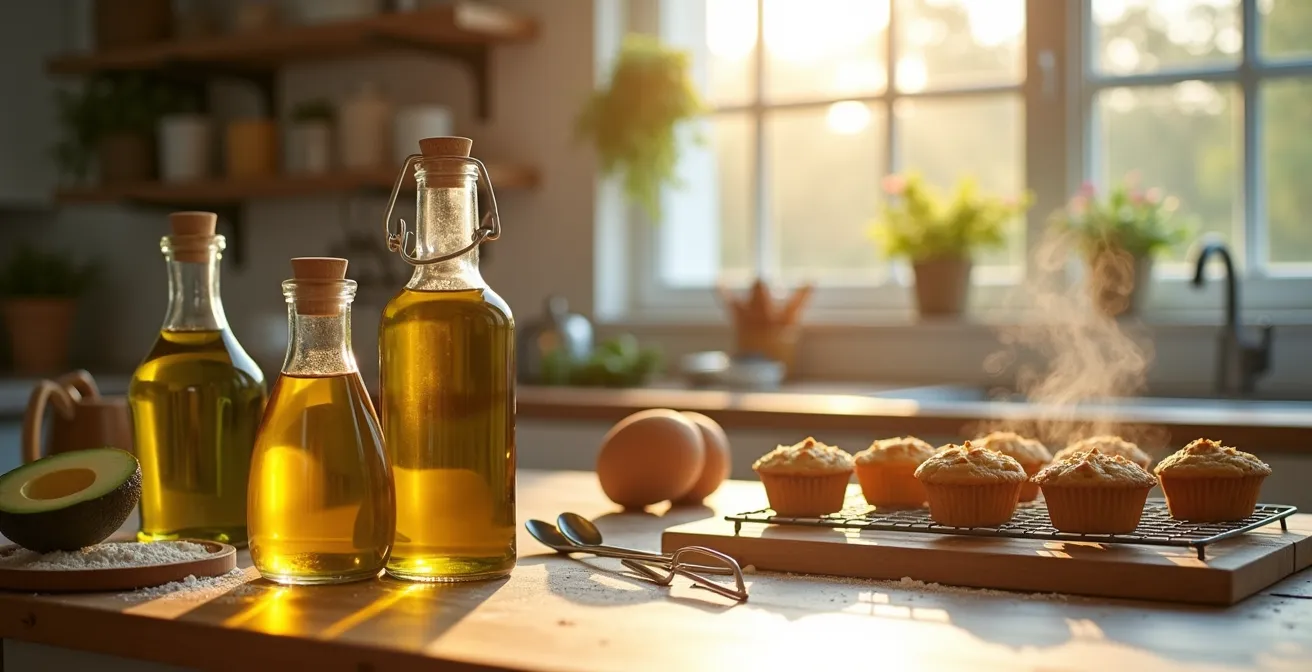
The secret to heart-healthy baking that doesn’t sacrifice texture lies in understanding the science of fat—specifically, how to replicate butter’s structural magic with the right plant oils.
- Replacing saturated animal fats with monounsaturated fats from oils like avocado directly benefits cardiovascular health by improving cholesterol profiles.
- Achieving flaky pastries or chewy cookies with oil requires compensating for butter’s water content and its ability to trap air, using techniques like whipping eggs and adjusting leaveners.
Recommendation: Start by substituting 75% of the butter with a high-quality, neutral plant oil in a simple cookie recipe to see and taste the difference in moisture and texture firsthand.
For home bakers passionate about both health and flavour, the quest to replace saturated animal fats like butter with healthier plant oils can feel like a compromise. We’re often told it’s a simple switch, yet the results can be disappointing: cookies that spread into thin, greasy crisps and pastries that lack that signature flaky, delicate structure. The common advice to just “use oil” or add applesauce often ignores the fundamental role fat plays in creating texture, leaving us to believe that heart-healthy treats are destined to be inferior.
This frustration stems from a misunderstanding of what butter actually does. It’s not just a fat; it’s an engine for texture, providing structure through aeration when creamed with sugar and creating flaky layers through its solid-state emulsion of fat and water. Simply pouring in liquid oil, which is 100% fat, breaks this delicate system. But what if the key wasn’t a direct substitution, but a strategic reconstruction? What if we could use the science of fats to our advantage, choosing specific plant oils and adjusting our techniques to build back that coveted texture, creating baked goods that are not only better for our hearts but also delightfully moist and tender?
This guide will move beyond simple conversion charts. We will delve into the science of why these swaps work and sometimes fail. We’ll explore which oils are best for different applications, from high-heat pastry to delicate cookies, and how to master the techniques that ensure your heart-healthy creations are a textural triumph every time. Get ready to turn your kitchen into a laboratory for delicious, guilt-free baking.
This comprehensive guide breaks down the science and technique of successfully substituting plant oils for animal fats. Below is a summary of the key areas we will explore to help you master heart-healthy baking without compromising on texture or taste.
Summary: The Baker’s Guide to Swapping Animal Fats for Plant Oils
- Why Replacing Butter with Avocado Oil Reduces Cardiovascular Risk?
- How to Use Coconut Oil Without Exceeding Saturated Fat Limits?
- Butter vs. Vegan Block vs. Oil: Which Creates the Best Croissant Flakes?
- The Texture Mistake When Using Liquid Oil in Cookie Recipes
- Which Plant Fat to Use for High-Temperature Pastry Baking?
- The Science of Vegan Baking: Replacing Eggs Without Flops
- Lowering Cholesterol Levels Naturally: Which Plant Sterols Actually Work?
- Using Ground Flaxseeds: The Omega-3 Powerhouse and Binder
Why Replacing Butter with Avocado Oil Reduces Cardiovascular Risk?
The primary health motivation for swapping butter with a plant oil like avocado oil comes down to their dramatically different lipid profiles. Butter is rich in saturated fats, which are known to raise levels of low-density lipoprotein (LDL), often called “bad” cholesterol. High LDL cholesterol is a major risk factor for atherosclerosis, the hardening and narrowing of the arteries that can lead to heart attacks and strokes. The switch is about more than just avoiding something “bad”; it’s about actively introducing something beneficial.
Avocado oil, in contrast, is predominantly composed of monounsaturated fats, specifically oleic acid. This type of fat has a dual benefit for heart health: it helps lower LDL cholesterol while simultaneously maintaining or even increasing high-density lipoprotein (HDL), the “good” cholesterol that helps remove excess cholesterol from the bloodstream. By making this simple swap, you are fundamentally altering the fatty acid composition of your diet in a way that actively supports a healthier cardiovascular system.
Furthermore, avocado oil is a source of antioxidants like vitamin E, which help combat oxidative stress in the body—another factor implicated in cardiovascular disease. Unlike butter, which contains dietary cholesterol, plant oils are naturally cholesterol-free. This shift away from saturated fats and dietary cholesterol toward beneficial monounsaturated fats is a powerful, evidence-based strategy for creating baked goods that are not just treats, but active contributors to long-term heart health.
How to Use Coconut Oil Without Exceeding Saturated Fat Limits?
Coconut oil is often touted as a healthy baking alternative, but its use requires a precise and informed approach. While it is a plant-based fat, it is unique in that it’s very high in saturated fat—even more so than butter by weight. The key to its perceived health benefits lies in the *type* of saturated fats it contains: Medium-Chain Triglycerides (MCTs). Unlike the long-chain triglycerides (LCTs) found in butter and other animal fats, MCTs are metabolized differently. They are transported directly to the liver, where they are more readily converted into energy, much like carbohydrates.
However, it’s a common misconception that coconut oil is pure MCT oil. In reality, a nutritional analysis reveals that coconut oil contains about 54% MCTs, with a large portion of that being lauric acid. Lauric acid is a controversial fatty acid, as it behaves somewhere between an MCT and an LCT in the body, and it can raise both LDL (“bad”) and HDL (“good”) cholesterol. Therefore, using coconut oil indiscriminately can still contribute significantly to your daily saturated fat intake.
The key is moderation and strategic use. Use refined coconut oil for its neutral flavor and solid-at-room-temperature properties, which can mimic butter in recipes for shortbread or flaky pie crusts. To keep saturated fat in check, consider using a blend of fats. For instance, replace half the butter with coconut oil and the other half with a monounsaturated-rich oil like avocado oil. This approach, often called “mouthfeel engineering,” gives you the structural benefits of a solid fat while improving the overall lipid profile of your baked good.
| Fat Type | MCT Content | Lauric Acid | Metabolism Speed |
|---|---|---|---|
| Coconut Oil | 54% | 49% | Moderate (lauric acts like LCT) |
| MCT Oil | 100% | Minimal | Rapid liver metabolism |
| Butter | <5% | 3% | Slow (mostly LCTs) |
| Palm Kernel Oil | 50% | 48% | Moderate |
Butter vs. Vegan Block vs. Oil: Which Creates the Best Croissant Flakes?
Creating the delicate, flaky layers of a croissant is the ultimate test of a fat’s performance, and it hinges on the science of lamination. This process involves folding a sheet of cold, solid fat into dough multiple times. When baked, the fat melts and the water within it turns to steam, pushing the dough layers apart to create hundreds of airy pockets. This is why liquid oil, which is 100% fat and contains no water, is a disastrous choice for laminated doughs—there is no steam to create lift, resulting in a dense, greasy pastry.
This is explained perfectly by baking experts. As Mary’s Test Kitchen notes in her guide on the topic:
Dairy butter is actually an emulsion of fat, protein and water. When raw croissant dough is baked, the fat melts and the water turns to steam, lifting the layers apart and creating that classic croissant flaky texture
– Mary’s Test Kitchen, How to Make Vegan Croissants Guide
So, if liquid oil is out, what about solid plant-based fats? This is where modern vegan butter blocks shine. These are engineered emulsions of plant oils, water, and emulsifiers designed to have a melting point and plasticity similar to dairy butter. They provide both the solid fat needed for layering and the water content required for steam-powered lift.

Case Study: King Arthur Baking’s Vegan Butter Trials
In a direct comparison, King Arthur Baking tested puff pastry using dairy butter against vegan butters like Earth Balance and Miyoko’s Kitchen Cultured Vegan Butter. The results were remarkable: all three produced beautifully browned pastries with distinct, high-rising layers and a light, flaky texture. An unexpected benefit was that the slightly softer texture of the vegan butters made the rolling and folding process easier and less prone to cracking. While the dairy butter offered a slightly richer flavor from caramelized milk solids, the vegan alternatives proved they could create an equally impressive flaky structure, making them a superb choice for heart-healthy lamination.
The Texture Mistake When Using Liquid Oil in Cookie Recipes
One of the most common disappointments when substituting oil for butter in cookies is a flat, greasy final product. This failure is rooted in a fundamental misunderstanding of butter’s dual role in a cookie recipe. It’s not just a fat; it’s a key player in both aeration and structure. The classic “creaming method,” where solid butter and sugar are beaten together, is a mechanical process that creates thousands of tiny air pockets. These pockets are held in place by butter’s crystalline structure and expand during baking, providing lift and a tender crumb.
Liquid oil cannot be creamed. It has no solid structure to trap air. When you simply stir oil and sugar together, you are only dissolving the sugar, not creating any aeration. This is the primary reason oil-based cookies often bake flat. Furthermore, the composition is different; an understanding of composition reveals that butter is only about 80% fat, with the remaining 20% being water and milk solids. Oil is 100% fat. Using a 1:1 swap introduces too much fat and not enough water, leading to excessive spread and a greasy mouthfeel.
To succeed with oil, you must re-engineer the recipe to build back that lost aeration and adjust for the higher fat content. This involves shifting the aeration role from the fat to the eggs. By whipping eggs and sugar together until they are pale and thick (the “ribbon stage”), you incorporate the air that the butter would have provided. This structural change is the secret to achieving chewy, well-risen cookies with the moist, tender crumb that oil provides. It’s not a simple swap, but a change in technique.
Your Action Plan: Auditing Your Oil-for-Butter Cookie Conversion
- Initial Ratio: Start by reducing the oil amount. A good rule of thumb is to use ¾ cup of oil for every 1 cup of butter, accounting for butter’s 20% water content.
- Aeration Method: Ditch the creaming method. Instead, whip your eggs and sugar together for 2-3 minutes until they form a thick, pale ribbon. This is your new leavening engine.
- Leavening Boost: Increase your chemical leaveners (baking soda/powder) by about 25% to provide extra lift that compensates for the lack of aeration from fat.
- Dough Hydration: If the dough seems too dry after adjusting the fat, add a tablespoon or two of milk or water to replicate the moisture lost from the butter.
- Chill Time: Always chill oil-based cookie dough for at least 1-2 hours. This solidifies the fats and helps prevent the cookies from spreading too quickly in the oven.
Which Plant Fat to Use for High-Temperature Pastry Baking?
When baking pastries at high temperatures, the stability of your chosen fat is paramount. Many bakers focus solely on an oil’s “smoke point,” the temperature at which it begins to burn and produce smoke. While important, a more critical factor for baking quality and health is oxidative stability. This refers to how resistant an oil is to breaking down and forming harmful compounds when exposed to heat, light, and oxygen. Oils high in unstable polyunsaturated fats (like grapeseed or standard sunflower oil) can oxidize quickly during baking, producing off-flavors and free radicals.
For high-temperature applications like puff pastry, pies, or choux, the ideal plant fat is one with both a high smoke point and high oxidative stability. Refined avocado oil is the gold standard, boasting a smoke point over 500°F and excellent stability due to its high monounsaturated fat content. High-oleic sunflower oil and light olive oil are also excellent, stable choices. Coconut oil has moderate stability due to its saturated nature but a lower smoke point, making it better for medium-temperature bakes.
Choosing the right oil ensures your pastries are golden brown and delicious, not scorched or carrying a rancid taste. It also means you are not inadvertently creating unhealthy compounds during the baking process. The goal is to match the oil’s properties to the demands of the recipe, ensuring a perfect, heart-healthy result every time.
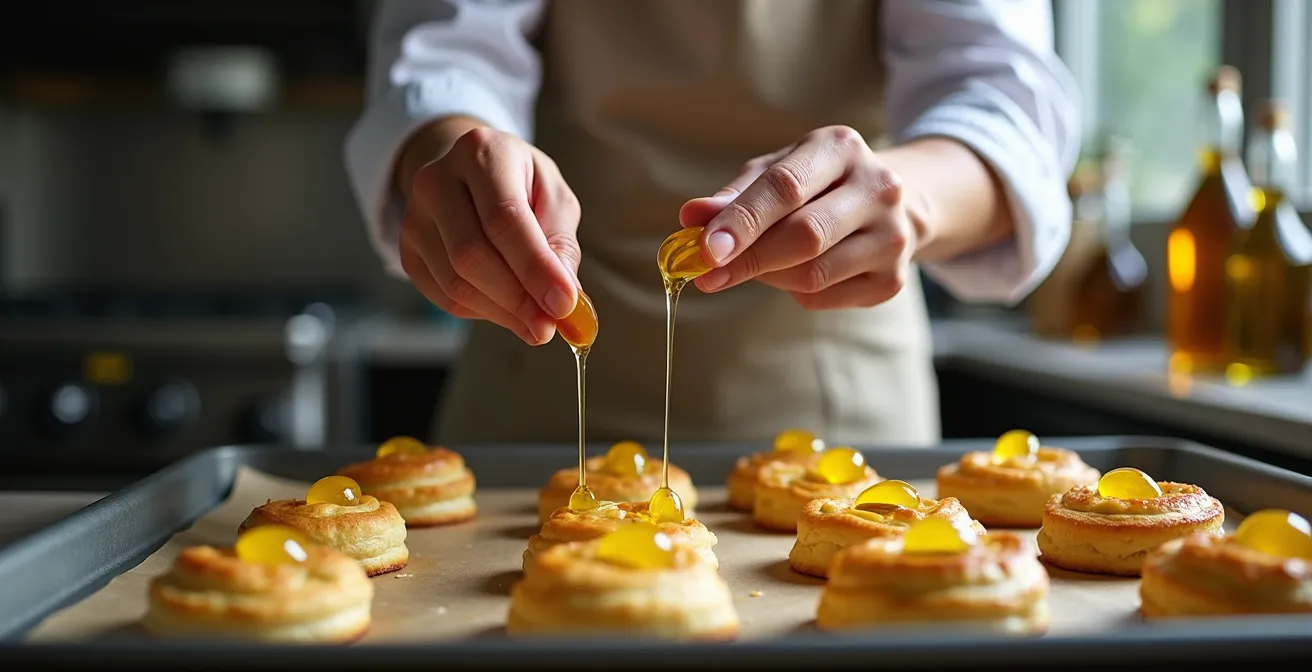
Advanced bakers and professional kitchens are even pushing the boundaries further. Some now use technical ingredients like hydrocolloid-protein mixtures (guar gum, konjac) to create stable emulsions that allow for a significant reduction in total oil content while actually improving moisture and texture, proving that fat reduction doesn’t have to mean a compromise on quality.
| Oil Type | Smoke Point | Oxidative Stability | Best Use |
|---|---|---|---|
| Avocado Oil | 520°F | Very High | All high-temp baking |
| High-Oleic Sunflower | 450°F | High | Pastries, cookies |
| Light Olive Oil | 465°F | High | Savory pastries |
| Coconut Oil | 350°F | Moderate (saturated) | Medium-temp baking |
| Grapeseed Oil | 420°F | Low (polyunsaturated) | Quick bakes only |
The Science of Vegan Baking: Replacing Eggs Without Flops
Successfully creating heart-healthy, plant-based baked goods often involves more than just swapping fats; it frequently requires replacing eggs as well. Eggs are multifunctional powerhouses in baking, providing binding, leavening, moisture, and richness. Replacing them effectively requires understanding which function is most critical for a given recipe and how that interacts with your choice of fat. A liquid-oil-based cake, for example, has different needs than a solid-fat-based scone.
For binding in oil-based recipes, a “flax egg” (one tablespoon of ground flaxseed mixed with three tablespoons of water) is a fantastic option. The mixture forms a gel that mimics the binding properties of an egg white and adds valuable omega-3 fatty acids and fiber. For leavening and a lighter texture, aquafaba (the liquid from a can of chickpeas) is revolutionary. It can be whipped into a meringue-like foam, perfect for airy cakes or mousses. Often, the best results come from combining replacers: using a flax egg for structure and a touch of vinegar reacting with baking soda for extra chemical lift.
This holistic approach to substitution is not just about making a recipe vegan; it’s about building a healthier final product from the ground up. Each swap is an opportunity to introduce beneficial nutrients. The effort is well worth it, as the long-term health benefits of shifting towards plant-based ingredients are significant. In fact, a major JAMA Internal Medicine study found substituting just 10 grams of butter with plant oils daily was associated with a 17% lower risk of total mortality.
Lowering Cholesterol Levels Naturally: Which Plant Sterols Actually Work?
For those looking to take their heart-healthy baking to the next level, incorporating plant sterols is a scientifically-backed strategy. Plant sterols (and stanols) are compounds found naturally in small amounts in fruits, vegetables, nuts, and seeds. They have a molecular structure similar to cholesterol, and this similarity is their superpower. When consumed, they compete with dietary and biliary cholesterol for absorption in the intestine. By blocking cholesterol absorption, they help lower LDL (“bad”) cholesterol levels in the blood.
The effect is not trivial; it is clinically significant and backed by robust research. In fact, clinical guidelines recommend consuming 2 grams of plant sterols daily to achieve a meaningful reduction in LDL cholesterol, typically in the range of 5-10%. While you could get this amount from whole foods, it would require eating a very large quantity. A more practical approach for most people is to use foods that have been fortified with these compounds.
This is where baking comes in. Several sterol-fortified spreads, like Benecol or Flora ProActiv, are available and designed to be used just like butter or margarine. They can be swapped 1:1 in many recipes, from cookies to muffins to quick breads. The sterols are heat-stable, so their cholesterol-lowering efficacy is not diminished by the baking process. By using these fortified spreads, you can turn a daily treat into a functional food that actively works to improve your cardiovascular health, one delicious bite at a time.
Action Plan: Incorporating Plant Sterols Into Your Baking
- Choose a Fortified Spread: Look for products specifically marketed for cholesterol reduction, such as Benecol or similar sterol-fortified spreads, which can be used as a 1:1 butter replacement.
- Calculate Dosage: To be effective, aim for about 2g of plant sterols per day. Check the product’s nutrition label to see how much spread provides this amount, and portion your baked goods accordingly (e.g., if 2 tablespoons contain 2g, and your recipe makes 12 muffins, use 2 tablespoons of spread).
- Confirm Heat Stability: Most commercial fortified spreads use sterols that are stable at normal baking temperatures, so their effectiveness is preserved.
- Combine for Synergy: For an extra cholesterol-lowering boost, combine the use of a sterol-fortified spread with other beneficial ingredients like ground flaxseed or oats.
- Expand Beyond Baking: Remember that these spreads can also be used on toast or for sautéing vegetables, helping you easily reach your daily 2g target.
Key takeaways
- The primary benefit of swapping butter for oils like avocado oil is the replacement of LDL-raising saturated fats with LDL-lowering monounsaturated fats.
- Achieving good texture with oil requires scientific adjustments: compensating for butter’s water content and replicating its aeration function, often by whipping eggs and sugar.
- For flaky pastries, a solid plant-based butter block is superior to liquid oil because its emulsified water content creates the steam needed for lamination.
Using Ground Flaxseeds: The Omega-3 Powerhouse and Binder
In the world of healthy baking substitutions, ground flaxseed is a true multitasking champion. While often used to create “flax eggs” for binding, its benefits extend far beyond simply holding a recipe together. Flaxseeds are one of the richest plant-based sources of alpha-linolenic acid (ALA), a type of omega-3 fatty acid. This essential fat plays a crucial role in heart health by reducing inflammation, improving blood vessel function, and contributing to a healthier cholesterol profile.
When you incorporate ground flaxseed into your baking, you are not just replacing a fat or an egg; you are infusing your creation with a potent, heart-protective nutrient. It’s a powerful way to add functional value. A single tablespoon of ground flaxseed contains approximately 1.6 grams of ALA, a significant portion of the recommended daily intake. Unlike some other healthy ingredients, flax has a mild, nutty flavor that is easily incorporated into a wide variety of baked goods, from muffins and breads to cookies and pancakes.
Beyond its omega-3 content, flaxseed is also an excellent source of both soluble and insoluble fiber, which aids in digestion and helps regulate blood sugar levels by slowing the absorption of carbohydrates. This can help prevent the blood sugar spikes often associated with sweet treats. When considering your toolkit for healthy substitutions, think of ground flaxseed not just as a binder, but as a nutritional powerhouse that can elevate the health profile of almost any recipe.
| Fat Source | ALA Omega-3 per Tbsp | Additional Benefits | Recipe Adjustment |
|---|---|---|---|
| Ground Flaxseed | 1.6g | Fiber, lignans, binding | Reduce oil by 1-2 tsp per flax egg |
| Chia Seeds | 2.5g | Gel formation, calcium | Use 1:3 with water |
| Walnut Oil | 1.4g | Vitamin E, flavor | 1:1 oil replacement |
| Hemp Hearts | 1.0g | Complete protein | Add 2 tbsp per cup flour |
By understanding the science behind each ingredient, you can move from simply swapping fats to intelligently engineering delicious, heart-healthy baked goods with superior texture and nutritional value. Start your next baking project not with hesitation, but with the confidence of an informed and creative baker.
Frequently Asked Questions on How to Swap Saturated Animal Fats for Healthy Plant Oils in Baking?
Which egg replacer works best with liquid oils?
For oil-based cakes, a robust combination often yields the best results. Try blending 2-4 tablespoons of nut butter with 1-3 dates and a bit of applesauce. This creates both binding and adds healthy fat, while the dates boost sweetness to compensate for the reduced richness from butter. It’s best to blend all wet ingredients, including this mixture, until completely smooth before combining with dry ingredients.
How does the choice of fat affect egg replacement?
The type of fat is critical. Liquid oil-based batters are inherently less stable and require stronger binders. A flax egg (1 tbsp ground flax + 3 tbsp water per egg) is excellent here as it provides structure. Conversely, recipes using solid fats (like vegan butter or coconut oil) are more structurally sound and work better with lighter replacers like aquafaba, which can maintain airiness without adding density.
Can I combine multiple egg replacers?
Yes, combining replacers is an advanced technique that often produces superior results. You can use different replacers to perform different jobs in the same recipe. For example, use a flax egg for its strong binding properties, add whipped aquafaba for lift and airiness, and include a small amount of vinegar reacting with baking soda for an extra chemical leavening boost. This multi-pronged approach helps replicate the complex functions of a real egg.