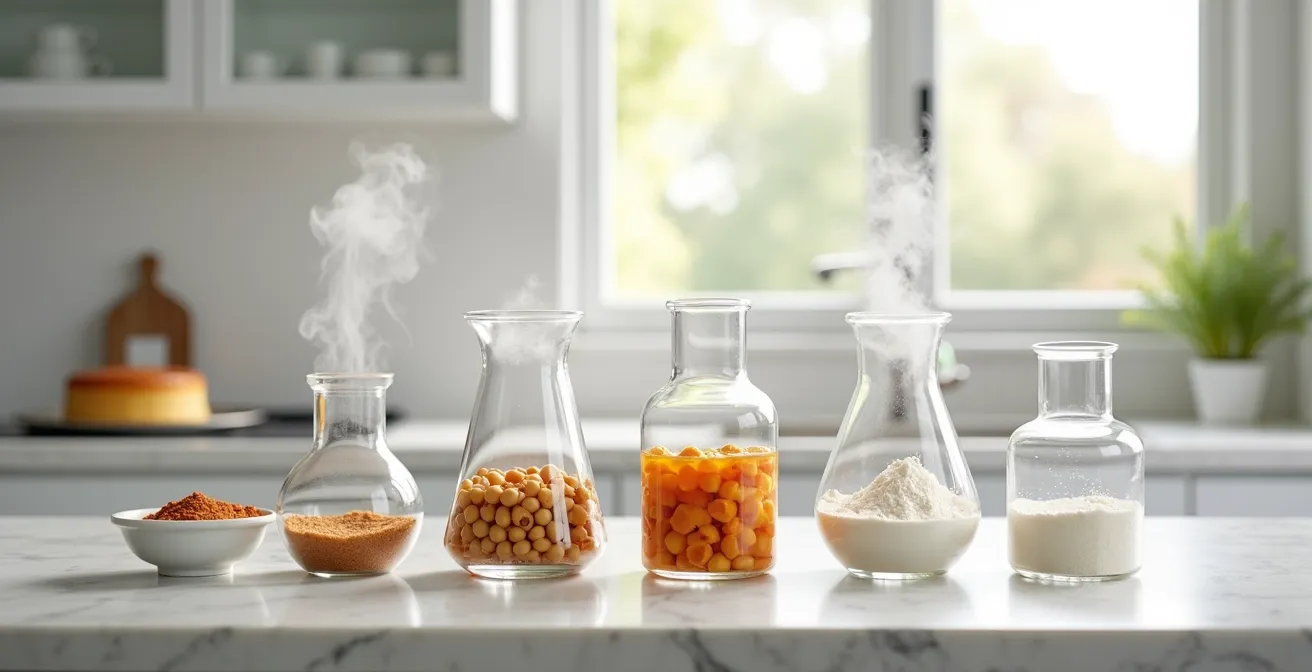
In summary:
- Successful vegan baking requires deconstructing an egg’s functions (binding, leavening, fat, structure) and rebuilding them with specific ingredients.
- Gumminess is often caused by over-developed gluten in lean batters; mix just until combined.
- Chemical leavening (baking soda + acid) is crucial for creating lift in the absence of egg proteins.
- The final structure of a vegan cake forms during cooling through a process called starch retrogradation; slicing it warm will cause it to collapse.
- Fat choice is critical: oil creates a moister, more tender crumb, while vegan butter provides flavour and a slightly sturdier texture.
The journey into vegan baking often begins with optimism, followed by a series of frustrating collapses. You follow the recipe meticulously, swap the eggs for applesauce or a flax egg, and pull a cake from the oven that looks promising, only for it to be dense, gummy, or disappointingly flat. This experience is common, and it leads many home bakers to believe that achieving a light, tender crumb without eggs or dairy is a matter of luck or some elusive, magical substitute.
The conventional advice—simple lists of one-to-one egg replacements—oversimplifies a complex chemical process. An egg is not a single ingredient; it is a multi-functional system providing leavening, binding, emulsification, fat, and structure. Simply removing it leaves a void that no single plant-based ingredient can perfectly fill. The result is often a structural failure, a problem compounded when bakers also attempt to create gluten-free versions, which introduces its own set of textural challenges.
The key to success, however, is not in finding a miracle replacer. It lies in understanding the fundamental chemistry at play. This is where we shift our perspective from a cook to a pastry chemist. Instead of asking “what can I use instead of an egg?”, we must ask, “which chemical and physical functions of the egg do I need to replicate, and how can I rebuild them with precision?”
This guide will deconstruct the science behind common vegan baking failures. We will explore the precise reactions needed for leavening, the molecular changes that create structure, and the role of fats in developing the perfect crumb. By understanding the ‘why’ behind each technique, you can move beyond guesswork and begin engineering consistently successful vegan cakes.
Summary: The Science of Vegan Baking: Replacing Eggs Without Flops
- Why You Must Mix Vegan Batter Differently to avoid Gumminess?
- Baking Soda and Vinegar: How to Create Lift Without Eggs?
- The Density Risk: Why Vegan Cakes Are Often Heavy?
- Oil vs. Vegan Butter: Which Creates a Better Crumb Structure?
- Why Vegan Cakes Must Cool Completely Before Slicing?
- How to Swap Saturated Animal Fats for Healthy Plant Oils in Baking?
- Using Ground Flaxseeds: The Omega-3 Powerhouse and Binder
- Using Ground Flaxseeds: The Omega-3 Powerhouse and Binder
Why You Must Mix Vegan Batter Differently to avoid Gumminess?
One of the most common complaints about vegan cakes is a dense, chewy, or gummy texture. This textural flaw is almost always a direct result of over-developed gluten. In traditional baking, egg yolks and butter coat flour proteins, inhibiting the formation of long, elastic gluten strands. This “shortening” effect is what creates a tender, delicate crumb. Vegan batters, however, are often leaner, containing more water and less fat. This aqueous environment is the perfect breeding ground for gluten development.
When you mix flour with water, the proteins glutenin and gliadin link together to form an elastic network: gluten. The more you mix, the stronger and more extensive this network becomes. While this is desirable for chewy bread, it is the enemy of a tender cake. Without the protective barrier of animal fats and the structural interference from egg proteins, every stir of a vegan batter encourages these gluten strands to form and toughen.
The solution is a fundamental shift in mixing technique. You must adopt a minimalist approach. The “muffin method” is ideal: mix your wet ingredients in one bowl and your dry ingredients in another. Then, gently fold the wet into the dry, mixing just until the last streak of flour disappears. Lumps are acceptable and, in fact, desirable—they are a sign that you have not over-worked the batter. Resisting the urge to mix until smooth is the first and most critical step in preventing gumminess.
Baking Soda and Vinegar: How to Create Lift Without Eggs?
Eggs provide significant leavening in traditional baking. When beaten, egg whites trap air, and when heated, the water in both the yolk and white turns to steam, pushing the batter upwards. To replicate this powerful lift without eggs, vegan baking relies on pure chemistry: the acid-base reaction. This technique is the engine that powers the rise of many vegan cakes, and its precision is non-negotiable, especially as the global vegan dessert market is expanding at a 10.1% CAGR, driving innovation in these methods.
The primary players are sodium bicarbonate (baking soda), a base, and an acid, such as apple cider vinegar, lemon juice, or even the molasses in brown sugar. When the base and acid are combined in a liquid medium (the batter), they react to produce carbon dioxide (CO2) gas. These gas bubbles become trapped within the batter’s structure, and upon heating in the oven, they expand, forcing the cake to rise. This reaction begins the moment the wet and dry ingredients meet, which is why it’s critical to get the batter into the preheated oven immediately after mixing.
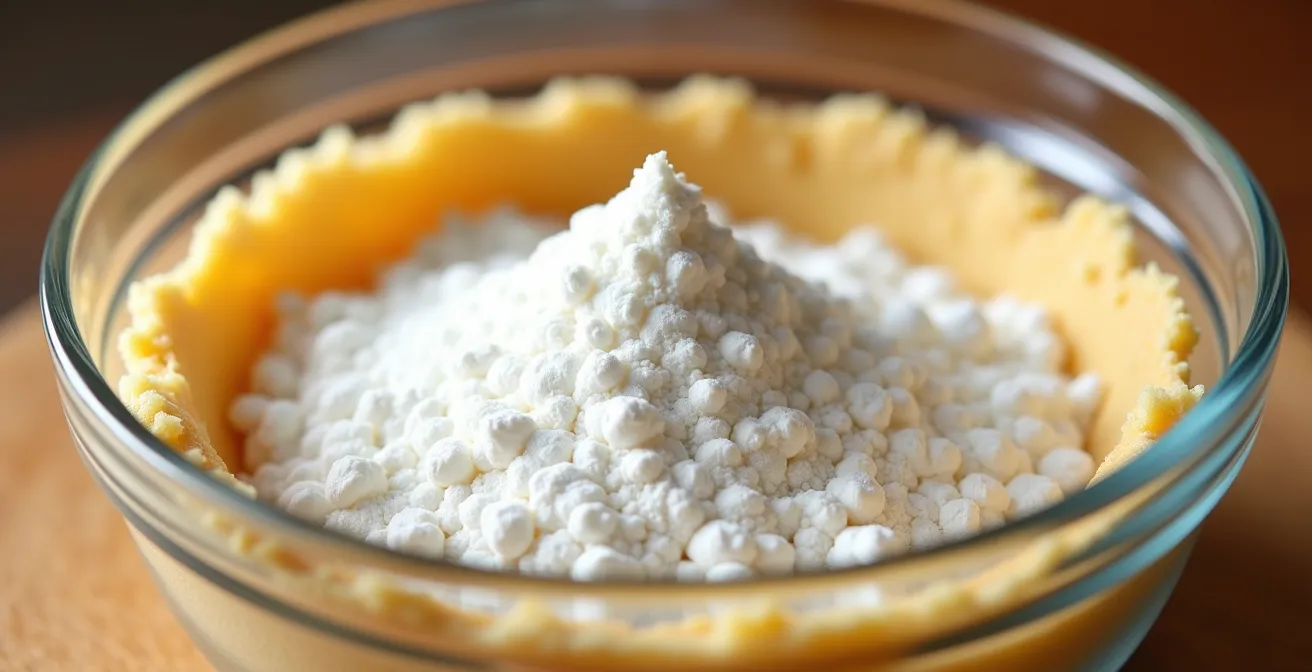
A common mistake is an imbalanced ratio, leading to a soapy or metallic taste. This indicates that there was excess baking soda that did not react with an acid. A general rule of thumb is 1/4 teaspoon of baking soda per 1 cup of flour, activated by roughly 1 teaspoon of vinegar or lemon juice. The goal is complete neutralization. For recipes calling for baking powder, remember that it already contains both a base (baking soda) and an acid, but adding a small amount of extra vinegar can provide a welcome boost to the reaction, ensuring a lighter, more aerated final product.
The Density Risk: Why Vegan Cakes Are Often Heavy?
Beyond gumminess and a lack of lift, the third major hurdle in vegan baking is density. A vegan cake can feel heavy or leaden, lacking the airy structure of its conventional counterpart. This density arises from the absence of a key process: protein coagulation. When eggs are heated, their proteins denature and link together, forming a stable, semi-rigid mesh that sets the cake’s structure and traps air. Without this protein scaffolding, the cake’s structure is inherently more fragile.
Vegan binders like banana or applesauce add moisture and some binding power, but they are primarily composed of sugars, water, and pectin. They do not undergo the same structural transformation as egg proteins. This means the batter relies much more heavily on the gluten network and the setting of starches to create its final form. If the leavening is not powerful enough or the batter is too wet, gravity wins, and the structure collapses on itself, resulting in a dense, heavy crumb.
This challenge is often magnified when bakers try to accommodate multiple dietary needs. For instance, the demand for gluten-free products is significant, as some studies show that beyond the 1% with celiac disease, 10-12% of Americans experience gluten sensitivity. A cake that is both vegan and gluten-free has lost its two primary structural components: egg protein and gluten. In this scenario, the role of starches (from the gluten-free flour blend) and hydrocolloids (like xanthan gum) becomes paramount in creating a matrix to trap air and provide structure, but the risk of a dense outcome increases substantially.
Oil vs. Vegan Butter: Which Creates a Better Crumb Structure?
Fat is not just a flavour carrier; it is a primary architect of a cake’s crumb structure. It works by coating flour particles, inhibiting gluten development and creating a tender texture. In vegan baking, the choice between liquid fat (oil) and solid fat (vegan butter or margarine) has a profound and predictable impact on the final product.
Oil, being 100% fat, is a superior tenderizer. It coats flour more effectively than vegan butter, which contains water and other solids. This results in a cake with a very fine, moist, and tender crumb. Because oil is liquid at room temperature, cakes made with it will feel moister and stay softer for longer. Canola, sunflower, or light olive oil are excellent neutral choices that will not overpower other flavours. The downside of oil is that it provides no leavening assistance. It simply adds richness and tenderness.
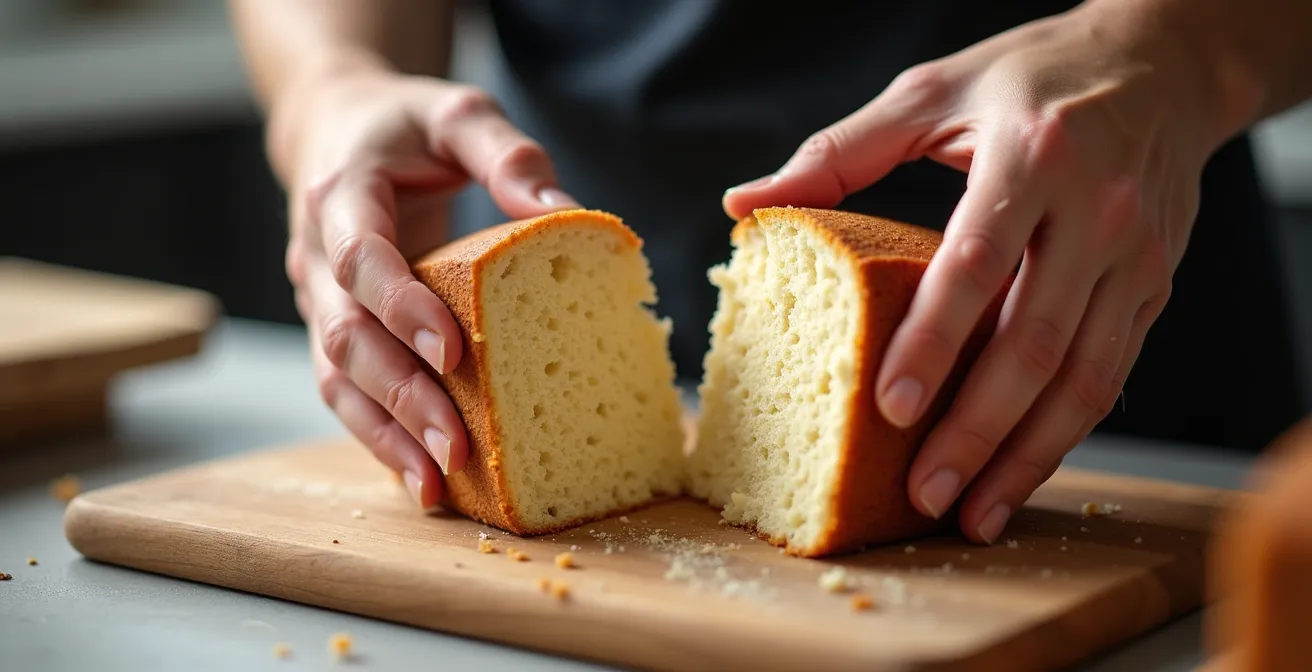
Vegan butter, on the other hand, functions more like traditional dairy butter. It can be “creamed” with sugar. This mechanical process incorporates tiny air pockets into the fat, which contribute to leavening when the cake bakes. The water content in vegan butter also turns to steam, providing additional lift. The resulting crumb is typically a little less tender than an oil-based cake but is often perceived as more “cake-like” or “sturdy,” with a flavour profile many associate with classic baking. For a light and fluffy texture with good flavour, creaming vegan butter is the way to go. For the most moist and tender crumb possible, oil is the superior choice.
Why Vegan Cakes Must Cool Completely Before Slicing?
The final, and perhaps most violated, rule of vegan baking is the mandate for complete cooling. A baker’s patience is tested as a fragrant, beautiful cake sits on the counter, but slicing into it while still warm is a recipe for disaster. While a traditional cake with eggs is robust enough to handle being served warm, a vegan cake is a different chemical entity. Its structural integrity is not fully established until it reaches room temperature.
As discussed, a vegan cake lacks the rigid, heat-set protein network provided by eggs. Its structure is primarily derived from the gelatinization and subsequent setting of starches from the flour. When the cake is hot, these starches are swollen, soft, and fragile. The fats are in a liquid state, and the sugars are molten. The entire matrix is delicate and unstable. Slicing into it at this stage will cause the delicate air pockets to collapse under the pressure of the knife, resulting in a gummy, compressed texture.
As the cake cools, a crucial process called starch retrogradation occurs. The starch molecules begin to recrystallize and align themselves into an ordered, semi-rigid structure. The fats solidify, and the sugars firm up. Together, these processes lock the cake’s crumb into its final, stable form. This is the point at which the cake achieves its intended texture and can be sliced cleanly without compressing. Allowing a vegan cake to cool completely is not merely a suggestion; it is the final, non-negotiable step of the baking process itself.
This principle is clearly demonstrated when comparing the structural components of different cake types. An analysis from Science ATL highlights this critical distinction.
| Cake Type | Structural Support | Cooling Requirement |
|---|---|---|
| Traditional (with eggs) | Coagulated egg proteins provide immediate structure | Can be handled warm |
| Vegan | Relies on starch retrogradation and fat solidification | Must cool completely |
As this comparative analysis shows, patience is a key ingredient in vegan baking success.
How to Swap Saturated Animal Fats for Healthy Plant Oils in Baking?
Replacing saturated animal fats like butter with healthier plant-based oils is not a simple one-to-one substitution. It requires a chemical understanding of how different fats behave. Butter is approximately 80% fat, with the remaining 20% being water and milk solids. Most plant oils, however, are 100% fat. This difference in composition directly affects moisture and texture.
When substituting oil for butter in a recipe, you must account for this difference. A common guideline is to use about 3/4 of the amount of oil for the amount of butter called for. For example, if a recipe requires 1 cup of butter, start by using 3/4 cup of oil. Because you are also removing the water content from the butter, you may need to add a small amount of extra liquid (1-2 tablespoons of plant milk or water per 1/2 cup of oil) to maintain the batter’s hydration.
The type of oil also matters. For delicate cakes and pastries, a neutral oil like sunflower, grapeseed, or canola is ideal as it will not interfere with the primary flavours. For richer recipes like chocolate or spice cakes, an oil with more character, like a light olive oil or melted coconut oil, can add a complementary flavour note. However, be mindful of smoke points; while less critical in a contained bake, using an oil far beyond its smoke point can produce off-flavours. The goal is to choose an oil that provides the desired tenderness without disrupting the flavour profile of the final product.
Key takeaways
- Vegan baking success is a matter of chemistry, not magic; focus on replacing the functions of an egg, not just the egg itself.
- The texture of a vegan cake is determined by a trifecta of factors: minimal gluten development, precise chemical leavening, and proper fat selection.
- Patience is a critical ingredient: vegan batters must be mixed minimally to avoid gumminess and cooled completely to allow the starches to set the final structure.
Using Ground Flaxseeds: The Omega-3 Powerhouse and Binder
Among the pantheon of egg replacers, ground flaxseed holds a preeminent position, primarily for its exceptional binding capabilities. When mixed with water, the hull of the flaxseed releases soluble fibers known as mucilage. This substance forms a thick, viscous gel that effectively mimics the binding and emulsifying properties of an egg white, holding the batter together and preventing it from becoming crumbly.
The standard ratio for a “flax egg” is one tablespoon of finely ground flaxseed to three tablespoons of water. It is crucial to let this mixture sit for 5 to 10 minutes to allow the mucilage to fully hydrate and thicken. This resulting gel can then be added to recipes for muffins, cookies, and dense cakes where its primary role is to bind the ingredients and provide moisture. The brown colour and nutty flavour of flax can affect the final product, making it best suited for whole-grain or spiced bakes rather than light, white vanilla cakes.
While an excellent binder, a flax egg does not provide the leavening power of a real egg. It adds density, not lift. Therefore, it must be used in recipes that have another primary leavening agent, such as the baking soda and vinegar reaction. Its strength lies in its ability to create structure and cohesion in batters that might otherwise fall apart, making it an indispensable tool in the vegan baker’s chemical arsenal.
Using Ground Flaxseeds: The Omega-3 Powerhouse and Binder
Beyond its structural role as a binder, flaxseed is celebrated for its nutritional profile, specifically as one of the richest plant-based sources of alpha-linolenic acid (ALA), a vital omega-3 fatty acid. This makes it a functional ingredient that adds significant health value to baked goods. However, these polyunsaturated fats are delicate and highly susceptible to oxidation when exposed to heat, light, and air, which can diminish their nutritional benefits and produce off-flavours.
The ALA content in flaxseed is substantial; in fact, studies show ALA content in linseed oil ranges from 34.1% to 63.0%, a remarkable concentration. To protect these valuable fatty acids during the baking process, several precautions must be taken. The most important is using freshly ground flaxseed. Pre-ground flax has a larger surface area exposed to oxygen, accelerating degradation. Grinding whole seeds just before use is optimal.
Furthermore, storage is key. Both whole and ground flaxseeds should be stored in an airtight, opaque container in the refrigerator or freezer to minimize exposure to the catalysts of oxidation. When incorporating them into a recipe, you are not only adding a powerful binder but also a dose of healthy fats, and taking these steps ensures you are preserving the very nutritional benefits that make flaxseed such a powerhouse ingredient.
Action Plan: Preserving Flaxseed’s Nutritional Value in Baking
- Store Properly: Keep ground flaxseed in airtight, opaque containers in the refrigerator to minimize exposure to oxygen and light.
- Grind Fresh: For maximum potency, grind whole flaxseeds in a coffee or spice grinder immediately before use. Aim to use within 2-3 days.
- Add Antioxidants: Consider including other ingredients rich in natural antioxidants, like a small amount of vitamin E oil or spices like cinnamon and cloves, to help protect the delicate omega-3s.
- Monitor Temperature: While unavoidable in baking, be aware that very high temperatures (above 180°C / 350°F) can degrade omega-3s more rapidly. Stick to the recipe’s recommended temperature.
- Assess Freshness: Before using, smell your ground flax. If it has a bitter or “off” smell, it has likely oxidized and should be discarded.
By approaching vegan baking with these chemical principles, you can move from frustrating guesswork to predictable, delicious success. The next logical step is to choose one of your favorite recipes and apply these scientific swaps to engineer your perfect vegan cake.