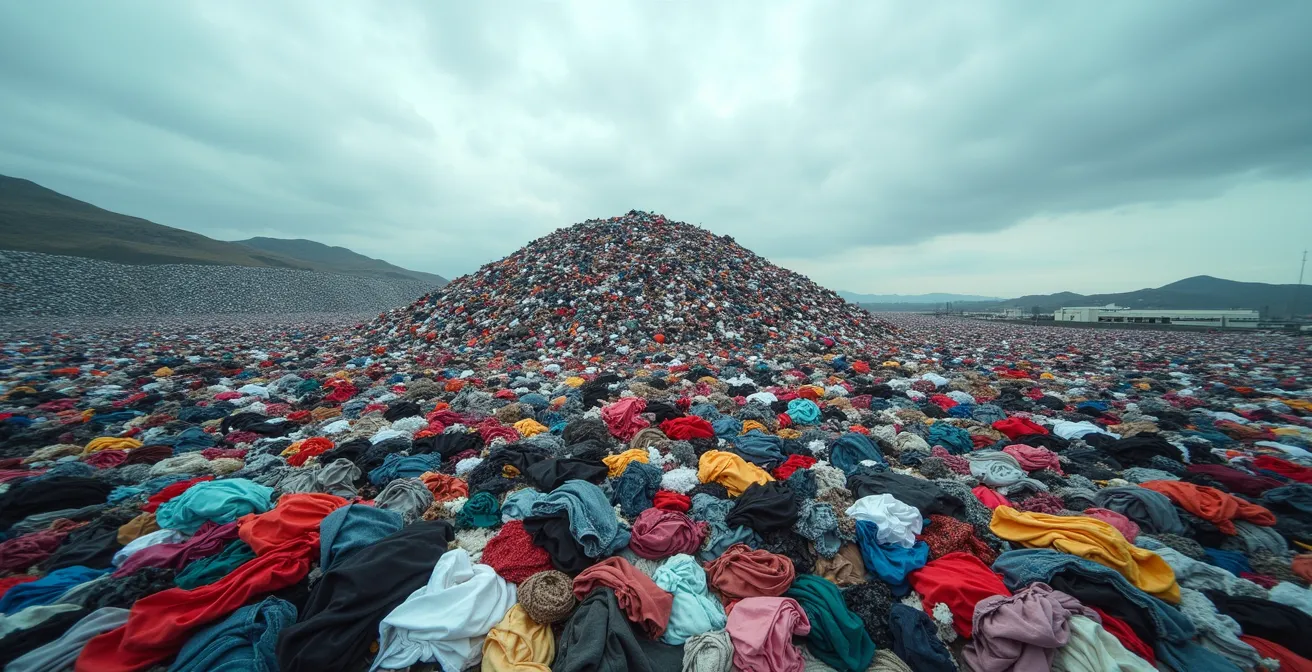
Contrary to popular belief, donating clothing is not a simple act of charity but the first step into a broken global system where most items become waste.
- The vast majority of donated clothes are not resold locally; they are bundled and traded as a low-value commodity on a saturated global market.
- Lack of recycling infrastructure and complex fabric blends mean less than 1% of clothing is truly recycled into new garments.
Recommendation: Shift your focus from mass donation to waste reduction—prioritize repairing, upcycling, and drastically reducing clothing purchases to manage your wardrobe’s end-of-life responsibly.
For decades, the ritual has been the same: you fill a large bag with clothes you no longer wear, drop it at a local charity bin, and feel a sense of virtuous relief. You’ve decluttered your space and helped someone in need. This is the comforting story we tell ourselves. But as a waste management investigator, my job is to look past the story and follow the material. The reality of that bag of clothes is far more complex and, frankly, far more grim than the donation bin sticker would have you believe.
The global system for used textiles is not a charity network; it is a high-volume, low-margin commodity industry buckling under the weight of fast fashion. Our well-intentioned donations have become a deluge, overwhelming the sorting facilities, charity shops, and recycling technologies that exist. This isn’t about blaming individuals for donating. It’s about revealing a systemic failure that turns good intentions into an environmental crisis, from overflowing landfills in the US to fabric-choked markets in the Global South. The problem isn’t the act of giving, but the sheer, unsustainable volume of what we’re trying to give away.
This report will dismantle the donation myth piece by piece. We will follow the trail of your old t-shirts and jeans to uncover the logistical and economic realities that dictate their fate. More importantly, we will shift from the illusion of donation as a solution to a new framework of responsible management, giving you the tools to stop contributing to the problem and start being part of the solution.
Summary: The Truth About Textile Waste: What Actually Happens to Donated Clothes?
- Why 85% of Donated Clothes End Up in Landfills or Incinerators?
- How to Turn T-Shirt Scraps into Cleaning Rags (No Sewing Required)?
- Recycle vs. Donate vs. Trash: A Flowchart for Your Old Clothes
- The Greenwashing Risk of H&M’s Garment Collection Boxes
- How Often Should You Buy Clothes to truly Minimize Waste?
- Sustainable Fashion on a Budget: How to Quit Fast Fashion?
- How Your Local Grocery Choices Impact Sustainable Food Systems and Carbon Footprint?
- Sustainable Fashion on a Budget: How to Quit Fast Fashion?
Why 85% of Donated Clothes End Up in Landfills or Incinerators?
The primary reason your donated clothes become waste is a simple mismatch of supply and demand. Charities are inundated with far more clothing than they can ever hope to sell in their local shops. This isn’t a minor overflow; it’s a systemic flood. The result is that a staggering 87% of materials and fibers used to make clothing end up in incinerators or landfills. This figure accounts for the entire lifecycle, but the donation system is a major contributor to this final, wasteful destination.
Once a donation bin is full, the contents are taken to a sorting facility. Here, workers face the impossible task of sifting through tons of material. Items that are stained, torn, moldy, or simply not clothing are immediately discarded as trash. This “contamination rate” can be significant. Of the remaining items, only the highest quality, most fashionable pieces—perhaps 10-20%—will make it to the sales floor of a local thrift store. The rest is bundled into massive bales and sold by weight on the global secondhand market.
This is where the system truly breaks down. These bales are often shipped to countries in the Global South, where local importers buy them blind. They might find a few sellable items, but the majority is low-quality fast fashion that no one wants. This clothing clogs local markets, outcompetes local textile industries, and ultimately ends up in massive landfills. A 2024 U.S. Government Accountability Office report confirmed this grim reality, stating that of all textile waste generated, 66 percent was landfilled, 19 percent was combusted, and only 15 percent was recycled. The report highlights that a “consistent, convenient, and widespread infrastructure” for collection and recycling simply does not exist, leaving disposal as the default option.
How to Turn T-Shirt Scraps into Cleaning Rags (No Sewing Required)?
Faced with the reality of textile waste, the most responsible action for clothing that is no longer wearable—items that are stained, torn, or hopelessly out of style—is not donation. It is upcycling. One of the simplest and most effective forms of upcycling is transforming old cotton garments, like t-shirts, into a valuable household resource: reusable cleaning cloths. This single act diverts waste from the global trash stream and reduces your reliance on disposable paper towels.
The process requires no sewing skills and minimal tools. The goal is to create a system that makes using cloth rags as convenient as reaching for a paper towel. It starts with sorting your textile “waste” by material. 100% cotton t-shirts are highly absorbent and perfect for general spills and cleaning, while old towels or denim can be used for heavy-duty scrubbing. The key is to prepare them in advance so they are ready when you need them.
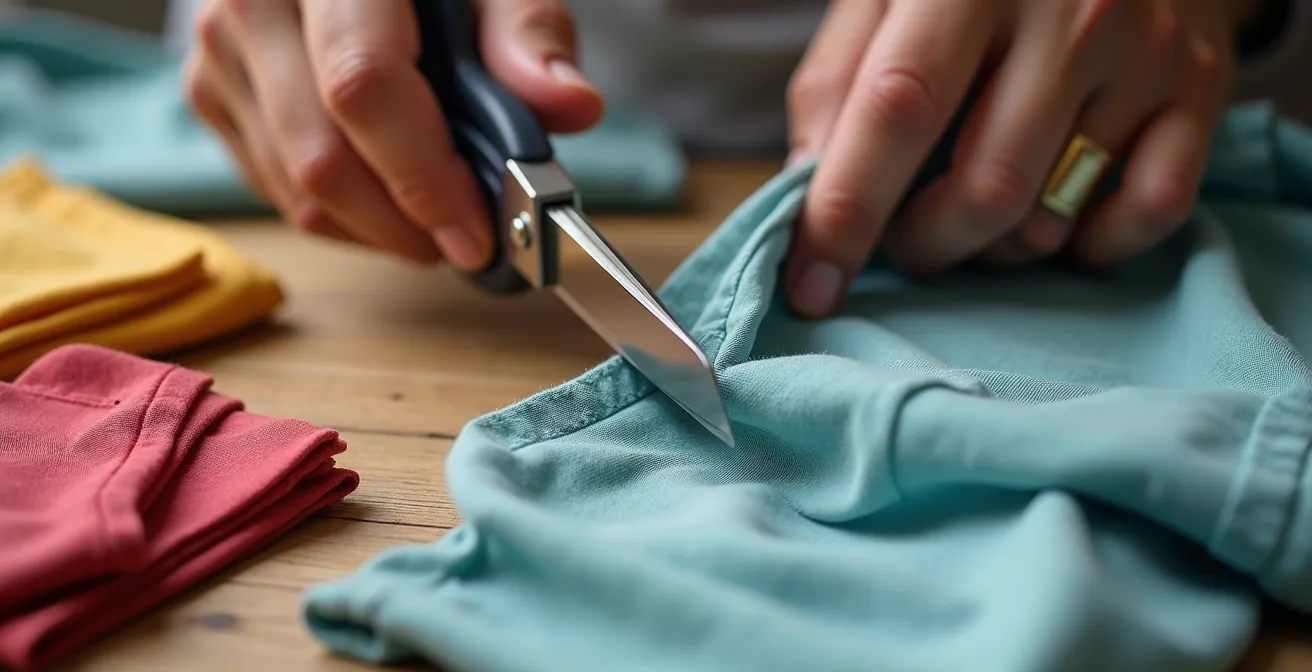
As the image above illustrates, the process is straightforward. By creating a dedicated storage and washing system, you build a sustainable habit that has a direct impact on your household waste. This is the first step in shifting your mindset from a linear “wear and discard” model to a circular “wear and repurpose” one. Every t-shirt you cut up is one less item overwhelming a sorting facility in a distant country.
Your Action Plan: From T-Shirt to Cleaning Cloth
- Sort by Fabric: Separate old t-shirts and other garments. Keep 100% cotton separate from synthetic blends, as they have different cleaning properties.
- Cut into Squares: Use sharp fabric scissors to cut the body of the shirts into uniform squares, roughly 12×12 inches. Avoid thick seams, collars, and printed graphics if possible.
- Create Storage: Designate separate, accessible baskets or containers for your new rags. For example, one for cotton cloths for the kitchen and another for microfiber cloths for dusting.
- Establish a Washing Routine: Collect used, dirty rags in a mesh laundry bag. Wash them as a dedicated load at least once a week using hot water to properly sanitize them for reuse.
- Replace and Integrate: Stack your clean, folded rags in an accessible place, such as under the kitchen sink, to make them the default choice over disposable paper towels.
Recycle vs. Donate vs. Trash: A Flowchart for Your Old Clothes
Navigating the end-of-life for your wardrobe requires a more nuanced approach than simply bagging everything for charity. Once you’ve repaired what you can and upcycled what’s unwearable, you’re left with items that still have life in them. The question becomes: what is their most responsible next destination? The answer depends entirely on the item’s condition, material, and style.
Only about 20% of clothes donated to thrift stores are actually sold through their retail outlets. The rest enters the volatile global secondhand trade or is sent for “downcycling.” True fiber-to-fiber recycling, where an old garment is turned into a new one, is exceedingly rare due to technological and economic hurdles, especially with blended fabrics like poly-cotton. Therefore, your decision-making process should be a triage system, prioritizing the highest-value reuse first.
The following decision matrix provides a clear framework for this triage. It’s designed to help you move beyond wishful thinking and make an informed choice based on the likely outcome for each type of garment. This systemic approach ensures you are not inadvertently contributing to the waste problem you are trying to solve.
| Clothing Condition | Best Option | Environmental Impact | Success Rate |
|---|---|---|---|
| Like-new, fashionable | Donate to thrift stores | Extends garment life | High (70% resold) |
| Worn but wearable | Donate to shelters/charities | Direct reuse | Moderate (40% used) |
| Stained/torn (natural fibers) | Textile recycling programs | Downcycled to insulation | Low (15% recycled) |
| Synthetic blends, damaged | Brand take-back programs | Limited recycling options | Very low (<5% recycled) |
| Completely unwearable | Specialized recyclers (TerraCycle) | Prevents landfill | Variable by location |
The Greenwashing Risk of H&M’s Garment Collection Boxes
In response to growing criticism, many fast-fashion giants have launched in-store garment collection programs, often accompanied by vouchers or discounts for future purchases. These initiatives are marketed as a responsible, circular solution, giving consumers a guilt-free way to dispose of old clothes. However, from a waste investigator’s perspective, these programs are a textbook example of greenwashing—a marketing tactic that presents a company as more environmentally friendly than it actually is.
The core issue is the gap between the marketing promise and the technological reality. Brands imply that your old t-shirt will be magically transformed into a new one. The truth is that less than 1% of collected garments are recycled into new textiles. The complex blends of fibers, dyes, and accessories (like zippers and buttons) make fiber-to-fiber recycling technically difficult and economically unviable on a large scale.
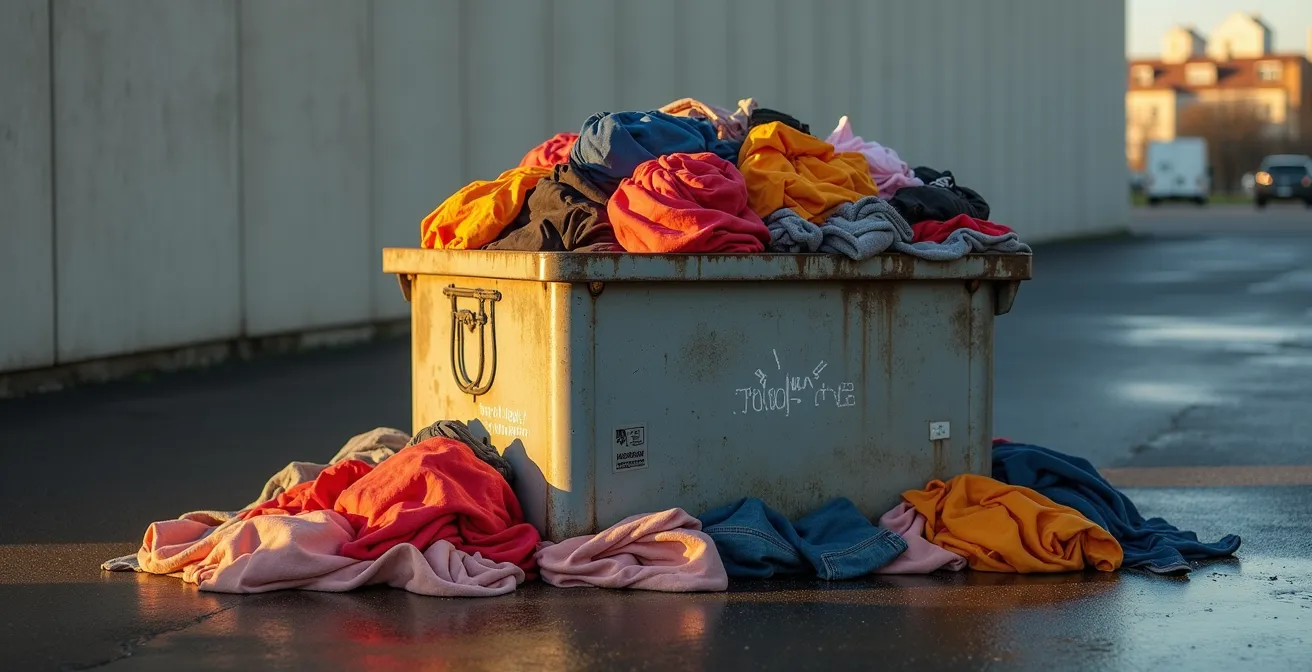
These collection boxes are less a recycling program and more a marketing campaign. They encourage continued consumption by offering discounts, fueling the very cycle of overproduction that created the waste crisis. Investigations have shown that the vast majority of what is collected follows the same path as other donations: it is sold to third-party sorters, exported, or landfilled. An analysis on fast fashion waste highlights the scale, noting that of 100 billion garments produced annually, 92 million tonnes end up in landfills. That is the equivalent of a garbage truck of clothes being landfilled every single second. The take-back box does little to change this devastating equation; it merely masks it behind a green facade.
How Often Should You Buy Clothes to truly Minimize Waste?
The most effective way to address the textile waste crisis is not by finding better ways to dispose of clothes, but by drastically reducing the number of clothes we acquire in the first place. The problem is one of volume. The fast fashion business model, built on micro-trends and low-quality production, has fundamentally altered our relationship with clothing. We buy more and wear it less than any previous generation.
The data is stark: on average, consumers buy 60% more clothing than 15 years ago but wear items 50% less often. This behavior is the engine driving the entire waste stream. Garments are no longer seen as durable goods but as disposable items. To truly minimize waste, the focus must shift from disposal management to consumption management. This involves a conscious and deliberate decision to slow down, buy less, and choose better.
There is no magic number for how many items you should buy per year. The goal is a radical reduction. Before any new purchase, the first step should be to “shop your own closet.” Re-discover what you already own, experiment with new combinations, and identify genuine gaps rather than fleeting wants. When a purchase is necessary, prioritize durability, timelessness, and natural fibers. Calculate the “cost-per-wear”—a $200 high-quality coat worn 200 times is far more sustainable and economical than a $30 trendy jacket worn five times. This mindful approach is the ultimate antidote to the disposable mindset of fast fashion.
The most sustainable fashion choice is often the one you already own.
– Earth.Org Editorial Team, 10 Eye-Opening Documentaries That Reveal Fast Fashion’s Hidden Costs
Sustainable Fashion on a Budget: How to Quit Fast Fashion?
Quitting fast fashion can feel like a daunting and expensive proposition. Sustainable and ethically made clothing often comes with a higher price tag. However, building a sustainable wardrobe on a budget is not only possible, it’s a powerful way to reclaim your style from the cycle of overconsumption. It’s not about replacing your entire closet with expensive eco-brands; it’s about adopting a new set of habits and skills.
The secondhand market is your greatest ally. It has exploded in recent years, with digital platforms making it easier than ever to find high-quality, pre-owned garments at a fraction of their original price. This is the epitome of a circular economy: extending the life of clothes that already exist. Beyond buying, clothing swaps with friends or community groups offer a free way to refresh your wardrobe without any financial or environmental cost.
Another critical component is skill-building. The fast fashion industry has deskilled consumers, making us believe that a small tear or a missing button means a garment is trash. Learning basic mending skills—how to sew on a button, patch a hole, or darn a sock—is a revolutionary act. These simple repairs can extend the life of a garment by years, saving you money and preventing waste. These habits, combined, create a resilient and affordable alternative to the fast fashion treadmill.
Your Action Plan: Build a Sustainable Wardrobe Affordably
- Master Digital Thrifting: Set up saved searches and alerts on platforms like Vinted, Depop, and Poshmark for specific brands or items you need. Be patient and wait for the right piece to appear.
- Organize Clothing Swaps: Join or initiate a quarterly clothing swap in your community. It’s a social, fun, and free way to trade items you’re tired of for something new-to-you.
- Learn Basic Mending: Watch online tutorials for simple repairs. Darning socks, patching jeans, and hemming trousers are skills that offer a massive return on investment.
- Invest in a Capsule Wardrobe: Focus on acquiring fewer, higher-quality basics that can be mixed and matched to create numerous outfits, rather than chasing fleeting trends.
- Calculate Cost-Per-Wear: Before any purchase, new or secondhand, divide the price by the number of times you realistically expect to wear it. Aim for a cost-per-wear under $1.
- Shop Your Closet First: Challenge yourself to create new outfits from what you already own before considering any purchase. Rediscover forgotten gems and get creative.
How Your Local Grocery Choices Impact Sustainable Food Systems and Carbon Footprint?
The connection between your closet and your dinner plate may not be obvious, but the systemic impacts of fast fashion extend far beyond landfills. The textile industry is a major consumer of global resources, directly competing with and impacting food systems. Understanding this hidden connection is crucial for a complete picture of the true cost of our clothing.
The most glaring link is water. The production of textile fibers, particularly cotton, is incredibly water-intensive. According to industrial data, it takes up to 20,000 liters of water to produce just one kilogram of cotton—roughly the amount needed for a single t-shirt and a pair of jeans. This is freshwater that is diverted from agriculture, often in water-stressed regions, impacting the ability of local communities to grow food. When we overconsume clothes, we are indirectly contributing to global water scarcity and putting pressure on food production.
The impact becomes even more direct when we consider synthetic fabrics. Garments made from materials like polyester and nylon are essentially plastics. With every wash, they shed microscopic plastic fibers. A study on fast fashion’s impact found that an estimated half a million tons of these microfilaments reach the ocean each year, the equivalent of over 50 billion plastic bottles. These microplastics enter the food chain, consumed by fish and marine life, and bioaccumulate. When we eat seafood, we are, in effect, eating the plastic waste shed from our own synthetic clothing. Your fashion choices are literally ending up on your grocery list.
Key takeaways
- The donation system is overwhelmed; most clothes are not resold locally but enter a global waste stream.
- True clothing recycling is rare. Most “recycled” textiles are downcycled into lower-value products like insulation.
- The most sustainable action is to reduce consumption, repair what you own, and upcycle unwearable items.
Sustainable Fashion on a Budget: How to Quit Fast Fashion?
The imperative to quit fast fashion is not just an ethical consideration; it is a response to a quantifiable crisis of production and waste. The economic model of fast fashion relies on creating an ever-accelerating cycle of desire and disposal, and the scale has become unsustainable. Fast fashion brands are now producing double the amount of clothes they did in the year 2000, creating a glut of low-quality garments destined for a short life.
The consequences are starkly visible in national waste statistics. In the UK alone, an estimated 300,000 tonnes of clothing end up in landfills annually. This sheer volume of discarded material represents not only a massive environmental problem but also a colossal waste of the resources—water, energy, and labor—that went into making them. This is the systemic reality that individual choices, scaled up, can begin to challenge.
Fortunately, a powerful counter-movement is gaining economic momentum: the secondhand market. As consumers become more aware of the waste crisis, they are increasingly turning to thrift stores and online resale platforms. This is not just a niche trend; it is a booming market sector providing a viable, affordable, and sustainable alternative to the fast fashion industry. By choosing to buy secondhand, you actively divest from the wasteful production model and invest in a circular system that values longevity and resourcefulness. This economic shift is the most powerful vote you can cast against the destructive cycle of fast fashion.
The journey from a cluttered closet to a sustainable wardrobe begins with a single, powerful realization: the donation bin is not the end of the story. By shifting your mindset from disposal to responsible management—by reducing, repairing, upcycling, and choosing secondhand first—you can dismantle your personal contribution to this global crisis and build a more intentional relationship with the clothes you wear.
Frequently Asked Questions on The Truth About Textile Waste: What Actually Happens to Donated Clothes?
Can I donate underwear and socks to charity?
Most charities cannot accept used underwear for hygiene reasons. However, clean socks in good condition may be accepted by homeless shelters. Consider textile recycling programs for these items instead.
What happens to clothes that don’t sell at thrift stores?
Unsold items are typically bundled and sold to textile recyclers, exported overseas, or sent to landfills. Only about 20% of donated clothes actually get sold in thrift stores.
How can I tell if a fabric is recyclable?
Check the care label – single-fiber fabrics (100% cotton, 100% polyester) are more recyclable than blended fabrics. Mixed materials like poly-cotton blends are nearly impossible to recycle with current technology.