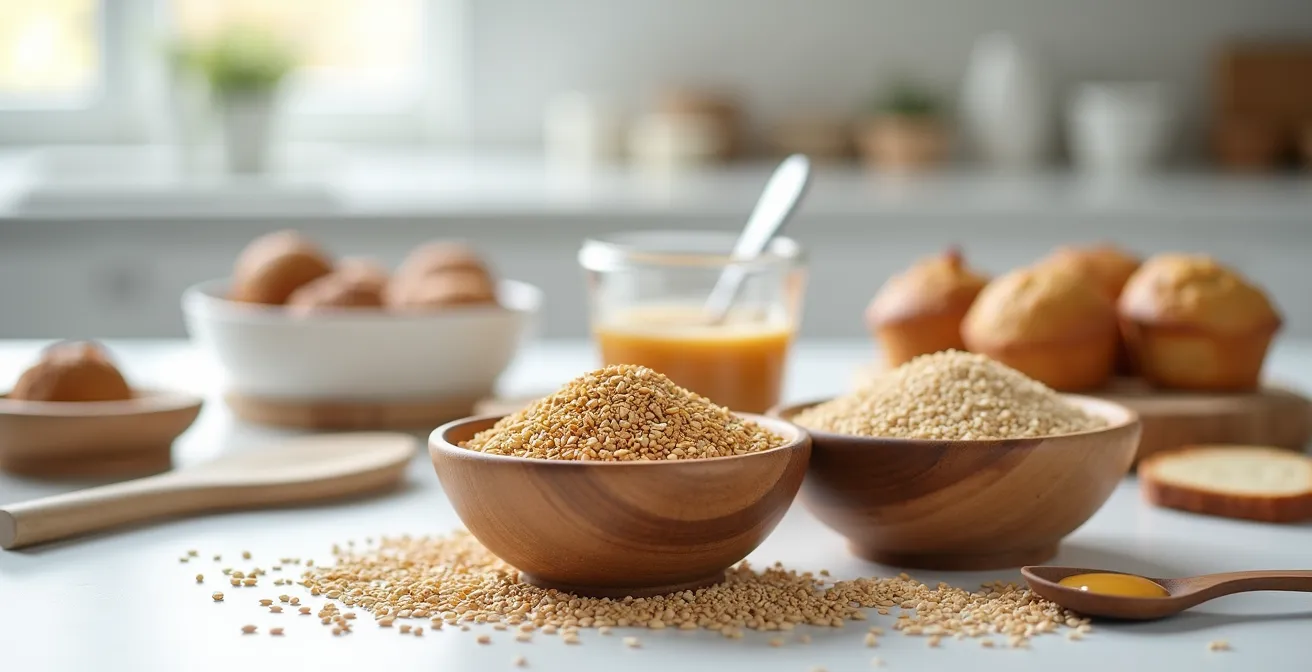
Contrary to popular belief, simply adding flaxseed to your diet isn’t enough; using it incorrectly can negate its benefits and ruin your recipes.
- The potent Omega-3s in flax are highly unstable and quickly turn rancid, requiring specific storage and sensory checks.
- A flax “egg” is a powerful binder due to its mucilage but provides zero leavening, making it a disaster for light, airy cakes.
Recommendation: Treat ground flaxseed as a functional ingredient with specific chemical properties. Always grind it fresh or store it in the freezer, and understand its role as a binder—not a lifter—in baking.
Ground flaxseed has rightfully earned its place in the pantries of bakers and health enthusiasts alike. Praised as a plant-based source of Omega-3 fatty acids and a versatile egg substitute, it’s often touted as a simple “add-in” to boost the nutritional profile of smoothies, oatmeal, and baked goods. The common advice is to sprinkle it liberally and reap the rewards. But this simplistic approach is a disservice to both the ingredient and your goals.
Many users are left disappointed when their flax-fortified smoothies taste strangely “fishy,” or their attempt at a vegan sponge cake results in a dense, gummy brick. The problem isn’t the flaxseed itself, but a lack of understanding of its functional properties. The very compounds that make it a health powerhouse—the delicate polyunsaturated fats—are also its greatest liability, prone to rapid oxidation. Its celebrated binding ability is a double-edged sword, providing structure in some contexts while completely failing in others.
But what if the key to unlocking flaxseed’s true potential wasn’t just about *using* it, but about understanding its underlying science? This guide moves beyond the superficial tips. We will delve into the chemistry of rancidity, the physics of its gelling action, and the precise applications where it shines—and where it’s guaranteed to fail. By mastering the “why” behind this functional seed, you’ll be empowered to use it strategically, ensuring you get all the health benefits without any of the culinary flops.
For those who prefer a deep dive into the critical role of Omega-3s in a plant-based diet, the following discussion with Dr. Michael Greger provides essential context on why sourcing these fats correctly is non-negotiable for long-term health.
To navigate the nuances of this powerful ingredient, this article breaks down its most critical aspects. The following summary outlines the key areas we will explore to transform you from a casual user into a flaxseed expert.
Summary: Mastering the Science and Application of Ground Flaxseed
- The Fishy Smell Risk: How to Tell if Your Flaxseed Is Rancid?
- Grinding Fresh vs. Pre-Ground: Which Is Better for Nutrition?
- Why Flax Eggs Work for Cookies but Fail for Sponge Cakes?
- How Long Must Flax Sit in Water to Become Gelatinous?
- How to Use Flax to Thicken Smoothies Without Changing the Taste?
- The Science of Vegan Baking: Replacing Eggs Without Flops
- Are You Getting Enough Essential Dietary Fiber for Heart Health?
- The Science of Vegan Baking: Replacing Eggs Without Flops
The Fishy Smell Risk: How to Tell if Your Flaxseed Is Rancid?
The most significant risk associated with flaxseed is not spoilage from mold, but chemical degradation. The prized Omega-3, alpha-linolenic acid (ALA), is a polyunsaturated fat, making it highly susceptible to oxidation when exposed to air, light, and heat. This process turns healthy fats into harmful compounds and produces off-flavors and odors. A “fishy,” “painty,” or “crayon-like” smell is a clear indicator that your flaxseed has gone rancid and should be discarded, as it has lost its nutritional benefits and can contribute to oxidative stress in the body.
Because this degradation can happen quickly, especially with pre-ground flax, relying on your senses is crucial. A multi-sensory check is the most reliable way to ensure the quality of your seeds before consumption.
- Visual check: Examine the ground meal for any clumping or signs of moisture, which can accelerate the oxidation process.
- Smell test: This is the most important test. A fresh flax meal should have a mild, nutty aroma. Any sharp, bitter, or chemical-like odors are red flags for rancidity.
- Taste test: If the smell is questionable, touch a tiny amount to your tongue. A bitter or acrid taste is a definitive sign of spoilage. Spit it out immediately.
- Color assessment: While subtle, significant darkening in golden flaxseeds can sometimes indicate oxidation has occurred.
Proper storage is your best defense against rancidity. The goal is to minimize exposure to oxygen, light, and heat. An airtight container is non-negotiable.
| Flaxseed Type | Storage Method | Shelf Life | Key Protection Factor |
|---|---|---|---|
| Whole seeds | Pantry (airtight) | 1-3 years | Intact outer shell |
| Ground (regular) | Refrigerator | 3-6 months | Cold temperature |
| Ground (regular) | Freezer | Up to 1 year | Minimal oxygen exposure |
| Freshly ground | Room temperature | 1 week maximum | Use quickly |
Grinding Fresh vs. Pre-Ground: Which Is Better for Nutrition?
The debate between fresh-ground and pre-ground flaxseed centers on one key concept: bioavailability. The tough outer shell of a whole flaxseed is largely indigestible, meaning its valuable Omega-3s and other nutrients pass through the body unabsorbed. Grinding breaks this shell and unlocks the nutritional content. While pre-ground flax offers convenience, it comes at a significant nutritional cost. The moment the seed is broken, the protective barrier is gone, and the volatile fats inside begin to oxidize.
Even with advanced commercial techniques like cold-milling and vacuum sealing, degradation begins immediately and continues throughout storage. Freshly grinding your seeds in small batches (using a coffee or spice grinder) ensures you are consuming the fats and lignans at their peak potency and with minimal oxidation. This practice guarantees you receive the maximum anti-inflammatory and cardiovascular benefits the seed has to offer.
Oxidative Stability Study
The speed of this degradation is not just theoretical. A 2016 study published in a prominent nutrition journal tested commercial cold-pressed flaxseed oils (which face similar stability challenges to ground meal). Even when stored under optimal refrigerated conditions for just three months, the oils showed a significant reduction in stability and a marked increase in acid values, demonstrating substantial quality degradation. The research confirmed that the freshest possible product, analogous to freshly ground seeds, maintains a far superior antioxidant capacity compared to products that have been processed and stored.
Why Flax Eggs Work for Cookies but Fail for Sponge Cakes?
The “flax egg”—typically a mixture of one tablespoon of ground flax and three tablespoons of water—is a cornerstone of vegan baking. Its success or failure, however, depends entirely on understanding its specific function. When ground flax is mixed with water, its soluble fiber forms a viscous, gelatinous substance called mucilage. This gel is an exceptional binder and moisture-provider, perfectly mimicking two of a real egg’s primary roles in baking.
This is why flax eggs excel in recipes like cookies, brownies, muffins, and dense quick breads. In these applications, the primary goal is to bind ingredients together and add moisture. The flax gel holds the structure, prevents crumbling, and contributes to a pleasantly moist crumb. The visual texture of the gel itself shows its binding power.

However, an egg has other crucial functions that flax mucilage cannot replicate, most notably leavening and providing structural integrity for airy textures. A real egg, when whipped, traps air and creates lift, which is essential for light and fluffy recipes like sponge cakes, angel food cake, or soufflés. A flax egg has zero leavening power. Substituting it in a recipe that relies on eggs for lift will invariably result in a dense, flat, and often gummy product. The function simply isn’t there.
This table breaks down the functional comparison, clarifying where a flax egg is a star performer and where it’s destined to fail, as detailed in an in-depth analysis of its scientific properties.
| Function | Regular Egg | Flax Egg | Best Application |
|---|---|---|---|
| Binding | Excellent | Excellent | Cookies, muffins, brownies |
| Moisture | Excellent | Good | Dense cakes, quick breads |
| Leavening | Excellent | Poor | Not suitable for sponge cakes |
| Emulsification | Excellent | Fair | Limited in mayo/custards |
| Structure | Excellent | Fair | Works for dense items only |
| Color | Good | None | No browning effect |
How Long Must Flax Sit in Water to Become Gelatinous?
The gelling process of a flax egg is a simple yet fascinating display of food science in action. When ground flaxseed is hydrated, water molecules are drawn into its soluble fiber, causing it to swell and create the thick, viscous mucilage that acts as a binder. The time it takes to reach the ideal consistency is not fixed; it is primarily influenced by water temperature. While the standard advice is to wait 5-10 minutes, you can manipulate the timing and texture for specific applications.
Understanding the science behind this gelling action allows for greater control. As a research review in the *Journal of Food Science and Technology* notes:
The mucilaginous fiber in ground flaxseeds gels when mixed with water due to complex polysaccharides, primarily arabinoxylan and pectic materials, which have strong water affinity.
– Research review on flaxseed mucilage, Journal of Food Science and Technology
This “water affinity” can be accelerated or slowed based on temperature, giving you a toolkit for adjusting your flax egg’s properties:
- Room temperature water (approx. 20°C): This is the standard method. Mix 1 tbsp ground flax with 3 tbsp water and wait about 5 minutes for a reliable, all-purpose gel.
- Warm water (approx. 35°C): Using warm (not hot) water can accelerate the process, forming a gel in just 3-4 minutes. This often results in a slightly thinner consistency.
- Cold water (approx. 4°C): Chilled water slows the process, requiring 10-15 minutes in the refrigerator. This method produces the thickest, most robust gel, ideal for recipes needing maximum binding power.
- For a stronger binding gel: Use slightly less water (e.g., 2.5 tbsp) and allow it to sit for 8-10 minutes.
- For a lighter moisture gel: Use slightly more water (e.g., 4 tbsp) and wait only 5 minutes.
How to Use Flax to Thicken Smoothies Without Changing the Taste?
Adding ground flaxseed to smoothies is an excellent way to boost fiber, protein, and Omega-3 intake. However, two common issues arise: an unwanted “grassy” or “earthy” taste and a texture that can become overly thick or even slimy. The key to avoiding these problems lies in choosing the right type of flax and employing a few simple techniques to mask its flavor and control its gelling properties.
The taste of flaxseed is noticeable, and if not managed, it can easily overpower the delicate flavors of fruits and vegetables. Fortunately, with the right ingredients and method, you can make it virtually undetectable while still getting all the benefits.
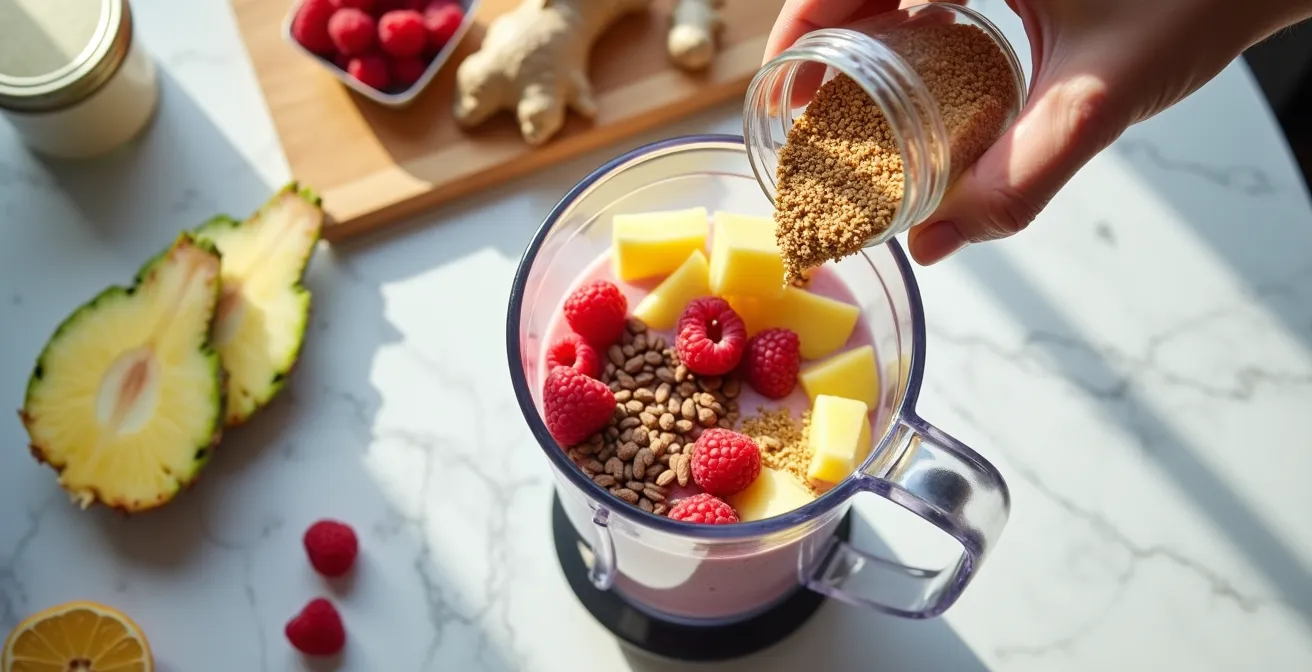
The goal is seamless integration. Instead of just dumping it in, a strategic approach will yield a delicious, nutrient-dense smoothie every time.
- Choose golden flaxseeds: Golden flax has a significantly milder, nuttier flavor compared to brown flax. This simple switch is the most effective first step.
- Toast the seeds lightly: Before grinding, toasting whole flaxseeds in a dry pan for 2-3 minutes can reduce their raw taste, enhancing their nutty notes.
- Add flax at the end: Blend all other ingredients first, then add the ground flaxseed in the last 20-30 seconds of blending. This minimizes its time in the liquid, preventing excessive mucilage formation that leads to a slimy texture.
- Pair with strong flavors: The flavor of flax is easily masked by potent ingredients like cacao powder, cinnamon, peanut butter, or tart fruits like pineapple and raspberries.
- Use a high-speed blender: A powerful blender will completely pulverize the seeds, integrating them fully into the smoothie and avoiding any gritty texture.
- Start small: If you are new to the taste, begin with just one teaspoon and gradually increase to one or two tablespoons as your palate adjusts.
The Science of Vegan Baking: Replacing Eggs Without Flops
Moving beyond simple substitutions requires a deeper understanding of ingredient synergy in vegan baking. While a standard flax egg is a workhorse for binding, more complex recipes often demand a more sophisticated approach. Professional vegan bakers have found that flax works best as part of a team, and there’s a practical limit to its use. While some experience shows that up to 5 flax eggs can be used in very dense vegan cakes, a maximum of two is generally recommended for recipes requiring any semblance of a light texture.
For those who do a lot of vegan baking, creating a universal egg replacement blend can be a game-changer. This pre-mixed powder combines the binding power of flax and chia with other ingredients that add structure and a hint of flavor, creating a more well-rounded substitute that performs better across a wider range of recipes.
Your Action Plan: Universal Vegan Egg Blend
- Mix the dry batch: In a large jar, combine 1 cup of ground flax meal, 1/2 cup of chia seeds, 1/4 cup of nutritional yeast (for a savory, “eggy” flavor), and 2 tablespoons of baking powder.
- Store properly: Seal the jar tightly and store it in the freezer. This protects the fats in the seeds from oxidation and keeps the blend fresh for up to 6 months.
- Prepare for use: To replace one egg, mix 3 tablespoons of the dry blend with 1/2 cup of water in a small bowl.
- Hydrate fully: Whisk the mixture and let it sit for at least 10 minutes to allow the flax and chia to form a thick, cohesive gel before adding it to your recipe.
- Boost the leavening: For cakes and muffins, consider adding an extra 1/2 teaspoon of baking powder to your dry ingredients for each “egg” you are replacing to compensate for the lack of lift.
Are You Getting Enough Essential Dietary Fiber for Heart Health?
Beyond its utility in baking, the primary driver for incorporating flaxseed into the diet is its profound impact on cardiovascular health. This benefit is delivered through a powerful combination of soluble fiber, lignans, and, most importantly, ALA Omega-3 fatty acids. The soluble fiber helps lower cholesterol by binding with it in the digestive system, while the ALA has potent anti-inflammatory effects and contributes to maintaining healthy blood vessels.
The question then becomes: how much is enough to make a difference? Health experts and nutritional guidelines converge on a consistent recommendation. According to a comprehensive review of its health benefits, consuming just 1-2 tablespoons (7-14 grams) of ground flaxseed daily is an effective dose. This small amount provides a significant 1.6 grams of ALA Omega-3 and 2-4 grams of dietary fiber, contributing substantially to daily heart health goals. This is reinforced by high-level scientific consensus, as stated by Parikh, Netticadan, and Pierce in a 2023 review in the *American Journal of Physiology*:
The regular consumption of flaxseed may help to improve lipid profile and lower blood pressure, fasting glucose, and insulin resistance index (HOMA-IR).
The impact of this simple dietary addition can be powerful enough to rival pharmaceutical interventions, particularly for managing hypertension.
Clinical Trial: Flaxseed’s Impact on Hypertension
A landmark double-blind, randomized, placebo-controlled trial investigated the effects of flaxseed on patients with hypertension. For six months, participants consumed baked goods that were secretly fortified with either 30g of ground flaxseed or a placebo. The results were remarkable. The group consuming flaxseed experienced significant blood pressure reductions, with systolic numbers dropping by up to 10 points—a decrease greater than that achieved with many standard antihypertensive medications. This study, highlighted in an analysis of dietary interventions for inflammation, powerfully demonstrates that a consistent, targeted food-as-medicine approach can produce clinically significant outcomes for cardiovascular health.
Key takeaways
- Flaxseed’s Omega-3s are fragile; always check for a fishy or painty smell, which indicates rancidity and nutrient loss.
- A flax egg is a binder, not a leavener. Use it for dense recipes like cookies and brownies, but never for light, airy cakes.
- For heart health, a consistent daily intake of 1-2 tablespoons of *ground* flaxseed is more important than occasional large doses.
The Science of Vegan Baking: Replacing Eggs Without Flops
Ultimately, mastering ground flaxseed is about shifting your mindset from seeing it as a simple supplement to respecting it as a complex, functional ingredient. The path to avoiding culinary flops—whether it’s a bitter-tasting salad topping or a leaden vegan cake—is paved with an understanding of its core scientific properties. The rancidity risk is real, the binding power is specific, and the health benefits are conditional on proper use.
By learning to identify freshness, control the gelling action of its mucilage, and respect its structural limitations in baking, you move beyond guesswork. Success comes not from a single tip, but from a holistic appreciation of the ingredient. The difference between a gritty smoothie and a creamy one, or a perfect cookie and a failed cake, lies in applying this knowledge. Integrating flaxseed effectively is a skill built on science.
To put these principles into practice, the next logical step is to assess your own pantry and habits. Start today by evaluating how you store your flaxseed and choose one recipe to test its binding power correctly.