
Contrary to the simple advice of “just use oat milk,” achieving dairy-like microfoam from plant-based alternatives is a matter of molecular engineering, not a search for a single magic bullet.
- The performance of a plant milk is dictated by its protein structure and, more importantly, the specific stabilizers (like gellan gum) that prevent curdling in acidic coffee.
- Blending different milks, such as oat and cashew, allows a barista to “hack” the final viscosity and fat content to achieve a custom texture ideal for pouring complex art.
Recommendation: Stop searching for the one perfect brand and start thinking like a food scientist—master the ingredients and create your own ideal blend for unparalleled foam stability and texture.
For any serious barista, the quest for the perfect plant-based milk is a journey paved with frustration. We’ve all been there: the promising carton that results in a latte that splits the moment it hits the espresso, the foam that looks beautiful for ten seconds before collapsing into a sad, bubbly mess. The common advice is to simply reach for a “barista edition” oat milk and call it a day. While often effective, this advice barely scratches the surface of what’s happening at a molecular level.
The truth is, creating silky, stable, and pourable microfoam from nuts, grains, and legumes is a technical challenge that involves a delicate balance of proteins, fats, pH levels, and temperature control. It’s less about the primary ingredient itself and more about the science of emulsification and stabilization. Understanding this science is what separates a good barista from a great one. It’s the key to not only choosing the right milk but also to innovating and creating custom blends that outperform anything straight out of the carton.
This guide isn’t another list of brand recommendations. Instead, we’re going to deconstruct the mechanics of plant-based foam. We’ll explore why some milks fail, how stabilizers work to create a resilient protein-stabilizer matrix, and how you can apply these principles to master your craft, whether you’re working with a commercial blend, a homemade creation, or even a challenging golden latte. It’s time to move beyond the basics and into the science of perfect plant-based latte art.
This article will guide you through the technical and ethical considerations of choosing and using plant-based milks, providing the knowledge to elevate your coffee craft. The following sections break down everything from environmental impact to the molecular science of foam.
Summary: Deconstructing Plant-Based Milk for Perfect Latte Art
- Why Is Almond Milk Production Harder on Water Resources Than Oat Milk?
- How to Mix Cashew and Oat Milk for the Perfect Creamy Texture?
- Barista Edition vs. Regular: Is the Extra Cost Justified?
- The Hidden Gums and Oils in “Healthy” Nut Milks
- How Long Does Homemade Nut Milk Last Before Spoilage?
- Why an Ethical Barista Considers the Water Footprint of Milk
- Mastering Anti-Inflammatory Golden Lattes for Optimal Foam
- Beyond the Basics: Using Raw Cashews and Other Innovations
Why Is Almond Milk Production Harder on Water Resources Than Oat Milk?
A professional barista’s choice of milk extends beyond taste and performance; it involves an understanding of its origin and environmental impact. When comparing the two giants of the plant-based world, almond and oat, the difference in water consumption is stark and undeniable. The primary reason lies in the fundamental agricultural needs of the source crops. Almonds are a tree nut, predominantly grown in water-scarce regions like California, and they require significant and sustained irrigation over many years to become productive.
In contrast, oats are a grain crop. They are typically grown in more temperate climates with higher rainfall, such as Canada and the Northern United States, and often do not require extensive irrigation beyond natural precipitation. This fundamental difference in farming practice leads to a dramatic disparity in the water footprint of the final product. Meticulous research from agricultural monitoring platforms shows that producing a single liter of almond milk can require up to 371 liters of water.
On the other hand, a liter of oat milk requires a fraction of that amount, often cited at around 60 liters. This isn’t a minor discrepancy; it’s a significant factor for any coffee professional conscious of their supply chain’s sustainability. While almond milk has a low greenhouse gas footprint, its high water demand places a considerable strain on local ecosystems, a fact that has rightly pushed many in the specialty coffee community towards oat and other, less thirsty alternatives like soy or pea protein milk.
How to Mix Cashew and Oat Milk for the Perfect Creamy Texture?
While oat milk has become the industry standard for its balance and steaming performance, the exacting barista knows that perfection often lies in customisation. This is where the art of blending, or “viscosity hacking,” comes into play. Cashew milk, while often overlooked, possesses a high-fat content and a natural creaminess that can elevate oat milk from good to exceptional. By blending the two, you can engineer a final product with a precise texture, richness, and stability that surpasses either milk on its own.
The goal is to leverage the strengths of each component. Oat milk provides a stable protein structure and a neutral, slightly sweet base that doesn’t overpower the espresso. Cashew milk contributes a luxurious mouthfeel and fat content that creates a shinier, more elastic microfoam. According to Charlie, a home cafe expert, “Oat milk is naturally a little sweeter than soy or almond milk, but it still has a mild flavour so you can still taste the flavours of the coffee,” making it the perfect canvas for cashew’s richness.
The precise ratio depends on your objective:
- The Foam-First Blend (70% Oat / 30% Cashew): This is the ideal starting point for intricate latte art. The oat milk provides the structural integrity, while the cashew adds just enough fat to create a glossy, paint-like foam that holds sharp lines.
- The Richness Blend (50% Oat / 50% Cashew): For a more decadent, dessert-like beverage such as a mocha or a flat white where mouthfeel is paramount, this blend delivers a full-bodied experience reminiscent of whole dairy milk.
- The Budget Blend (80% Oat / 20% Cashew): If you’re using a lower-quality oat milk, adding a small amount of cashew milk can significantly improve its texture and steaming performance without a major cost increase.
Regardless of the blend, the steaming technique remains critical. Always aim for a final temperature between 55-60°C (131-140°F). Going above this thermal degradation point will cause the proteins to break down, destroying the microfoam you’ve worked so hard to create. Introducing the milk mixture slowly to the espresso also helps reduce excess air incorporation, resulting in a silkier integration.
Barista Edition vs. Regular: Is the Extra Cost Justified?
The “barista edition” label on a carton of plant milk is more than just marketing; it’s a declaration of chemical engineering. The significant price premium, often 30-40% higher than regular versions, is justified by the inclusion of specific ingredients designed to solve the two fundamental problems of steaming plant milk: foam stability and curdling in acidic coffee. Regular plant milks, designed for cereal or smoothies, lack the resilience needed for the high-temperature, high-pressure environment of an espresso machine steam wand.
The key difference lies in the additives. Barista blends contain a carefully calibrated set of stabilizers and pH buffers. These ingredients create a robust “protein-stabilizer matrix” that mimics the behavior of dairy proteins. This matrix helps to create a finer, more uniform bubble structure—the coveted microfoam—and, crucially, prevents it from collapsing. In fact, professional barista training data indicates that the foam in regular plant milk can collapse up to 50% faster when heated above 60°C compared to its barista blend counterpart.
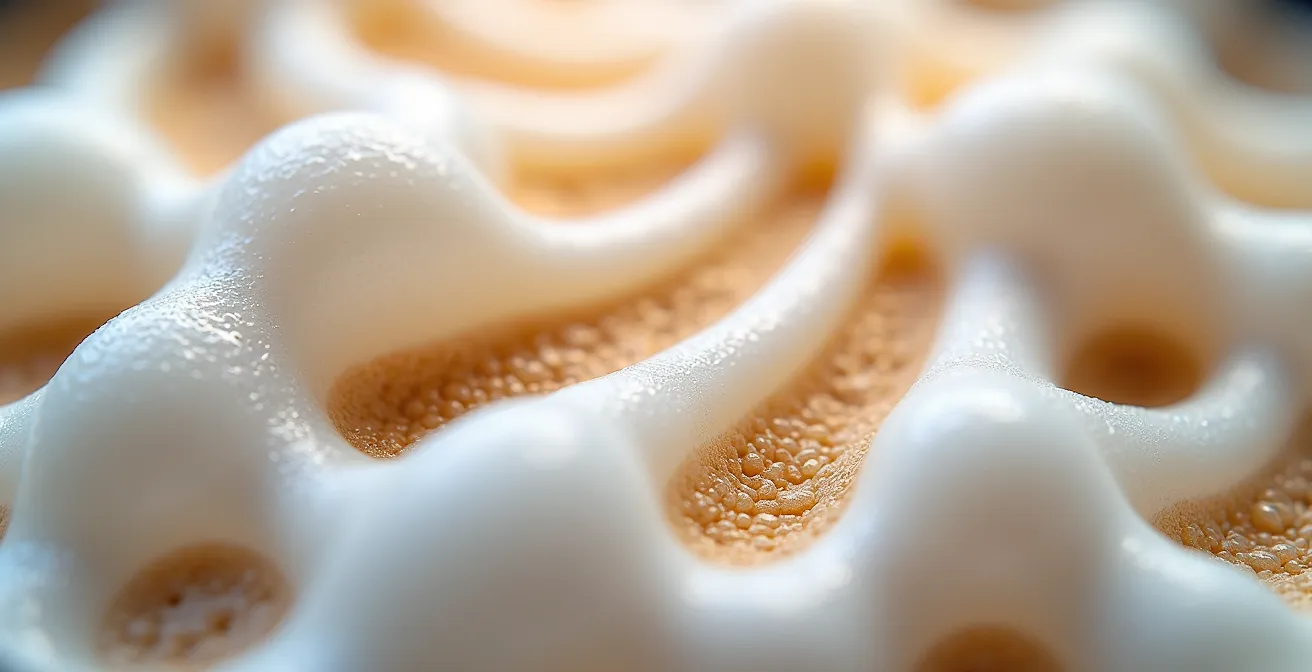
As the image above illustrates, the difference in foam structure at a microscopic level is profound. The dense, interconnected network of the barista blend contrasts sharply with the large, unstable bubbles of a regular milk. A real-world test confirms this. In their performance analysis of barista blends, Califia Farms found that their formulated milks consistently produced stable foam and resisted curdling, directly justifying the higher cost for any establishment or home enthusiast where quality and consistency are non-negotiable.
Case Study: Califia Farms Barista Blends Performance
Califia Farms tested their barista blends across multiple coffee applications, finding that their formulated oat and almond milks with added dipotassium phosphate and gellan gum consistently produced stable foam for latte art, while maintaining smooth integration with espresso without curdling, justifying the 30-40% premium over regular versions.
The Hidden Gums and Oils in “Healthy” Nut Milks
The term “gum” often carries a negative connotation in health-conscious circles, but in the world of beverage science, ingredients like gellan gum and dipotassium phosphate are the unsung heroes of plant-based lattes. These are not “fillers”; they are highly functional stabilizers that perform critical tasks. Without them, most plant milks would immediately curdle upon contact with hot, acidic espresso, and the foam would be non-existent.
The primary function of these additives is to control the milk’s integrity at a molecular level. As the Coffee Basics Pro Training Team explains, “Barista blends include stabilizers (gellan gum, dipotassium phosphate) to improve foaming. These functional ingredients serve specific purposes: controlling pH levels and maintaining milk integrity.” Dipotassium phosphate acts as a pH buffer, raising the alkalinity of the milk slightly so it doesn’t “break” or coagulate when it meets the low pH of coffee.
Gellan gum, a soluble fiber produced through fermentation, is a master of texture. It creates a fluid gel network within the milk that suspends proteins and fats, preventing them from separating. This network is the backbone of stable microfoam. Research published in 2025 demonstrated that gellan gum in plant-based milks significantly reduces protein aggregation when mixed with acidic coffee, preventing curdling while maintaining foam stability. The study noted that while other gums like xanthan could improve foam expansion, gellan gum was uniquely effective for the specific demands of coffee applications. These ingredients are the core of the “molecular engineering” that makes great latte art possible.
How Long Does Homemade Nut Milk Last Before Spoilage?
For the purist barista who ventures into making their own nut milk, the primary trade-off for ultimate freshness is a dramatically shortened shelf life. Commercial plant milks undergo ultra-high temperature (UHT) pasteurization and are packaged in sterile, aseptic containers, giving them a shelf life of months. Homemade nut milk, by contrast, is a fresh, living product with no preservatives. Without these industrial processes, it is highly susceptible to bacterial growth and will typically only last for 3 to 5 days in the refrigerator.
The spoilage process varies by nut. Homemade almond milk tends to become slimy, while cashew milk develops a distinctively sour, cheese-like odor. Oat milk often separates, with a thick layer of sediment forming at the bottom. Recognizing these specific signs is crucial to avoid serving a compromised product. However, there are several professional techniques you can employ to maximize the freshness and extend the life of your homemade creations, treating it with the same care as any other fresh ingredient in your kitchen.
Proper storage is paramount. The goal is to minimize the two primary drivers of spoilage: bacterial growth and oxidation. By implementing a few key steps immediately after production, you can push the shelf life closer to that 5-day maximum while preserving its delicate flavor and texture, though it’s critical to remember one rule: never freeze homemade nut milk intended for foaming. The formation of ice crystals permanently ruptures the delicate protein structures, rendering it incapable of producing microfoam.
Your Action Plan: Extending Homemade Nut Milk Freshness
- Inhibit Bacteria Naturally: Add a small pinch of sea salt per liter of milk. Salt is a natural preservative that helps slow the growth of spoilage-causing microbes without affecting the taste.
- Minimize Oxidation: Store the milk in vacuum-sealed glass bottles or jars. Removing air from the container significantly slows the oxidation process that leads to off-flavors.
- Implement Super-Chilling: Cool the milk to below 4°C (39°F) as rapidly as possible—ideally within 30 minutes of making it—by placing the container in an ice bath. This quickly moves it out of the temperature “danger zone” where bacteria thrive.
- Monitor for Spoilage Signs: Perform a daily sensory check. Look for changes in texture (slimy almond milk), smell (sour cashew milk), or appearance (thick sediment in oat milk). Discard immediately if any are present.
- Avoid Freezing for Foam: Never freeze homemade nut milk if you plan to steam it. Ice crystal formation will permanently damage the proteins required to create a stable microfoam structure.
Why an Ethical Barista Considers the Water Footprint of Milk
In the world of specialty coffee, every ingredient tells a story. The concept of “seed-to-cup” traceability for coffee beans has taught consumers and professionals alike to value sourcing, ethics, and environmental impact. This same philosophy must be applied to the second most important ingredient in a latte: the milk. A truly professional barista’s knowledge doesn’t end at the espresso machine; it extends to a holistic understanding of their entire supply chain. Choosing a plant-based milk is not just a decision about flavor, texture, or performance—it is also an ethical one.
The water footprint of a food is a measure of the total volume of fresh water used to produce it, from farm to table. As we’ve seen, the differences between plant milks can be immense. The choice between almond milk, with its high water demand in drought-prone areas, and oat or soy milk, which require significantly less irrigation, has real-world consequences for ecosystems and communities. This is not about declaring one milk “good” and another “bad,” but about making an informed, conscious decision.

This consideration is the final piece of the puzzle. An ethical barista weighs all the factors: performance in the cup, flavor profile with their specific coffee, cost, and the environmental story behind the product. It’s about aligning the final beverage with the values of the specialty coffee movement. By being transparent with customers about why a certain milk is chosen—perhaps favoring a locally produced pea milk or a water-conserving oat milk—baristas can educate their clientele and elevate the conversation beyond mere taste.
Mastering Anti-Inflammatory Golden Lattes for Optimal Foam
Steaming a perfect golden latte presents a unique molecular challenge that pushes a barista’s skills to their limit. The very ingredients that give the drink its anti-inflammatory benefits—turmeric and ginger—are also the primary saboteurs of a stable microfoam. Unlike soluble espresso, these are ground spices composed of fine, solid particles. When introduced into the milk before steaming, these particles act as millions of tiny anchors, physically disrupting the formation of the uniform bubble network required for latte art.
The result is often a thin, bubbly, and quick-to-collapse foam. The key to overcoming this is to change the order of operations and the state of the ingredients. Instead of mixing the dry spice powder directly into the milk, the professional technique is to first create a highly concentrated, smooth spice paste. This is done by whisking the turmeric, ginger, and any other spices (like cinnamon or black pepper) with a small amount of hot water or a splash of the plant milk until a completely homogenous, lump-free slurry is formed.
Undissolved spice particles like turmeric and ginger can disrupt the formation of a stable bubble network. Create a smooth, concentrated spice paste first before incorporating it into the milk for optimal foaming.
– Professional Barista Community, Alternative Milk Steaming Techniques
This paste is then added to the cup first. The plant-based milk (a robust barista blend oat milk is highly recommended for this application) is then steamed separately to create the perfect microfoam, free from any particulate interference. By pouring the textured milk over the spice paste, the ingredients are integrated smoothly while preserving the integrity of the foam. This method allows the barista to pour latte art on a golden latte with the same quality and definition as they would on a standard espresso-based drink, demonstrating a true mastery of beverage science.
Key takeaways
- The best plant-based foam is achieved through a scientific understanding of stabilizers, not just the base ingredient.
- Blending milks like oat and cashew is a professional technique to “engineer” a specific texture and richness.
- Barista edition milks are a worthwhile investment due to added pH buffers and gums that prevent curdling and create stable microfoam.
Beyond the Basics: Using Raw Cashews and Other Innovations
While the oat and almond duopoly dominates the market, the truly innovative barista is always looking ahead to the next frontier of flavor and texture. Raw cashews offer a versatility that extends far beyond simply being blended into milk. When soaked and blended, they create a thick, rich cream with a fat content and structure surprisingly similar to heavy dairy cream. This “cashew cream” can be used as a base for dairy-free cheeses, decadent dessert toppings, and, most importantly for our craft, as a powerful additive to enhance any plant-based milk.
A spoonful of concentrated cashew cream can transform a standard, watery plant milk into a viable steaming option, adding the body and fat necessary to build a stable foam. This moves beyond simple blending and into the realm of creating a custom barista base from scratch. But the innovation doesn’t stop with cashews. The market is constantly evolving, with new players emerging that challenge our assumptions. One of the most promising is macadamia nut milk.
Testing by industry experts has revealed macadamia milk to be a top-tier performer. A case study from Whole Latte Love highlights this emerging star.
Case Study: Macadamia Nut Milk Innovation in Coffee
Whole Latte Love testing found macadamia nut milk comparable to cashew in sweetness but with a superior thickness that prevented instant separation in espresso. The higher fat content created stable foam similar to heavy cream, ranking it among top performers alongside whole dairy milk for latte art applications.
This finding is significant. It shows that by looking at properties like fat content and natural thickness, we can identify high-potential milks outside the mainstream. The journey to the perfect plant-based latte is ongoing. It requires a foundation in science, a respect for ethics, and a constant curiosity to experiment with new ingredients and techniques. The goal is not just to find a substitute for dairy, but to create beverages that are exceptional in their own right.
By moving your mindset from that of a consumer to that of a creator, you unlock a new level of control and artistry. Start experimenting with blends, research the function of each ingredient on the label, and never stop pushing the boundaries of what’s possible in the cup.